
Archive

June 17, 2026

Browsing

  • Bitcoin price is trading at the $66K mark.
  • If momentum holds, this region is BTC’s next major resistance target.

Bitcoin has finally reclaimed and broken above the key $64,360 resistance level, a zone that had capped price advances over the past several sessions. The chart shows multiple failed attempts to push through this level, making the latest breakout significant from a technical standpoint.

The sequence of higher lows that developed along the rising trendline is noteworthy because it shows that buyers were gradually entering the market at increasing prices. The short-term acquisition of control by buyers is confirmed by the breakout above resistance.

The next significant level to keep an eye on is about $67,630. If the current momentum holds, this region might become Bitcoin’s immediate target as it is the next major resistance. The bullish structure would be strengthened by a persistent advance above $64,360.

The power of the move would be strengthened if $64,360 moved from resistance to support. The path of least resistance seems to be upward as long as the price stays above this level, with $67,630 looming as the next important upside target.

Additionally, following a surge of more than 2.60%, the price of Bitcoin is currently $66,153. The asset’s price began the day at a low of $63,634 and reached a high of $66,297. At $28.92 billion, the trade volume has increased by more than 72%. Meanwhile, the BTC Fear and Greed Index value is settled at 20, which indicates extreme fear. 

What’s Next for Bitcoin’s Price Trend?

According to the price chart, the price may challenge the $65,792 support if the BTC bears get stronger. A more intensified downside may initiate the death cross to emerge and drive the price even lower. On the upside, assuming the Bitcoin bulls gain momentum, the price could climb to the resistance at $66,421. The golden cross might form with the potential bullish correction.

The MACD line is above the signal line, and both are above the zero line, signalling strong bullish momentum. Both short and long-term momentum are aligned to the upside. Moreover, BTC’s CMF value at 0.27 indicates strong buying pressure and healthy capital inflows. Buyers are actively accumulating the asset and supporting the current uptrend.

(Source: TradingView)

Bitcoin’s BBP reading of 2,397 reflects strong bullish pressure. The buyers are dominating the market, pushing the price far above its average. The trend is still firmly under the bulls’ grip. Additionally, the daily RSI has entered the overbought zone at 70.71. Traders keep an eye out for consolidation or a brief decline at these levels, even though the rally may continue.

Crypto Market Highlights

$4.93M in Profit and a 90% Win Rate: Ethereum Whale Makes Big Moves as ETH Holds $1.7K

British inflation remained unchanged in May, according to official data released on Wednesday, providing a closely watched update for policymakers and investors ahead of the Bank of England’s latest interest rate decision.

The Consumer Prices Index rose by 2.8% in the 12 months to May 2026, matching the annual rate recorded in April.

Every month, CPI increased by 0.2% in May, the same pace seen in May 2025.

The broader Consumer Prices Index, including owner-occupiers’ housing costs, also remained unchanged at 3.0% in the 12 months to May.

Monthly CPIH growth stood at 0.2%, unchanged from the same month a year earlier.

Inflation defies expectations

The inflation reading came in below economists’ expectations.

Economists polled by Reuters had forecast that CPI inflation would rise to 3.0% in May.

Instead, inflation held at the 13-month low reached in April.

Following the release of the data, sterling weakened slightly as markets digested the lower-than-expected inflation figure.

The latest figures arrive just one day before the Bank of England announces its next monetary policy decision.

Transport costs drive inflation higher

According to the official data, transport made the largest upward contribution to the monthly change in both CPIH and CPI annual inflation rates.

However, the increase was partially offset by lower inflation in food and non-alcoholic beverages, which made the largest downward contribution to annual price growth.

The data suggest that while some areas of the economy continue to experience price pressures, easing food costs helped prevent a broader acceleration in inflation during the month.

Mixed signals from core inflation measures

Underlying inflation indicators presented a mixed picture.

Core CPIH, which excludes energy, food, alcohol, and tobacco, increased by 2.8% in the 12 months to May, unchanged from April.

Within this measure, the annual inflation rate for goods slowed to 2.0% from 2.4%, while services inflation rose to 3.6% from 3.4%.

Meanwhile, Core CPI rose to 2.6% in May from 2.5% in April.

The increase was slightly smaller than economists had anticipated.

The annual inflation rate for CPI goods slowed to 2.0% from 2.4%, while CPI services inflation accelerated sharply to 3.7% from 3.2%.

The Bank of England closely monitors services inflation as an indicator of underlying domestic price pressures.

Focus on future inflation risks

Inflation has remained above the Bank of England’s 2% target for most of the past five years.

In April, the central bank said inflation was likely to rise above 3.5% by the end of 2026 and could potentially exceed 6% in an adverse scenario.

Economists cited the impact of the US-Iran conflict as one factor keeping British inflation higher than the BoE had projected in January.

Britain has been particularly exposed because it relies on imported natural gas.

However, financial markets have recently taken comfort from signs of an agreement between the United States and Iran that could reopen the Strait of Hormuz, a key route for global oil exports.

The agreement is reportedly expected to be signed in Switzerland on Friday.

While BoE Governor Andrew Bailey has indicated that policymakers have time to assess the economic effects of the conflict, some MPC members remain concerned that businesses could pass higher costs on to consumers more broadly or that the situation could weaken public confidence in the central bank’s ability to control inflation.

The post British consumer inflation remains steady at 2.8% in May appeared first on Invezz

The crypto market is doing relatively well this week, helped by the risk-on sentiment following the US-Iran Memorandum of Understanding (MoU) to reopen the Strait of Hormuz. This article provides a forecast for top altcoins like Venice Token (VVV), Worldcoin (WLD), and Stellar (XLM).

Venice Token price prediction

Venice Token has been one of the best-performing cryptocurrencies this year, surging from $1.70 in January to $16 today. The rally has been driven by growing investor interest in AI-focused tokens as the artificial intelligence industry continues to expand, as well as anticipation surrounding the potential IPOs of OpenAI and Anthropic.

Venice has continued to grow this year, with traffic to its platform rising to nearly 10 million visits last month. As a result, the network has continued burning VVV tokens, strengthening its tokenomics and supporting long-term supply dynamics.

The chart shows that the VVV token has remained above the 100-day moving average, which is a bullish sign. However, the coin has formed a head-and-shoulders pattern, whose neckline is at $12.83. It has also formed a bearish divergence pattern as the Relative Strength Index (RSI) has formed a series of lower lows and lower highs. 

Therefore, the most likely Venice Token prediction is neutral, with the key targets to watch being $12.8 and $21.4. A move above $21.4 will invalidate the H&S pattern and point to more gains, potentially to $30. On the other hand, a drop below $12.8 will point to further downside.

Venice Token price chart | Source: TradingView

Worldcoin price prediction

The Worldcoin (WLD) price has jumped in the past few weeks, moving from a low of $0.2287 in May to $0.6800, its highest point since November last year.

This surge has been driven by its association with Sam Altman, its founder and the CEO of OpenAI. OpenAI recently filed confidential documents for its IPO, which may value it at over $1 trillion. 

Traders are hoping that OpenAI, whose products are used by millions of people every day, will join the growing list of companies integrating World ID. Some of the leading firms already using the product include Tinder, Okta, Shopify, and DocuSign. Also, Worldcoin is preparing a major tokenomics revamp that will slash its emitted tokens by 43%.

The daily chart shows that the WLD price has jumped in the past few months. It has already jumped above the 100-day moving average, while the RSI has continued rising. Its volume in the spot and futures markets has continued rising.

WLD token has formed a cup-and-handle pattern, a common continuation sign in technical analysis. Therefore, there is a possibility that the token will continue rising, potentially to the psychological level of $1. 

WLD price chart | Source: TradingView

XLM price prediction

Stellar Lumens token has also made a strong bullish breakout in the past few days, helped by the ongoing PayFi buzz. It jumped to $0.2256, its highest level since June 2nd this year.

Before that, the XLM price remained inside the narrow range between $0.1371 and $0.1856 between January and May 29. It surged above that level earlier this month, reaching the year-to-date high of $0.30. 

Most importantly, it has formed a break-and-retest pattern by falling to $0.1833. This pattern is a common continuation sign in technical analysis. It has also moved above the 100-day moving average, while the Relative Strength Index has flipped the neutral point of 50.

Stellar price chart | Source: TradingView

Therefore, the coin will likely continue rising as bulls target the key resistance at $0.300, up by 35% from the current level. This bullish outlook will become invalid if it drops below $0.1833.

The post Top crypto price predictions: Venice Token, Worldcoin, XLM appeared first on Invezz

SpaceX’s new options market exploded on Tuesday, giving traders a fresh and far riskier way to bet on the rocket company’s post-IPO surge.

The contracts began trading only days after SpaceX’s blockbuster Nasdaq debut, and demand was immediate.

Call options, which profit when a stock rises, dominated early activity. But the pricing also showed something more complicated than simple excitement.

Wall Street is now bracing for a huge move in either direction, with traders seeing room for another sharp rally while also preparing for a painful reversal.

A blockbuster IPO sets the stage

SpaceX priced its IPO at $135 a share last week, already making it one of the most closely watched listings in market history.

Since then, the stock has climbed roughly 50%, lifting the company’s market value past Amazon and briefly above Microsoft during Tuesday’s trading.

That speed matters, as normally, a stock needs time to settle after going public.

In SpaceX’s case, investors have rushed in almost immediately, helped by the company’s rare mix of space launches, Starlink, defence contracts, artificial intelligence ambitions, and Elon Musk’s personal following.

The rally has also created pent-up demand among investors who either received small IPO allocations or missed out entirely. For them, options offer another route in.

An option is a contract that gives the buyer the right, but not the obligation, to buy or sell a stock at a fixed price before a set date.

A call is a bet on upside. A put is protection, or a bet, against downside. With SpaceX moving so fast, both sides have become expensive.

Options debut like a rocket launch

The scale of Tuesday’s options debut was striking. Around 1.8 million SpaceX options contracts changed hands, far above Meta’s previous first-day options record in 2012.

Calls outpaced puts, showing that bullish demand remained strong even after the stock’s dramatic run.

Susquehanna said SpaceX had the fifth-highest call volume of any stock that day.

Data from Trade Alert indicates that SpaceX options were the third-most heavily traded single-stock contracts overall, behind only Tesla and Nvidia.

“It’s unusual in history for companies to have options trade so quickly,” Mike Khouw, chief strategist at YieldMax ETFs, told Yahoo Finance.

“This is the third busiest single stock options contract trading today.”

The bigger story was not just volume. It was what the options prices implied about future movement.

Susquehanna estimated that the market was pricing roughly a 15% chance that SpaceX rises another 50% over the next three months.

It was also pricing a similar chance that the stock loses half its value over the same period.

That is what traders mean when they talk about “tails.” It refers to extreme outcomes at either end of the range.

In this case, the market is saying SpaceX could keep ripping higher, or crack sharply, and neither outcome looks remote.

Also read- SpaceX stock soars after IPO: Will it follow the Circle, Figma, Klarna path?

‘Too dangerous to sell’: Wall Street’s warning

That two-sided risk is why derivatives strategists are sounding cautious, even as volume booms.

“The tails look too expensive to buy, but they also look too dangerous to sell,” Chris Murphy, a strategist at Susquehanna, said in comments cited by CNBC.

The line captures the problem facing traders. Buying options is costly because implied volatility is high. Implied volatility is the market’s estimate of how violently a stock may move.

But selling options can be even riskier, because a sharp move either way could leave sellers exposed to steep losses.

On the upside, call buyers are betting SpaceX can repeat the kind of momentum seen in Tesla during its most speculative phases.

On the downside, put demand reflects concern about valuation, lock-up expiry risk, and the possibility that early excitement fades once more shares become available.

Reuters reported that one large September trade appeared to hedge against the stock falling below $205, likely linked to future share supply after IPO lock-up restrictions ease.

Sceptics say the valuation already leaves little room for error.

“Investors rarely make money buying stocks valued at over 100x revenue,” short seller Jim Chanos told Yahoo Finance, while still acknowledging that Starlink is “a real business.”

The post SpaceX stock options explode as Wall Street prices in wild 50% move appeared first on Invezz

Shares of BMW fell 7% on Tuesday after the German luxury carmaker issued a sweeping profit warning, citing worsening market conditions in China and the impact of geopolitical tensions in the Middle East.

The decline pushed BMW shares to their lowest level since November 2020 and dragged other European automakers lower, with Volkswagen and Mercedes-Benz also coming under pressure as investors reassessed the outlook for the sector.

The warning comes just weeks after Milan Nedeljkovic succeeded Oliver Zipse as chief executive, adding to scrutiny over the company’s strategy at a time when European automakers are grappling with structural changes in their largest overseas market.

China’s weakness hits earnings outlook

In a statement released after market close on Tuesday, BMW said conditions in China deteriorated further during the second quarter, leading to more intense competition that has spilled over into the wider Asia-Pacific region.

The company said weaker sales in the region have outweighed stronger performance in Europe and the United States.

BMW also pointed to the economic fallout from the conflict in the Middle East, saying elevated energy prices have increased costs while geopolitical uncertainty has weakened consumer sentiment across global markets.

As a result, the company cut guidance across several key financial metrics.

BMW lowered its automotive earnings-before-interest-and-tax margin forecast to 1%-3%, down from a previous range of 4%-6%.

The return on capital employed in its automotive division was reduced to 1%-5% from 6%-10%, while group profit before tax is now expected to decline significantly, compared with an earlier forecast for a moderate decrease.

Analysts say cut exceeds expectations

The magnitude of the guidance reduction surprised analysts who had already anticipated some deterioration in earnings due to persistent weakness in China.

Deutsche Bank analyst Tim Rokossa said BMW was expected to revise its outlook, but the scale of the downgrade was larger than anticipated.

Rokossa noted that BMW shares had already been underperforming and highlighted the company’s recent decision to cancel a long-planned CEO-investor meeting.

He said the updated outlook reflected softer conditions in China and across Asia-Pacific, as well as second-order effects from the Middle East conflict.

“There are now more questions than answers,” Rokossa wrote, adding that investor events scheduled later this year may provide only limited clarity.

Deutsche Bank lowered its price target on BMW shares to 90 euros from 100 euros while maintaining a buy rating.

Questions over business model

Alongside the weaker outlook, BMW said it would intensify cost-cutting efforts and warned of a negative one-off impact during the second half of 2026.

That announcement has fuelled speculation that management may be preparing broader structural changes.

Jefferies analysts said investors had largely expected a profit warning but not a margin reset of this scale.

The brokerage suggested the comments indicate management may be preparing significant changes to BMW’s manufacturing footprint.

“It seems to us that BMW could be rethinking a global assembly business model,” Jefferies wrote.

The bank expects BMW to increase sourcing and production integration in North America and China, reducing reliance on exporting internal-combustion-engine components from Germany.

Jefferies also said future discussions could focus on capital allocation, non-automotive investments and the possibility of using China as a larger export base because of its cost advantages.

The brokerage cut its price target to 70 euros from 92 euros while maintaining a hold rating.

Industry faces broader shift

BMW’s challenges mirror wider changes confronting the European auto industry.

Volkswagen Chief Executive Oliver Blume has previously warned that the export-led model that underpinned Germany’s automotive success for decades is becoming less viable.

For years, European manufacturers relied on strong profits from China, the world’s largest car market.

However, domestic Chinese brands have steadily gained market share, while an extended slowdown in vehicle demand has intensified competition.

China’s auto market recorded its eighth consecutive month of declining sales in May, increasing pressure on foreign manufacturers already struggling to maintain pricing power.

For investors, BMW’s warning has become the latest indication that Europe’s carmakers may need to accelerate strategic changes as they adapt to a rapidly evolving global automotive landscape.

The post BMW shares tumble 7% as China weakness forces sharp forecast cut appeared first on Invezz

Tesco’s share price will be in focus as the company publishes its first-quarter trading statement on June 18.

The update should provide greater insight into its revenue growth, profitability trends, and market share performance.

Tesco shares were trading at 462p on Wednesday, slightly below this week’s high of 476p.

Tesco share price in the spotlight ahead of earnings

Tesco investors are hoping that the upcoming first-quarter earnings will help to supercharge its stock, which has moved sideways this year.

These results come at a difficult time for the UK economy, as households continue to face cost-of-living pressures and economic growth remains subdued.

Recent data from the Office of National Statistics (ONS) showed that retail sales have eased in the past few months.

UK retail sales stagnated in April after growing by 1.4% in March, 1.6% in February, and 4.6% in January this year. 

Tesco, the largest UK retailer, often performs well in times of uncertainty due to its lower prices. We saw this during the pandemic, when it increased its market share by boosting its e-commerce services.

The most recent results showed that Tesco made over £66.58 billion last year, up by 4.6% YoY. Its free cash flow rose by 11.8% to £1.957 billion, while its operating profit rose by 0.8% to £3.15 billion. 

A look beneath the surface showed that its market share grew to 28.3%, its highest level in over a decade. This happened despite the intense competition from companies like Aldi, Lidl, and Asda. 

Tesco has used its profits to boost its shareholder returns through a combination of dividends and share buybacks.

It paid £937 million in dividends last year, and completed a £1.45 billion share repurchase program. It has repurchased shares worth over £4.3 billion since 2021, reducing its share count to 6.35 billion from 6.7 billion last year. 

These numbers come at a time when it has become relatively undervalued. Data shows that its forward price-to-earnings (P/E) ratio stands at 16.47x, which is reasonable for a company with a leading market share. 

Similarly, Tesco has a PEG ratio of 1.8, suggesting moderate growth expectations relative to its valuation.

More data shows that it has an EV/EBITDA of 8.59x and a price-to-book ratio of 2.75x. 

Analysts have a bullish outlook for the company, with the average target being 516p. 10 of the 15 analysts tracking the company have a buy rating.

Tesco stock price technical analysis

TSCO stock chart | Source: TradingView

Technicals are also relatively bullish on Tesco shares despite the ongoing retreat.

It has formed a descending channel since February and is slightly below its upper side. This channel could be part of the bullish flag pattern, a common continuation sign.

The stock continues to trade above its 200-day moving average, signaling that the long-term uptrend remains intact.

Unless it breaks below this level, the chances of a bullish rebound remain elevated. In that scenario, the shares could retest their year-to-date high of 507p.

The post Tesco share price in focus ahead of Q1 earnings as a bullish pattern forms appeared first on Invezz

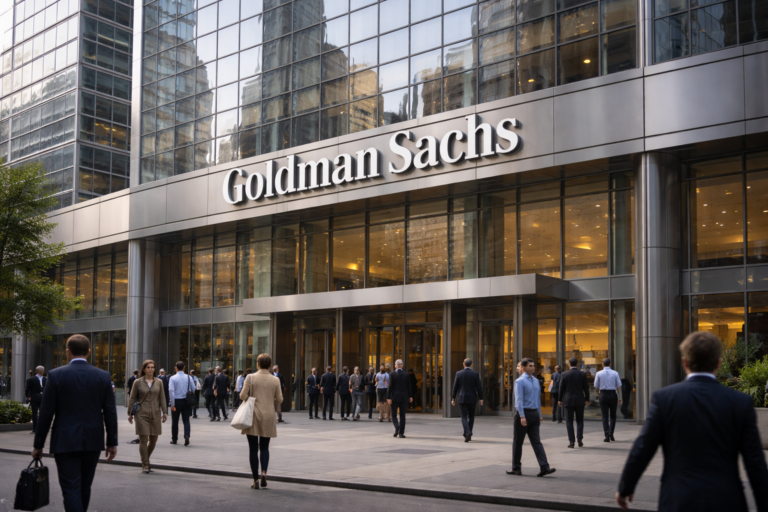
Goldman Sachs has crossed more than $1 trillion in announced M&A advisory volume in the first half of 2026, setting the fastest pace ever recorded by an investment bank.

The milestone, based on Dealogic data cited by Goldman Sachs, comes during a powerful rebound in dealmaking and capital markets activity.

It also lands days after Goldman served as lead-left underwriter on SpaceX’s blockbuster market debut, which pushed the Elon Musk-led company’s valuation past $2 trillion.

For Goldman, the story is more about whether a historic investment-banking boom can justify a stock already trading ahead of much of Wall Street’s target-price range.

Goldman Sachs’ record-breaking run

Goldman’s $1 trillion-plus M&A haul reflects a sharp revival in boardroom confidence after a quieter stretch for global deals.

The bank has advised on some of the year’s largest transactions, including Dominion Energy’s $66.8 billion sale to NextEra Energy, Unilever’s $44.8 billion combination of its foods business with McCormick, and the $33.4 billion acquisition of AES by a consortium led by BlackRock’s Global Infrastructure Partners and EQT.

SpaceX is not an M&A transaction, but it adds to the same investment-banking momentum.

Goldman won the prized lead-left role on the rocket and satellite company’s IPO, the most influential spot on an offering’s front page.

SpaceX priced at $135 a share and surged past a $2 trillion market value on its debut, giving Goldman both fees and prestige in one of the most closely watched listings in market history.

The underwriting payday is also meaningful.

Goldman and Morgan Stanley are each expected to earn roughly $100 million from the SpaceX IPO, according to reports citing the company’s regulatory filing.

Goldman CEO David Solomon said in a LinkedIn post that global M&A volumes have already exceeded $2.6 trillion this year, as artificial intelligence and strategic consolidation reshape industries.

Matt McClure, Goldman’s global co-head of investment banking, told Reuters that “CEOs and Boards are taking a long-term strategic view” despite a complex backdrop.

Wall Street’s split verdict on the stock

The tension is that Goldman’s operating momentum has not fully translated into analyst enthusiasm at current prices.

JPMorgan recently raised its price target on Goldman Sachs to $900 from $826, but kept a Neutral rating.

Morgan Stanley has also been around the $900 mark, while CICC Research is more constructive, lifting its target to $980 with an Outperform rating.

DBS Bank and BofA Securities are more bullish, with targets around $1,050, while Zacks Research earlier downgraded Goldman from Strong Buy to Hold.

That still leaves a gap. Goldman shares have recently traded around $1,090, above the average analyst target of about $942.

In plain English, the market has already priced in a lot of good news. The stock is being rewarded for stronger trading, revived M&A, higher IPO activity and the SpaceX halo.

But several analysts appear reluctant to chase it further at this valuation.

JPMorgan’s Rob Dwyer and Ayano Tsunoda, in a note cited by MarketWatch, said investors may be underestimating “a multiplier effect from IPOs and financing deals” on Wall Street banks.

Their point is that a mega-listing does not just produce underwriting fees, but can also drive secondary trading, financing activity, hedging and client flows.

That is the bull case. The cautious view is simpler: Goldman has already rallied hard, and even strong deal flow may not be enough if investors believe earnings are peaking.

The post Goldman Sachs hits $1T M&A record as SpaceX IPO adds Wall Street halo appeared first on Invezz

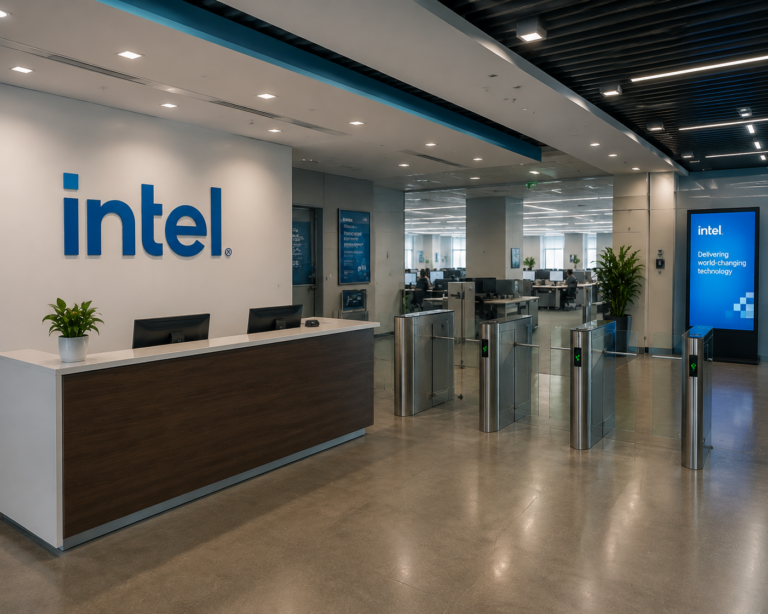
Intel stock (INTC) gained 4.5% in pre-market trading after the company announced that its next-generation Intel 18A-P manufacturing process has entered risk production.

The development comes after shares closed 8.45% lower at $117.05 in the previous session and signals progress in Intel’s semiconductor manufacturing roadmap.

The announcement was made at the 2026 VLSI Symposium, one of the semiconductor industry’s key technical conferences.

Risk production refers to the initial phase of manufacturing, where early production runs are carried out before large-scale commercial availability.

By moving the process into this stage, Intel is signalling progress on its manufacturing roadmap while preparing the technology for future customer adoption.

Performance and efficiency improvements

Intel described 18A-P as the first performance enhancement built on top of its existing Intel 18A process node.

According to the company, the new process delivers improvements in performance, power efficiency, and thermal characteristics without requiring customers to redesign existing chip architectures.

Compared with the base Intel 18A process, Intel said 18A-P provides either 9% higher performance at the same power level, known as iso-power, or 18% lower power consumption at the same performance level, referred to as iso-performance.

These gains can be applied differently depending on product requirements.

High-performance computing devices such as gaming processors may prioritise performance improvements, while mobile and business-focused devices could benefit from reduced power consumption and improved battery life.

Intel also reported notable thermal improvements.

According to the company, 18A-P delivers 20% to 40% better thermal resistance compared with the original 18A process.

This allows chips to operate more efficiently under heavy workloads by generating and retaining less heat.

The improvement could be particularly important for processors used in artificial intelligence inference, data centre computing, and advanced gaming systems, where sustained performance is critical.

New technologies behind 18A-P

Intel highlighted several engineering advancements that contribute to the performance gains.

Among them is Power Boost, a new dual-contact, low-resistance transistor option designed to increase drive current and enable higher operating frequencies without a proportional increase in capacitance.

The company also said it reduced electrical resistance in the vertical connections linking different chip layers by between 10% and 30% through materials and geometric optimisations.

Lower resistance can improve signal transmission speeds while reducing energy losses in the form of heat.

Another key feature is design-rule compatibility with Intel 18A.

Intel stated that chip designs and intellectual property already developed for the base 18A process can be transferred directly to 18A-P without modification.

The process maintains the same two cell heights of 180 nanometres and 160 nanometres, allowing semiconductor companies to reuse existing design flows and engineering investments.

This compatibility could reduce both development costs and time-to-market for customers moving to the enhanced process.

Implications for Intel

Intel said the decision to move 18A-P into risk production demonstrates that the company is executing on its manufacturing commitments.

The development may also help make Intel’s foundry technology more attractive to external customers.

The company’s approach appears to be evolving under Chief Executive Officer Lip-Bu Tan.

Earlier, Intel had viewed the 18A process primarily as a technology intended to support its own products.

The manufacturing update comes as Intel continues to benefit from strong demand for central processors from companies providing AI services.

The company said demand during the first quarter was robust enough that it sold processors that had previously been written off.

Intel also projected second-quarter revenue between $13.8 billion and $14.8 billion, above the estimate of $13.07 billion compiled by LSEG.

For investors, the launch of risk production for 18A-P represents another milestone in Intel’s effort to strengthen its manufacturing capabilities and expand its foundry ambitions.

The post Intel stock rebounds 5%: is 18A-P chip milestone a turning point? appeared first on Invezz

LAB has extended its rally to a sixth consecutive day, climbing about 57% over the past week as whale buying, technical momentum, and renewed interest in the project’s ecosystem pushed the token back toward the $14 level.

Data from CoinGecko showed LAB trading near $13.91 on June 17, up nearly 40% over the past 24 hours and more than 57% over the previous seven days. 

The move comes after the token spent much of early June under pressure following a steep correction from its June 2 all-time high of $27.30.

According to market commentator Alastar, whale wallets added roughly $540,000 in long positions within an hour as LAB continued its advance. 

Data shared by the trader showed 129 whale long positions against 85 short positions, with total long exposure reaching $27.58 million compared with $10.58 million in short exposure.

The same data showed a whale long-to-short ratio of 260.67%, while net whale buying volume during the previous hour stood near $490,000 against approximately $179,000 in net selling. 

Alastar described the $13 region as a key level to monitor, noting that larger holders could begin reducing positions around that area because many long positions were already sitting on substantial unrealised profits.

Recent buying activity arrived after LAB successfully defended support between $9 and $10, a zone that attracted dip buyers after weeks of selling pressure. 

Market participants also closed bearish positions as momentum indicators improved, helping fuel a rapid recovery from the June lows.

Speculative interest around the project has also remained active.

LAB operates as a multi-chain AI trading terminal connecting Ethereum, Solana, and BNB Chain, while community discussions have focused on the rollout of its mobile application and ongoing work tied to prediction market features.

LAB price analysis

Technical indicators continue to show improving conditions despite the token remaining well below its all-time high.

On the daily chart, LAB’s Relative Strength Index stood near 60.7, recovering from lower levels seen during the correction.

LAB/USDT 1-day price chart. Source: TradingView.

The indicator has moved above its signal line, suggesting momentum has strengthened alongside the recent price advance.

The Average Directional Index, or ADX, was close to 46 on the daily timeframe.

An ADX reading above 25 is generally associated with a strong trend, indicating that the current move has developed beyond a brief price bounce.

On the 4-hour timeframe, LAB is trading above its 20, 50, 100 and 200-period exponential moving averages.

LAB/USDT 4-hour price chart. Source: TradingView.

The 20-day EMA sits above the 50-day EMA, which remains above both the 100-day and 200-day EMAs.

Traders often view that alignment as evidence of a developing uptrend.

Even so, the recovery still faces significant hurdles before any retest of the record high becomes a realistic discussion. 

LAB currently trades roughly 50% below its June peak, leaving several resistance levels between current prices and the previous top.

The area between $15 and $16 stands out as the next major test. A sustained move above that range could open the door to a challenge of the $20 level. 

Failure to hold recent gains, however, could send attention back toward support around $13 and the rising 20-day EMA near $11.4.

Questions surrounding token distribution also remain in focus as selling pressure had intensified earlier this month after on-chain observers identified early wallets transferring large amounts of tokens to centralised exchanges. 

Investor caution has also been shaped by the project’s future token unlock schedule, with roughly 282 million tokens still locked and expected to enter circulation over time.

As of press time, LAB’s six-day rally has restored bullish momentum, but whether the token can continue climbing may depend on whether buyers can absorb future profit-taking while maintaining support above recently reclaimed levels.

The post LAB token jumps 57% in a week as whales pile into long positions appeared first on Invezz

Markets adopted a cautious stance during the European morning session on Wednesday as investors prepared for the Federal Reserve’s monetary policy announcement and assessed a series of geopolitical and economic developments.

Investors are also awaiting revisions to May Harmonized Index of Consumer Prices inflation data from Eurostat, while the United States economic calendar is scheduled to feature Retail Sales figures later in the day.

Wall Street trades mixed as US-Iran deal details remain unclear

After a strong risk rally on Monday, Wall Street’s major indices delivered a mixed performance on Tuesday as uncertainty persisted over the details of the framework agreement between the United States and Iran.

During the late American session, Iran’s foreign minister said that the next round of negotiations would begin on the same day the parties sign a Memorandum of Understanding.

The minister added that discussions would continue for 60 days in an effort to reach a final agreement covering nuclear issues and the removal of sanctions.

At the same time, Iran’s Top Joint Military Command, Khatam al-Anbiya Central Headquarters, reacted to Israel’s latest attack in southern Lebanon.

The command warned that Israel should expect a strong response if attacks continue.

G7 leaders signal tougher sanctions on Russia

In a joint statement released early Wednesday, leaders of the G7 nations said they would strengthen sanctions against Russia, including measures targeting the oil and gas sectors.

The statement also indicated that member nations would work to diversify energy supply routes, reduce dependence on the Strait of Hormuz, and increase energy stockpiles.

Dollar steady ahead of Federal reserve announcement

Following modest losses on Tuesday, the US Dollar Index remained broadly stable around the 99.50 level on Wednesday.

Markets widely expect the Federal Reserve to leave monetary policy settings unchanged.

However, attention remains focused on the revised Summary of Economic Projections and comments from Federal Reserve Chair Kevin Warsh during his first post-meeting press conference.

Investors are looking for indications regarding the future path of interest rates, with any changes in guidance likely to influence market volatility.

UK inflation holds steady

The UK’s Office for National Statistics reported that annual inflation, measured by the Consumer Price Index (CPI), remained unchanged at 2.8% in May.

Every month, CPI increased by 0.2%, slowing from April’s 0.7% rise and coming in below market expectations of 0.4%.

Additional details showed that the Retail Price Index increased 3.1% year-on-year, compared with 3% in April, while Producer Price Index Input inflation rose 8.7% over the same period.

The British pound initially strengthened following the release of the inflation data.

However, GBP/USD later lost momentum and was last trading broadly unchanged near 1.3420.

Precious metals remain supported

Gold maintained its gains after Monday’s rally and recorded modest advances on Tuesday.

During the European session on Wednesday, XAU/USD continued to consolidate above the $4,300 level.

Silver extended its rally for a fifth consecutive session.

Spot silver traded around $70.40 per ounce during Asian trading hours, continuing its recovery after a sharp decline in crude oil prices.

The rise in silver was driven not only by demand for safe-haven assets.

Lower oil prices have eased concerns that Middle East tensions could keep energy costs elevated.

Investors are also evaluating whether Kevin Warsh’s first Federal Reserve meeting as chair will point to a less aggressive policy path.

Currency markets trade in narrow ranges

The euro maintained its recent strength, with the EUR/USD pair trading in a narrow range above the 1.1600 mark after recording gains in the previous two sessions.

Meanwhile, the Japanese yen failed to gain support from the Bank of Japan’s decision to raise its policy rate by 25 basis points on Tuesday.

The yen ended the previous session slightly weaker against the US dollar, while USD/JPY traded within a narrow range above 160.00 during European hours.

The Australian dollar also struggled to establish a clear direction.

AUD/USD traded around 0.7050 following choppy market action during the previous session.

With the Federal Reserve’s policy decision approaching, investors remain focused on monetary policy signals, inflation trends, and geopolitical developments that could shape market direction in the coming sessions.

The post Market sentiment remains cautious as Fed meeting takes centre stage appeared first on Invezz