Archive

July 4, 2026

Browsing

  • As part of the launch, GoMining is onboarding an initial set of up to 10 merchants and ecosystem partners.
  • GoBTC Pay settles directly on Bitcoin while protecting user ownership and non-custody.

GoMining is announcing the GoBTC Pay Gen1 SDK and API, allowing merchants, wallet providers, and ecosystem partners to integrate Bitcoin payments into real-world products and services.

The introduction represents the next step of GoBTC Pay, GoMining’s layer 1 Bitcoin payment protocol intended to facilitate quick, non-custodial Bitcoin transactions. The Gen1 release changes GoBTC Pay from a restricted demo version into an open infrastructure layer, allowing merchants, wallets, and ecosystem partners to develop and scale Bitcoin payment experiences on top of the network.

As part of the launch, GoMining is onboarding an initial set of up to 10 merchants and ecosystem partners who will begin integrating GoBTC Pay into their products and services.

“Satoshi didn’t create Bitcoin to sit idle in wallets. It was designed to move value between people,” said Mark Zalan, CEO of GoMining. “With the launch of the GoBTC Pay SDK and API, we’re giving merchants and wallet providers the infrastructure to bring that vision into real-world commerce in a way that is seamless and intuitive for users. We believe Bitcoin’s next chapter will be defined by how people use it, in addition to how many people own it.”

GoBTC Pay settles directly on Bitcoin while protecting user ownership and non-custody. The Gen1 version offers merchant onboarding tools, payment management capabilities, a web-based merchant dashboard, online payment connectors, public developer documentation, and an open API for wallet providers and institutional partners.

GoBTC Pay is powered by GoMining’s private 15EH/s mempool based on the Stratum V2 protocol, permitting prioritizing of GoBTC Pay transactions. With an estimated 12-hour average settlement window, GoBTC Pay is meant to protect the essential concepts of Bitcoin while offering a debit card-like payment experience. Users keep custody of their BTC, transactions settle immediately on Bitcoin, and businesses enjoy a smooth payment experience without asking consumers to convert their assets into cash.

Its incentive scheme is meant to harmonize the interests of merchants, wallets, and miners. Merchants pay a 0.2% transaction fee, which is distributed equally between participating wallet providers and miners in the GoMining pool that handle payments. GoMining seeks to promote network expansion and boost actual Bitcoin payment activity for routine purchases by directly compensating infrastructure participants who enable transactions. The launch follows GoMining’s debut of GoBTC Pay at Consensus Miami and represents the beginning of a bigger ecosystem strategy focused on boosting merchant, wallet, and partner acceptance of Bitcoin payments.

GoMining is an all-in-one Bitcoin ecosystem that makes it easy and safe to mine, earn, and spend Bitcoin every day. GoMining services 5 million customers and is in the top-10 Bitcoin miners by hashrate worldwide, with data centers in the U.S. and overseas. The firm makes Bitcoin accessible via tokenized hashrate, and an increasing range of payment and earning tools.

GoBTC Pay is a Bitcoin-native payment protocol created by GoMining that allows rapid, non-custodial Bitcoin payments for businesses, customers, and ecosystem partners. Built to enable real-world commerce while keeping the concepts of non-custody and user ownership, GoBTC Pay offers businesses, wallets, and platforms with the infrastructure required to accept and handle Bitcoin transactions cheaply and promptly. Through its merchant tools, developer APIs, and partner integrations, GoBTC Pay is establishing an open payments ecosystem meant to extend the daily usage of Bitcoin globally.
  • A trader has opened a 20x long on 1,653 BTC.
  • Bitcoin is currently trading at $63.5K.

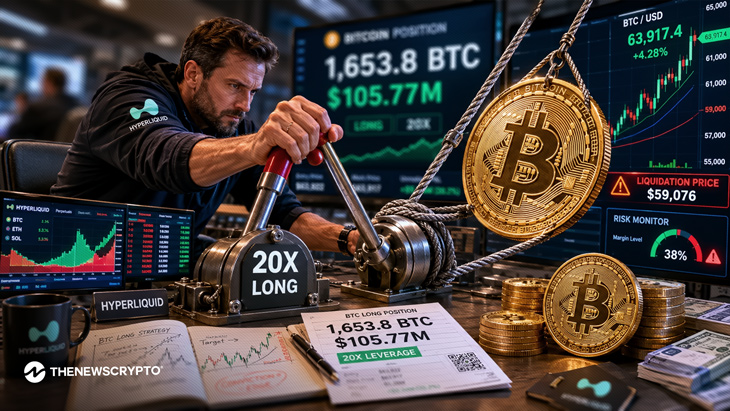
A known high-frequency trader, identified as 0x50b3, has captured the market’s attention after opening a massive 20x-leveraged long position in 1,653.8 BTC, valued at around $105.77 million. The move comes amid heightened interest in BTC’s short-term price direction, with traders closely monitoring large leveraged bets for clues about market sentiment.

What makes this position particularly noteworthy is the trader’s recent performance. Since June 2, 0x50b3 has executed 100 trades, reportedly closing 93 of them in profit. The impressive 93% win rate has helped generate more than $6 million in realised gains, making the latest Bitcoin position difficult for market participants to ignore.

Its Potential Impact on Market Sentiment

Large leveraged positions often influence traders’ psychology when opened by accounts with a proven record of success. A single trade can boost bullish emotion and promote greater market involvement, even though it cannot predict Bitcoin’s future course. 

However, because even small price fluctuations can result in large gains or losses, the use of 20x leverage draws attention to the increased risks involved.

Price Action of Bitcoin: Where is it Heading? 

Bitcoin has failed to escape the bearish zone. Currently, it is trading within the $63,587 range, with the daily trading volume having surged by over 27.86%, reaching the $24.1 billion mark. The Coinglass data has reported that the BTC market has seen a 24-hour liquidation of $92.53 million. 

If the bearish grip strengthens, the BTC price may fall to a support range at $63,428. Additional pressure on the downside could trigger the death cross to take place and send the price even lower. Upon the BTC market taking a bullish turn, the price could climb and find the resistance at the $63,649K level. With the uptrend gaining more traction, the golden cross would emerge, pushing the price higher. 

Will Bitcoin Momentum Weakens Further? 

The MACD line is below the zero line while the signal line remains above it; the short-term momentum of BTC has weakened. This setup can be viewed as a warning sign of weakening market strength. In addition, the CMF indicator at -0.05 exhibits slight selling pressure. Bitcoin’s capital outflows are marginally exceeding the inflows. It does not show strong distribution or heavy selling activity.

Besides, BTC’s daily RSI at 41.92 infers a weak bearish tone. It remains above the oversold zone, with the downtrend not extreme. The momentum is subdued, and a strong trend has yet to develop. Also, the BBP value at -824.21 points to a very strong bearish pressure. This level suggests that the bears are dominating, with buyers showing little strength to reverse the prevailing downward move.

Crypto Market Highlights

Humanity Protocol Under Pressure: Will the 24% Drop Open the Door to More Losses?

  • Bitcoin may fall to a bottom price of 42,000-44,000.
  • BTC is currently trading within the $61.4K mark.

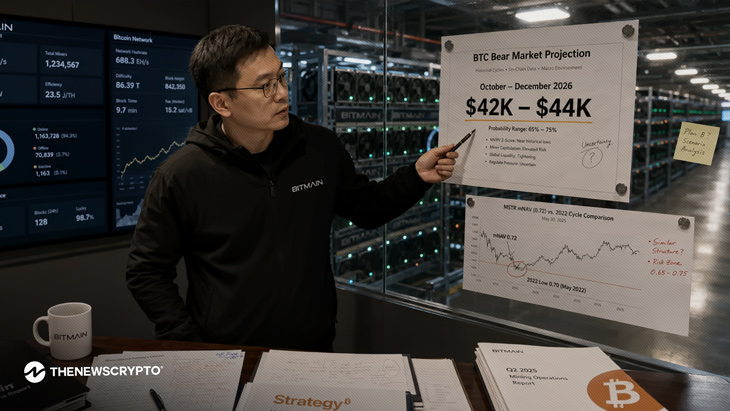
Jiang Zhuoer, a prominent Chinese Bitcoin miner and veteran market watcher, believes the current Bitcoin bear market could reach its final bottom between October and December 2026, with BTC potentially trading in the $42,000–$44,000 range.

The outlook is based on the behaviour of Strategy’s mNAV ratio, a metric that compares the company’s market value to the value of its BTC holdings. According to him, mNAV has fallen to 0.72, approaching the cycle low of 0.7 recorded on May 11, 2022, during the previous market downturn.

While the current mNAV level suggests deep pessimism in the market, Jiang cautioned that an mNAV bottom does not necessarily coincide with Bitcoin’s price bottom. In the previous cycle, Strategy’s mNAV hit its low when Bitcoin traded around $31,017. 

However, BTC continued falling and reached its bear market low of $15,476 in November 2022, roughly six months later. Moreover, based on this historical pattern, Jiang argues that mNAV may serve as a leading indicator rather than a direct signal of Bitcoin’s final price floor. 

He added that current market conditions, including the notable decoupling of Strategy’s STRC-related sentiment indicators, suggest mNAV is already trading within its lowest zone of this cycle.

A Four-Year Cycle Model Points to Late 2026

His forecast is built on a mathematical model that compares Bitcoin’s long-term market cycles to a bouncing ball, where each successive bounce becomes smaller as volatility declines. As Bitcoin’s market cap expands, price swings tend to moderate over time.

Jiang revealed that his recent trading strategy has involved reducing spot exposure and maintaining short positions. If his cycle thesis plays out, BTC could continue facing pressure through 2026 before entering its next major accumulation phase. 

Is Bitcoin’s Price at Risk of a Steeper Downturn?

The largest asset, Bitcoin (BTC), is currently trading at $61,424, with its daily trading volume having surged by over 38.47% to the $42.98 billion mark. During the last 24 hours, the BTC market has experienced a liquidation of $411.91 million, as reported by the Coinglass data

If the bearish phase intensifies, the BTC price could fall to the support at $61,320. Upon the downside correction gains more traction, the death cross might form, and send the price even lower. Assuming the current momentum shifts bullish, the price could climb to the resistance at $61,514. With the steady upside pressure, a golden cross would emerge and lead the price action to move up. 

Both the Moving Average Convergence Divergence (MACD) and signal lines are below the zero line, indicating that BTC is in a bearish trend. The sellers remain in control of the broader market, reflecting sustained downside pressure rather than a temporary pullback.

(Source: TradingView)

Besides, the daily Relative Strength Index (RSI) at 42.37 suggests a mild bearish trend. It is below the neutral level and remains above the oversold zone, with selling pressure present but not strong. The momentum is balanced, and a clear trend has yet to strengthen. 

Crypto Market Highlights

Humanity Protocol (H) in Freefall: Can Buyers Halt the 35% Slide?

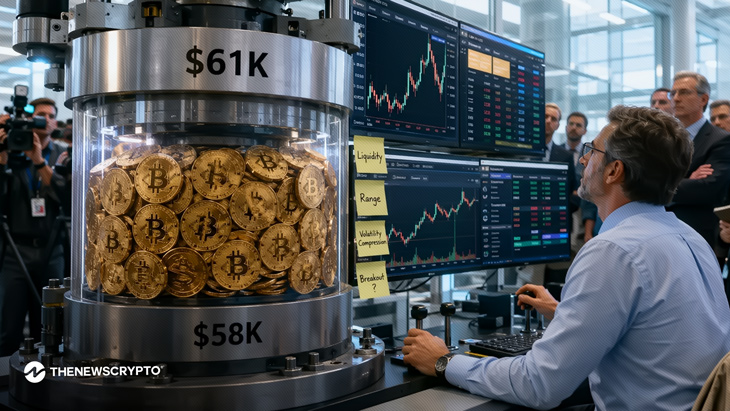
  • Bitcoin is hovering around $60.3K, remaining trapped between $58K and $61K levels.
  • The BTC indicators point to a cautious market.

Bitcoin (BTC) is continuing to trade within a well-defined range. Price action remains trapped between key support near $58,000 and resistance around $61,000, with repeated attempts to reclaim the $60,000 region falling short. 

Recent trading activity shows buyers stepping in at slightly higher lows, suggesting demand is strengthening despite the lack of a breakout. However, sellers continue to defend the $60K–$61K zone, keeping BTC confined within its current range.

As buying and selling pressure become more balanced, volatility tends to compress before expanding again. The longer Bitcoin remains within this range, the greater the potential for a sharp move once either support or resistance gives way.

Bitcoin Dominance Hints at a Shift in Market Sentiment

Beyond price action, Bitcoin dominance is also drawing attention. The metric has continued to form lower highs, indicating that Bitcoin’s share of the overall cryptocurrency market has been gradually declining.

While this does not guarantee an immediate rotation into altcoins, it suggests that market participants are becoming less concentrated in BTC alone. Some analysts believe recent caution has been driven more by uncertainty than by weakening fundamentals.

For now, a sustained move above $61K could strengthen bullish momentum, while a break below $58K may invite additional selling pressure. Until then, BTC appears to be in a period of consolidation, with traders monitoring both levels for confirmation of the market’s next significant trend.

Is Bitcoin Stuck in an Extended Downward Cycle?

Bitcoin is currently trading at around the $60,384, with its daily trading volume having surged by over 59.33%, and reaching $23.59 billion. As reported by the Coinglass data, the BTC market has witnessed a liquidation of $98.11 million in the last 24 hours. 

The recent trading session of Bitcoin shows the potential of the bears, with the price slipping to the key support at $60,231. Further correction on the downside could easily send the price even lower. Conversely, if the bulls re-entered, the BTC price could move up toward the $60.4K resistance range. With the strengthened upside pressure, the momentum is likely to drive the price higher.

Both the MACD and signal lines are below the zero line, exhibiting that the Bitcoin market remains under bearish momentum. While short-term recoveries can occur, the overall trend remains weak until the indicators move back above the zero line, reflecting a continued downtrend.

(Source: TradingView)

BTC’s daily RSI value is stationed at around 44.06, hinting at mild bearish momentum. The sellers have a slight edge, and it is above the oversold zone. This points to a cautious market, where bearish sentiment is present but not strong enough to confirm an extended downtrend.

Crypto Market Highlights

South Korea’s Crypto Push Gains Steam as Kiwoom Moves to Invest in Bithumb

  • As part of the launch, GoMining is onboarding an initial set of up to 10 merchants and ecosystem partners.
  • GoBTC Pay settles directly on Bitcoin while protecting user ownership and non-custody.

GoMining is announcing the GoBTC Pay Gen1 SDK and API, allowing merchants, wallet providers, and ecosystem partners to integrate Bitcoin payments into real-world products and services.

The introduction represents the next step of GoBTC Pay, GoMining’s layer 1 Bitcoin payment technology intended to facilitate quick, non-custodial Bitcoin transactions. The Gen1 release changes GoBTC Pay from a restricted demo version into an open infrastructure layer, allowing merchants, wallets, and ecosystem partners to develop and scale Bitcoin payment experiences on top of the network.

As part of the launch, GoMining is onboarding an initial set of up to 10 merchants and ecosystem partners who will begin integrating GoBTC Pay into their products and services. 

“Satoshi didn’t create Bitcoin to sit idle in wallets. It was designed to move value between people,” said Mark Zalan, CEO of GoMining. “With the launch of the GoBTC Pay SDK and API, we’re giving merchants and wallet providers the infrastructure to bring that vision into real-world commerce in a way that is seamless and intuitive for users. We believe Bitcoin’s next chapter will be defined by how people use it, in addition to how many people own it.”

GoBTC Pay settles directly on Bitcoin while protecting user ownership and non-custody. The Gen1 version offers merchant onboarding tools, payment management capabilities, a web-based merchant dashboard, online payment connectors, public developer documentation, and an open API for wallet providers and institutional partners.

GoBTC Pay is powered by GoMining’s private 15EH/s mempool based on Stratum V2 protocol supporting prioritizing of GoBTC Pay transactions. With an estimated 12hrs average settlement window GoBTC Pay is aimed to protect the essential concepts of Bitcoin while delivering debit card-like payment experience. Users keep custody of their BTC, transactions settle immediately on Bitcoin, and businesses enjoy a smooth payment experience without asking consumers to convert their assets into cash.

Its incentive scheme is meant to harmonize the interests of merchants, wallets, and miners. Merchants pay a 0.2% transaction fee, which is distributed equally between participating wallet providers and miners in the GoMining pool that handle payments. GoMining seeks to promote network expansion and boost actual Bitcoin payment activity for routine purchases by directly compensating infrastructure participants who enable transactions.

The launch is the start of a larger ecosystem strategy aimed at promoting merchant, wallet, and partner use of Bitcoin payments. It comes after GoMining introduced GoBTC Pay at Consensus Miami.

GoMining is an all-in-one Bitcoin ecosystem that makes mining, earning, and using Bitcoin every day easy and safe. GoMining maintains data centers in the United States and other countries, services 5 million customers, and is one of the top 10 Bitcoin miners worldwide by hashrate. Through tokenized hashrate and a growing range of payment and earning options, the firm makes Bitcoin accessible.

GoMining created GoBTC Pay, a Bitcoin-native payment protocol that allows quick, non-custodial Bitcoin payments for customers, businesses, and ecosystem partners. GoBTC Pay gives businesses, wallets, and platforms the infrastructure they need to accept and process Bitcoin transactions quickly and affordably. It was designed to enable real-world commerce while upholding the concepts of non-custody and user ownership. GoBTC Pay is creating an open payments ecosystem with partner integrations, developer APIs, and merchant tools to increase the widespread adoption of Bitcoin.

Tesla Inc. (TSLA) expanded its robotaxi service to Miami on Friday, extending its autonomous ride-hailing operations.

The move comes as Chief Executive Officer Elon Musk increasingly emphasizes artificial intelligence, robotics, and autonomous transportation as key drivers of Tesla’s future, alongside its electric vehicle business.

“Robotaxi now available in Miami,” Tesla’s official robotaxi account said in a post on X.

https://twitter.com/robotaxi/status/2073030246161367153

Tesla expands Robotaxi footprint

The Miami launch marks Tesla’s latest step in broadening access to its robotaxi platform, which relies on the company’s self-driving software.

Tesla launched its unsupervised robotaxi service in Austin, Texas, in June and later announced plans to expand the offering to Dallas and Houston.

The company has recently rolled out services in those cities as it seeks to increase adoption of its autonomous driving technology.

The expansion reflects Tesla’s broader effort to commercialize self-driving transportation and build new revenue streams tied to artificial intelligence and robotics.

Musk said in May that he expects fully self-driving vehicles operating without human safety monitors to become more common across the United States later this year.

Competition intensifies in Robotaxi market

Tesla’s latest expansion comes as competition in the autonomous ride-hailing sector continues to intensify.

Companies, including Alphabet’s Waymo and Amazon’s Zoox, have accelerated their own expansion efforts as the market for autonomous transportation develops.

While Tesla has expanded into additional cities, the scale of its robotaxi operations remains relatively limited compared with some rivals.

According to registration information submitted to the Texas Department of Motor Vehicles under new state reporting requirements that took effect in May, Tesla currently operates 42 robotaxis in Texas.

The disclosure provides the clearest picture yet of the size of Tesla’s autonomous fleet in the state, where the company launched its robotaxi service in Austin last year.

By comparison, Alphabet-owned Waymo has registered 577 automated vehicles in Texas, according to information published by the state, giving it a fleet more than 13 times larger than Tesla’s.

Robotaxis central to Tesla’s AI vision

Autonomous transportation remains a key component of Musk’s effort to transform Tesla from primarily an electric vehicle manufacturer into a broader artificial intelligence and robotics company.

Tesla’s robotaxi ambitions have become increasingly important to the company’s investment narrative, with investors closely monitoring the pace of deployment and expansion.

The company also operates a rideshare service in the San Francisco Bay Area.

Tesla said in April that it was preparing to expand its robotaxi operations to five additional cities.

However, Musk has cautioned that the network is unlikely to generate meaningful revenue for the company this year.

The Miami launch follows another positive development for Tesla this week.

On Thursday, the company reported second-quarter vehicle deliveries that exceeded Wall Street expectations, supported by a rebound in European demand.

The stock, however, ended the day deep in the red.

The post Tesla launches Robotaxi operations in Miami amid growing competition appeared first on Invezz

Europe’s major stock markets ended higher on Friday, with the pan-European STOXX 600 and Germany’s DAX reaching fresh record highs as investors welcomed easing expectations for near-term US interest rate hikes and rotated into cyclical sectors.

The STOXX 600 climbed 0.7% to close at a record high after touching an intraday peak of 652.35, registering its strongest weekly gain since mid-May.

Germany’s DAX advanced 0.8% to another all-time closing high.

In the UK, the FTSE 100 added 0.2% to close at 10,679.03, securing a weekly gain, while the FTSE 250 rose 0.5%.

Cyclical stocks lead European rally

The advance was driven by strength in cyclical sectors, including industrials, financials and defense stocks, as investors broadened their focus beyond technology shares.

“So, not only are Europe’s indices less exposed to the AI trade, but they are also relatively cheap.”

Defense stocks rose 0.7% as Russia launched its deadliest strike on Ukraine this year, reinforcing expectations for increased defense spending across Europe.

Banks, financial services and industrial companies were also among the week’s strongest performers as easing tensions in the Middle East supported broader market sentiment.

Germany’s Siemens gained 2.6% after Kepler Cheuvreux upgraded the stock to “hold” from “reduce.”

Semiconductor-related stocks also rallied, with Aixtron jumping 6%, while Soitec and BE Semiconductor Industries gained 5% and 4.2%, respectively.

French benefits company Pluxee rose 7.8% after reporting a smaller-than-expected decline in third-quarter organic sales.

FTSE supported by financials, miners and chemicals

In London, financial stocks helped lift the FTSE 100.

Close Brothers Group surged 7.9%, while Lion Finance Group and Standard Chartered gained 2.8% and 1.5%, respectively.

Precious metals miners rose 1.4% as gold prices strengthened after weaker-than-expected US employment data reduced expectations of a near-term Federal Reserve interest rate hike.

Chemical stocks also outperformed, rising 2.5%.

Johnson Matthey climbed 4.9% after receiving Chinese regulatory approval for the sale of its Catalyst Technologies business to Honeywell. The company said it expects the transaction to close by the end of August.

Central bank outlook remains in focus

Markets continued to assess the outlook for monetary policy following softer US economic data and fresh comments from European policymakers.

A weaker-than-expected US jobs report on Thursday strengthened expectations that the Federal Reserve could delay further interest rate hikes.

Meanwhile, euro zone inflation data released earlier this week showed price growth slowed more than expected in June.

European Central Bank President Christine Lagarde said risks to inflation and economic growth had become more balanced than they were only a few weeks ago.

According to LSEG data, traders now expect the ECB to raise interest rates by a total of 23 basis points this year.

In the UK, Bank of England policymaker Catherine Mann said lower market expectations for future rate increases since the June Monetary Policy Committee meeting would be an important consideration ahead of the central bank’s policy decision later this month.

Investors also monitored UK economic data, which showed businesses maintained elevated price expectations in June despite easing energy costs following the de-escalation of the Iran conflict.

A separate survey indicated Britain’s services sector contracted for a second consecutive month, recording its weakest performance since early 2023 as the effects of the conflict continued to weigh on business activity.

The post European markets close higher as STOXX 600 hits record, FTSE posts weekly gains appeared first on Invezz

Europe’s major stock markets ended higher on Friday, with the STOXX 600 and Germany’s DAX hitting record highs as investors rotated into cyclical sectors.

Bitcoin climbed above $62,000 as large holders accumulated coins despite record ETF outflows.

Tesla expanded its robotaxi service to Miami as competition in autonomous driving intensified.

Poland’s prime minister warned that the coming months could be “critical” amid reports of a potential Russian provocation.

European markets hit record highs

European equities closed higher on Friday, with the STOXX 600 rising 0.7% to a record close after touching an intraday high of 652.35.

The index recorded its strongest weekly gain since mid-May. Germany’s DAX advanced 0.8% to another all-time closing high.

In the UK, the FTSE 100 added 0.2% to 10,679.03, while the FTSE 250 rose 0.5%, securing weekly gains for both indices.

The rally was driven by cyclical sectors, including industrials, financials and defense stocks, as investors broadened exposure beyond technology.

Defense stocks rose 0.7% after Russia launched its deadliest strike on Ukraine this year, reinforcing expectations for higher European defense spending.

Banks, financial services and industrials also advanced during the week, supported by easing geopolitical tensions in the Middle East.

Among individual movers, Siemens gained 2.6% after Kepler Cheuvreux upgraded the stock to “hold” from “reduce.” Semiconductor-related names also rallied, with Aixtron up 6%, Soitec up 5%, and BE Semiconductor Industries gaining 4.2%.

Bitcoin climbs above $62,000 on whale accumulation

Bitcoin rose to as high as $62,550, its strongest level since June 24, according to CoinMarketCap data, as global markets remained closed for the US Independence Day holiday.

Market participants said the move reflected steady buying, though resistance remains nearby.

Trader Daan Crypto Trades highlighted the 200-week simple moving average near $62,652, stating: “It is key for BTC now to hold this breakout and maintain its low timeframe bullish market structure.”

According to Bitfinex analysts, wallets identified as whales accumulated more than 270,000 Bitcoin worth about $16.7 billion over two weeks, even as US spot Bitcoin ETFs recorded $4.06 billion in outflows during June.

“The knee-jerk reaction from investors was to push stock index futures higher, signaling a regime where bad economic news is good for stocks due to the impact on the rate outlook,” Mosaic Asset Company said.

Tesla expands Robotaxi service to Miami

Tesla expanded its robotaxi service to Miami on Friday, marking another step in its autonomous driving rollout. The company said: “Robotaxi now available in Miami,” in a post on X.

The move follows launches in Austin, Dallas and Houston as Tesla continues expanding its self-driving platform.

Competition in the sector is intensifying, with Alphabet’s Waymo and Amazon’s Zoox also scaling operations.

According to Texas regulatory filings, Tesla operates 42 robotaxis in the state, compared with 577 vehicles registered by Waymo in Texas.

Tesla said in April it was preparing to expand robotaxi operations to five additional cities, though Elon Musk has said the network is unlikely to generate meaningful revenue this year.

Poland warns of possible Russian threat escalation

Poland’s prime minister Donald Tusk said the country is preparing for “various” scenarios as concerns grow over potential Russian actions in the region.

“I don’t mean to scare anyone but the coming months may truly be critical, also due to the changing nature of the war. These concerns are particularly palpable in the Baltic states,” Tusk told reporters on Friday.

Reports cited by Polish media suggested Moscow could be planning a provocation targeting NATO territory to test allied resolve, though no official confirmation was provided.

The White House and US State Department did not comment on the reports.

Tusk added: “Let’s not be afraid, we are preparing for various situations, but we cannot ignore them… We are aware of the threats, also thanks to information from our allies”.

NATO leaders are expected to meet in Turkey next week, where defence spending and support for Ukraine will be key topics.

The post Evening digest: European stocks hit records, Bitcoin tops $62K appeared first on Invezz

Wall Street will enter the July 6-10 week with less room for error after a choppy start to the second half.

The S&P 500 is still sitting near record territory, but the market is carrying a tricky mix of stretched valuations, a cooling labour market, fragile oil prices and fresh pressure in semiconductor stocks.

The centrepiece will be Wednesday’s FOMC minutes, the first deeper look at Kevin Warsh’s debut meeting as Federal Reserve chair.

With investors already debating whether the June jobs slowdown reduces the odds of a near-term rate hike, every data point next week could matter more than usual.

5 factors investors can’t ignore next week

1. FOMC minutes: First real read on Warsh’s Fed

The biggest event lands on Wednesday, when investors get the minutes from the Fed’s June meeting.

That meeting was Warsh’s first as chair, and it left markets with a hawkish dot-plot message: nine of 18 officials projected that rates would end 2026 above the current 3.5%-3.75% range.

The minutes will be parsed for how strongly officials debated inflation, oil prices and the timing of any hike.

The June jobs report gave the Fed some cover to wait, with payrolls rising by just 57,000 and rate-hike odds falling after the data.

Evercore ISI’s Krishna Guha said Warsh sounded “relaxed” about the labour market.

2. ISM Services PMI: Week’s first economic test

Before the Fed minutes, Monday’s ISM Services PMI will set the tone.

ISM has scheduled the June services report for 10 a.m. ET on Monday, July 6, after the July 3 market holiday shifted the calendar.

The May reading rose to 54.5, showing the services side of the economy was still expanding.

A softer print would support the argument that growth is slowing enough to keep the Fed patient.

A stronger reading, especially if prices remain firm, would make the minutes feel more dangerous for rate-sensitive stocks.

3. Chip-sector aftershocks: Reset or warning sign?

Semiconductors remain the market’s most crowded trade, and that makes next week important.

The sector has been rattled by sharp swings in Korean memory names and US chip stocks.

The Kospi index surged on Friday after a two-day decline, helped by bargain-hunting in chipmakers, while US tech weakness had weighed on sentiment earlier in the week.

Samsung and SK Hynix rebounded strongly on July 3 after Thursday’s selloff, while Micron remained under pressure following a sharp drop.

The question for investors is whether this is a healthy reset after a huge AI rally, or the first sign that positioning has become too leveraged.

4. Levi Strauss and PepsiCo: Early consumer checks

Q2 earnings season does not fully accelerate until mid-July, but Levi Strauss and PepsiCo will offer early signals on the US consumer.

Levi will discuss second-quarter results on Wednesday, July 8, while PepsiCo has confirmed it will release second-quarter results on Thursday, July 9.

Levi offers an early read on discretionary spending and demand for apparel, while PepsiCo provides a staples-side check on consumer tolerance for higher snack and beverage prices.

Together, they will help show whether earnings strength is broadening beyond AI and mega-cap technology.

5. Oil and the fragile Iran ceasefire

Oil’s retreat has helped ease inflation anxiety, but the market is not treating the calm as permanent.

Brent is trading around $71.87 and WTI near $68.63, with prices close to pre-conflict levels as peace efforts held and some Strait of Hormuz traffic resumed.

That cooling helps consumers and the Fed. But it also depends on the diplomacy holding.

The oil prices have returned to pre-war levels even though shipping disruption, insurance costs and geopolitical risk have not fully disappeared.

That is why next week matters as Goldman Sachs has lifted its year-end S&P 500 target to 8,000, but valuations are already rich by long-term standards.

With stocks priced for good news, a hawkish Fed surprise, weak consumer readout or renewed chip volatility could hit harder than usual.

The post Wall Street’s big test: 5 factors investors can’t ignore next week appeared first on Invezz

US stock funds saw their biggest weekly exit since March, raising fresh questions about the strength of Wall Street’s rally.

Investors pulled $17.2 billion from US stock funds in the week through July 1, according to Bloomberg, citing Bank of America strategists led by Michael Hartnett and EPFR Global data.

The move does not signal a market crash, but it does show investors are turning more cautious after a strong run in US equities.

The key question now is simple: is this routine profit-taking, or an early warning that confidence in the AI-led rally is starting to fade?

Wall Street’s rally loses its flow cushion

Fund flows work like a sentiment gauge as they show whether investors are adding fresh money to equity funds or quietly taking some risk off the table.

A $17.2 billion weekly exit does not mean the S&P 500 is collapsing, but it indicates that investors are becoming more cautious after a powerful run in US equities.

That matters because this rally has leaned heavily on megacap technology, AI optimism and confidence that corporate earnings can keep absorbing higher rates.

When money is still pouring in, expensive markets can keep climbing, but when flows turn patchier, valuations become more exposed to bad news.

The shift did not appear from nowhere as US equity funds already saw $3.5 billion of outflows in the week to June 24, as worries over debt-funded technology spending and hawkish Federal Reserve expectations weighed on sentiment.

Technology sector funds saw nearly $20 billion of withdrawals that week, reversing the previous week’s inflows.

That makes the latest BofA number less of a surprise and more of a continuation and a signal that investors are no longer buying every dip with the same confidence.

Tech fatigue is becoming harder to ignore

The pressure point remains technology. The AI trade has been the engine of Wall Street’s advance, but it is also where concentration risk is highest.

The MSCI World Index fell 2.07% last week amid worries over concentration risks and hyperscalers’ spending plans.

Those concerns matter because investors are watching whether cloud giants can turn massive AI capex into durable profits, not just bigger bills.

BNY’s Bob Savage told Reuters that the AI-led equity rally was showing signs of fatigue.

That is the kind of line that lands because it captures the market’s current mood: still bullish on AI in principle, but less willing to ignore every valuation warning.

Oliver Shale, investment specialist for the US at Ruffer, made the positioning risk clearer.

He said that through the lens of valuations, positioning and sentiment, risk measures are “flashing amber.”

Rotation, not full retreat

The more balanced reading is that investors are rotating, not giving up on equities altogether.

LSEG data showed global equity funds pulled in $10.4 billion in the week to July 1. Asian equity funds attracted $7 billion, their biggest inflow in seven weeks, while US funds saw a smaller $1 billion inflow.

Technology funds also rebounded with $8.9 billion in inflows after the previous week’s heavy selling.

That complicates the bearish case. Investors may be trimming crowded US exposure while still buying technology and other regional equity opportunities.

William Bratton, head of cash equity research for APAC at BNP Paribas, struck that tone in a note cited by Reuters.

He said the bank’s tech analysts saw “no reason” for the sector’s earnings momentum to slow or reverse in the near term, with the coming second-quarter earnings season expected to be supportive.

The post US stocks see biggest exit since March: is Wall Street’s rally at risk? appeared first on Invezz