Archive

June 23, 2026

Browsing

Meta Platforms is facing fresh regulatory pressure in Europe as the European Union prepares to escalate its investigation into whether Facebook and Instagram use design features that are addictive to children.

The developments place Meta at the centre of two major stories at once.

In Europe, the company is facing closer scrutiny over the impact of its platforms on minors.

In India, it is deepening its push into digital payments and consumer finance.

EU prepares next step in Meta probe

The EU’s executive arm is preparing preliminary findings in its investigation into Meta unde the Digital Services Act.

The probe focuses on whether Facebook and Instagram use exploitative design features that keep younger users engaged for long periods.

The investigation was opened in May 2024 under the Digital Services Act, the bloc’s landmark online safety law.

At the time, regulators flagged concerns that Meta’s platforms could expose children to a so-called “rabbit-hole effect”, where recommendation systems keep users locked into a constant stream of content.

The latest step would deepen that probe.

Bloomberg News reported on Tuesday that the Commission is set to ramp up its investigation into whether Meta’s products are addictive to children.

The child-safety case is not Meta’s only problem in Europe.

In April, the Commission said it had preliminarily found Meta in breach of the Digital Services Act for failing to prevent children under 13 from accessing Facebook and Instagram.

According to the Commission, Meta’s current safeguards do not effectively stop underage users from joining the platforms or ensure their quick removal if they do gain access.

Child safety becomes a bigger regulatory battleground

The EU’s action reflects a wider push by governments to tighten rules around children’s use of social media.

Regulators are increasingly focused on platform design, age verification, and the exposure of minors to harmful content.

Under the Digital Services Act process, preliminary findings are a formal step but not a final ruling.

Meta would be able to respond to the allegations and propose remedies.

If the company ultimately fails to address the Commission’s concerns, it could face a fine of up to 6% of its annual global revenue under the law.

The scrutiny also comes amid a broader global backlash against large social media companies over the effect of their products on younger users.

Policymakers in several countries have been debating new restrictions on children’s access to platforms and tougher obligations for companies to design safer services.

Meta turns to India with $900 million CRED investment

At the same time, Meta is making a significant move in India’s fintech market.

On Monday, the company said it will invest $900 million in Bengaluru-based startup CRED as part of the company’s Series H funding round.

The transaction gives Meta a minority stake of about 20% in the fintech firm.

CRED said the funding round will raise ₹8,550 crore and value the company at ₹43,239 crore on a post-money basis.

The round includes a mix of primary and secondary share purchases.

Meta will join CRED’s cap table as a minority investor and will not gain access to customer data, the company said.

The two developments show Meta navigating very different priorities across markets.

The post EU ramps up pressure on Meta over child safety concerns appeared first on Invezz

US stocks opened lower on Tuesday as a technology-led selloff accelerated, with semiconductor and artificial intelligence-related stocks coming under renewed pressure.

The Dow Jones Industrial Average fell 326 points. The Nasdaq Composite dropped 2.2% while the S&P 500 was down 1.5%.

The weakness followed Monday’s session, when the Nasdaq Composite fell 1.3%, weighed heavily by Alphabet and other megacap technology companies.

The selloff quickly spread to global markets overnight.

South Korea’s Kospi index led regional losses, falling nearly 10% after a steep decline in technology shares.

Memory chipmaker SK Hynix, one of the biggest beneficiaries of the AI rally, closed down more than 12%.

Japan’s Nikkei 225 also declined 3.55%, ending an eight-session winning streak.

Semiconductor and AI stocks lead declines

The selloff was particularly pronounced across semiconductor and AI-linked stocks.

Micron Technology dropped 12% in trading ahead of its quarterly results scheduled for Wednesday.

SanDisk fell nearly 11%, while storage company Seagate Technology shed more than 7%.

Intel declined more than 6.4%, while Advanced Micro Devices and Qualcomm fell more than 6% and 7%, respectively.

Nvidia dropped 3.3%, and Alphabet extended Monday’s losses with another 1.6% decline.

The State Street Technology Select Sector SPDR ETF fell 3.7% in early trading, while the VanEck Semiconductor ETF declined 6.4%.

Morgan Stanley Investment Management senior portfolio manager Andrew Slimmon described the selloff as a healthy development.

“The AI beneficiaries are the sell-off, and I don’t think they’re expensive, but they’re crowded,” Slimmon said on CNBC’s “Squawk Box” Monday. “It’s captured kind-of the zeitgeist of the momentum traders and when that happens, you’re going to have sharp sell offs like we’re having. I’d argue it’s healthy.”

European markets also weakened, with the pan-European Stoxx 600 index falling 1%.

The region’s technology sector declined 3%, led by losses of more than 6% in Dutch semiconductor equipment maker ASMI and chipmaker STMicroelectronics.

Fed concerns and AI spending scrutiny remain in focus

Investors are increasingly questioning whether the massive spending commitments on AI infrastructure can be sustained, particularly as many large technology companies continue to fund expansion through debt issuance.

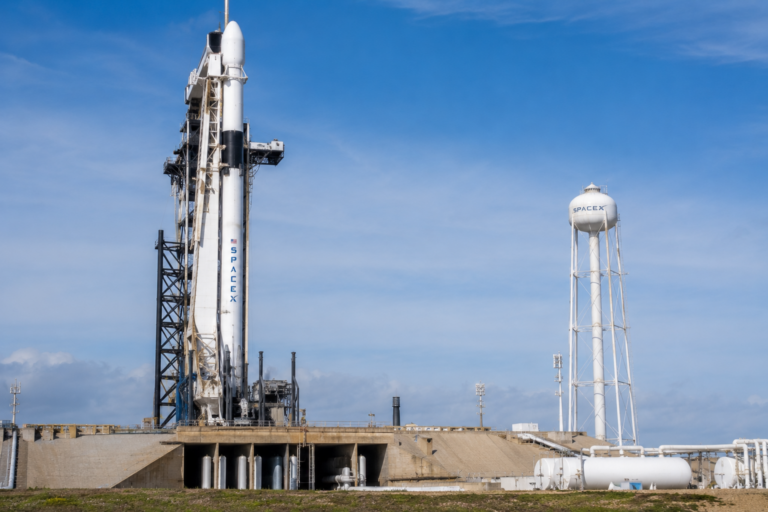
SpaceX fell 2.5% in trading, putting the stock on pace for a fourth consecutive decline.

More than $600 billion has been wiped from the company’s market value over the past three sessions.

Markets are also adjusting to expectations of a more hawkish Federal Reserve.

According to LSEG data, traders are increasingly pricing in a second interest-rate increase by December, compared with expectations of only one 25-basis-point hike two weeks ago.

Attention later on Tuesday will turn to private surveys of June business activity, while investors continue to await Thursday’s release of the Personal Consumption Expenditures Index, the Federal Reserve’s preferred inflation gauge.

Developments in the Middle East also remain in focus after the United States waived sanctions on Iran for 60 days following the first round of talks under an emerging peace agreement.

The post Dow falls 320 points as Nasdaq slides 2.2% in AI tech selloff appeared first on Invezz

SpaceX shares fell on Monday after announcing its inaugural offering of senior unsecured notes, marking its first foray into the investment-grade bond market.

The newly public company is seeking to refinance debt and support its long-term expansion plans in artificial intelligence and space infrastructure.

The Elon Musk-led company said proceeds from the offering would primarily be used to repay outstanding borrowings under its bridge loan facility, cover related fees and expenses, and fund general corporate purposes.

The company did not disclose the size, maturity, or pricing of the offering.

However, Reuters and Bloomberg had reported last week that SpaceX’s bankers were preparing to meet investors to discuss a bond offering of at least $20 billion.

The notes are being privately placed to qualified institutional buyers and certain non-US investors.

SpaceX said the senior unsecured notes would rank equally in right of payment with all existing and future unsubordinated indebtedness, liabilities, and other obligations.

Last week, Moody’s Ratings, Fitch Ratings, and S&P Global Ratings assigned investment-grade ratings to the company’s planned debt offering, paving the way for its entry into public debt markets.

Shares of SPCX fell about 10% on Monday.

Debt refinancing takes centre stage

According to regulatory filings, SpaceX had about $29 billion in total debt, of which roughly $20 billion consists of a bridge loan maturing in September 2027.

The bridge financing was used to repay debt at xAI, the artificial intelligence startup founded by Musk that was acquired by SpaceX in February.

The company also said a substantial portion of its remaining long-term debt is tied to obligations related to “certain AI infrastructure assets recorded as failed sale-leaseback transactions.”

The refinancing effort comes after SpaceX completed a record-breaking initial public offering less than two weeks ago, raising $85.7 billion in proceeds, the largest IPO on record.

Analysts say SpaceX to rely on debt markets for additional capital raising

Alongside the bond announcement, SpaceX disclosed that it held approximately $100.8 billion in cash and cash equivalents as of June 19.

That figure is more than six times the company’s cash position as of March 31, according to filings.

However, investors expect a significant portion of those funds to be deployed toward capital-intensive projects spanning both artificial intelligence and space exploration.

Among the company’s initiatives are plans to develop space-based data centers and accelerate work on Starship, the next-generation rocket system that forms a key pillar of Musk’s long-term vision for space transportation.

SpaceX is also expanding Terafab, a large-scale manufacturing project being developed alongside Tesla, another company led by Musk.

The company recently struck a $60 billion deal for Cursor, an autonomous coding agent that is expected to bolster SpaceX’s artificial intelligence capabilities and help it compete with rapidly advancing AI rivals.

Analysts expect debt financing to play an increasingly important role in funding those ambitions.

Oppenheimer analysts said in a note to clients last week that SpaceX would likely follow a financing strategy similar to Tesla’s and rely primarily on debt markets for additional capital raising going forward.

The bond offering represents an early step in that process as the company seeks to balance its strong cash position with the enormous funding requirements of its long-term AI and space infrastructure projects.

The post Why SpaceX stock is falling 10% today? appeared first on Invezz

Super Micro Computer (SMCI) shares are ripping higher this morning after the AI server specialist unveiled its Data Center Building Block Solutions (DCBBS) Blueprint optimized for next-gen architecture.

As investors reacted to the update at the ISC 2026 conference in Hamburg, Supermicro soared past its 50 and 100-day moving averages (MAs), signaling bullish momentum could be sustained in the near term.

SMCI stock has been a volatile investment in recent weeks – currently down some 30% versus its year-to-date high in early June.

Why is Supermicro stock rallying on Monday

Supermicro’s new architecture is built directly on the Nvidia Vera Rubin NVL4 platform.

Speaking at the said conference in Germany, management confirmed that the liquid-cooled rack solution scales up to an immense 1,152 NVDA Rubin GPUs and 576 NVDA Vera CPUs.

Deployments are locked in for the back half of this year to align with Nvidia’s general availability, giving investors a concrete, cutting-edge roadmap.

“Scientific discovery has always been driven by tools available to researchers, and AI has become an essential part of the research process. The institutions that accelerate infrastructure deployment will lead the next generation of breakthroughs,” CEO Charles Liang noted.

Note that despite the recent pullback, SMCI shares remain up some 70% versus their year-to-date low.

GF Securities sees significant upside in SMCI shares

Supermicro stock is extending gains on Jun. 22 also because GF Securities upgraded the artificial intelligence company to “Buy” with a $48 price target, indicating potential upside of another 40% from current levels.

According to analyst Evan Lee, the recently announced $7 billion capital raise that triggered a big sell-off in SMCI has created an incredibly attractive entry point.

The Nasdaq-listed firm is currently going for a forward price-to-earnings (P/E) multiple of about 14x only.

In his research note, Lee explicitly highlighted SMCI’s major role as an OEM supplier of NVL72 systems for SpaceX’s massive “Colossus 2” data centers.

GF Securities expects SpaceX to aggressively scale deployment orders starting in Q4, prompting them to upwardly revise the company’s NVL72 rack shipment forecasts to 7.2k for this year and 12k for FY27 (implied sales of $24 billion and $51 billion, respectively).

How Wall Street recommends playing Supermicro

Supermicro shares had been under brutal pressure throughout June after announcing its massive capital raise to fund its $39 billion AI server order backlog.

With the financing package now officially closed and completed, the looming fear of further near-term dilution is off the table.

Investors are shifting focus back to execution and structural demand rather than capital shortfalls.

That said, Wall Street analysts don’t really share GF Securities’ optimism on SMCI.

The consensus rating on Super Micro Computer currently sits at “Hold” only, with the mean price target of just under $36 indicating a lack of meaningful upside from current levels.

The post SMCI stock rallies as management turns heads at the ISC 2026 conference appeared first on Invezz

Alphabet shares fell as investors assessed the departure of prominent AI researchers and broader concerns about AI spending.

The stock dropped more than 6.6%, falling to $343.47 in morning trading, as the market assessed the departure of two senior AI leaders from Google’s research organizations.

DeepMind loses another high-profile researcher

The latest setback came after John Jumper, one of Google DeepMind’s most prominent scientists, announced he would leave the company to join Anthropic.

Jumper revealed the decision on Friday in a post on X.

“After nearly nine years, I have decided to leave Google DeepMind and join Anthropic,” Jumper said.

Jumper is best known as the co-creator of AlphaFold, the artificial intelligence system that predicted more than 200 million protein structures and became one of the most celebrated scientific breakthroughs produced by AI.

He shared the 2024 Nobel Prize in Chemistry alongside DeepMind chief executive Demis Hassabis.

His departure comes just days after another senior figure, Noam Shazeer, announced he would leave Google to join OpenAI.

Shazeer served as vice president of engineering and co-led the Gemini family of AI models, one of Google’s flagship artificial intelligence initiatives.

Shazeer’s departure is particularly notable because Google spent approximately $2.7 billion in 2024 to bring him back through its deal with Character.AI.

The back-to-back departures have intensified investor concerns about Google’s ability to retain elite AI talent at a time when competition among leading AI companies is accelerating.

AI talent war intensifies

Technology companies and AI startups are increasingly competing for a relatively small pool of elite researchers capable of developing next-generation artificial intelligence systems.

Anthropic and OpenAI have emerged as two of Google’s most significant competitors in frontier AI research, while Meta and other technology giants continue aggressively recruiting researchers and engineers.

Jumper’s move is particularly notable because of his role in one of DeepMind’s most successful scientific achievements.

Responding to Jumper’s announcement, Hassabis highlighted the significance of AlphaFold’s impact.

“What we achieved with AlphaFold changed the world, and showed the field what was possible with AI for science and medicine, lighting the way for how AI can benefit humanity,” Hassabis wrote.

Investors weigh talent loss against AI spending

While the departures have captured investor attention, Alphabet’s longer-term investment case remains tied to its financial strength and ability to continue funding large-scale AI initiatives.

The company continues to generate substantial profits and cash flow, providing significant resources for investments in artificial intelligence infrastructure and cloud computing.

However, investors remain increasingly focused on the costs associated with that strategy.

The rapid expansion of AI services has required enormous spending on data centers, computing infrastructure, and advanced chips.

At the same time, constraints on computing capacity have raised concerns that demand may outpace the company’s ability to monetize AI-related products and services in the near term.

Those concerns have become more pronounced as investors evaluate whether growing AI investments will translate into revenue growth quickly enough to offset rising expenses.

The latest departures from Google add another layer of uncertainty to that debate.

The post Why Alphabet stock is tanking over 6% on Monday appeared first on Invezz

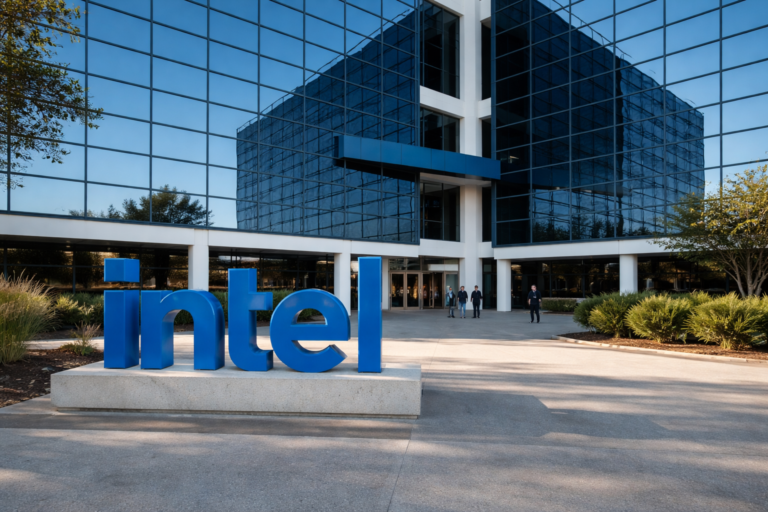
Intel INTC shares rose 3.9% on Monday, extending gains from the previous session after President Trump said on Truth Social that Apple AAPL had agreed to work with Intel to design and build chips in the United States.

The stock had already surged sharply on Thursday, closing at an all-time high of $133.99 after a 10.64% gain in a single session. However, neither Apple nor Intel has formally confirmed the terms of the arrangement.

Monday’s surge boosted the stock to a fresh all-time high of $141.45.

The latest rally adds to a strong upward move in the chipmaker’s stock over the past year, driven by renewed investor interest in its foundry and advanced packaging strategy.

Mizuho raises price target, highlights advanced packaging potential

Over the weekend, Mizuho increased its price target on Intel to $135 from $128 while maintaining a Neutral rating.

The firm cited Intel’s positioning in advanced packaging technologies as a potential long-term growth driver.

The analyst noted Intel’s EMIB-T and Foveros technologies, stating they could help the company capture 10% to 15% of the advanced packaging market over time.

The firm said it hosted an expert call on advanced packaging and identified Intel’s EMIB-T and TSMC’s CoWoS-L 2.5D approaches as gaining traction.

The analyst said glass substrate technology is beginning to emerge, with potential to improve thermal conductivity and enable denser wiring for tighter interconnections, while 3D integration approaches such as Foveros and SoIC continue to advance vertical stacking in chip design.

Mizuho added that EMIB-T and CoWoS-L could drive incremental demand for TSV, drilling, and lithography equipment, while SoIC and Foveros support hybrid-bonding processes.

The firm also highlighted supply chain constraints, noting ABF as a key bottleneck with one major supplier, and identified AMKR as a leading glass substrate partner for Intel.

It further pointed to potential upside for wafer fabrication equipment companies, including LRCX, MKSI, and AMAT, as the industry transitions toward silicon bridges and larger wafers.

Intel stock surpassed Mizuho’s price target of $135 in the session.

CEO ambitions and mixed analyst views

Intel CEO Lip-Bu Tan also added to bullish sentiment, saying on the “No Priors” podcast that his goal is a tenfold return for shareholders within five to ten years.

Tan, who took the helm early last year, has helped revive investor interest in Intel by attracting investments from Nvidia NVDA and the Trump administration.

Intel’s stock has seen a dramatic run, rising over 540% in the last twelve months and more than 250% year to date.

However, not everyone is sold on Intel’s turnaround.

According to TipRanks data, only 11 out of 38 analysts have a “buy” rating on the stock with 25 analysts have a “hold” rating.

Mizuho’s revised outlook comes as Intel’s shares have already surpassed prior expectations, reflecting the strength of its recent rally and the market’s focus on its foundry ambitions and advanced packaging roadmap.

The post Intel stock hits a new all-time high on Monday: here's why appeared first on Invezz

HIVE Digital (HIVE) shares soared on Monday morning as investors reacted to the firm’s recently announced pivot from BTC mining into AI and high-performance computing (HPC) infrastructure.

Late last week, HIVE said its wholly owned subsidiary, BUZZ HPC, signed a massive three-year commercial contract valued at about $220 million.

According to the press release, BUZZ will deploy 2,304 Nvidia Grace Blackwell GPU (configured as GB200 NVL72 rack-scale systems) at Bell’s data center facility in Merritt, British Columbia.

At the time of writing, HIVE stock is trading at a year-to-date high of about $5.3.

What’s driving HIVE stock higher today?

On Jun. 18, HIVE also secured approval from the Boden Municipal Council to outright purchase the Big Boden 32 MW data center in Sweden.

The company has operated out of this facility as a tenant since 2018, but moving to full ownership allows them to aggressively upgrade the site to Tier III standards to support heavy, next-generation AI and enterprise cloud computing workloads.

HIVE shares are rallying on a news that actually broke a few days ago mostly because today marks the first full trading session for the market to digest and price in those significant updates that also triggered positive revisions from Wall Street analysts over the weekend.

Cantor Fitzgerald analysts, for example, reiterated their “Overweight” rating on HIVE Digital and raised their price target aggressively to $7, indicating significant further upside from current levels.

Cantor Fitzgerald’s bull case for HIVE shares

In its latest research note, Cantor Fitzgerald analysts led by Brett Knoblauch said HIVE’s narrative is completely transforming.

Instead of being viewed as just a high-beta crypto miner subject to volatile Bitcoin prices, the firm is now building hard infrastructure that makes it an “AI infrastructure landlord.”

Knoblauch explicitly pointed out that the global tech market faces a massive compute and energy scarcity through 2026 and 2027.

And because HIVE has successfully secured tangible access to mega-scale power (anchored by their massive 320 MW AI gigafactory plans near Toronto and the recently solidified 32 MW site ownership in Sweden), HIVE stock is uniquely positioned to benefit.

“Compute scarcity makes it possible a large player would want access to HIVE Digital’s compute capacity,” he added.

What’s the consensus rating on Hive Digital

Following the AI pivot driven rally, HIVE shares’ relative strength index (RSI) sits in the early 70s – indicating “overbought” conditions that often precede a near-term pullback.

Still, Wall Street analysts remain bullish as ever on the stock for the next 12 months.

According to The Wall Street Journal, the consensus rating on Canada-based HIVE Digital Technologies Ltd sits at “Buy” currently, with the mean price target of $7.07 signaling potential upside of some 30% from current levels.  

The post Why is HIVE stock soaring today and what comes next? appeared first on Invezz