Archive

July 6, 2026

Browsing

Wall Street will enter the July 6-10 week with less room for error after a choppy start to the second half.

The S&P 500 is still sitting near record territory, but the market is carrying a tricky mix of stretched valuations, a cooling labour market, fragile oil prices and fresh pressure in semiconductor stocks.

The centrepiece will be Wednesday’s FOMC minutes, the first deeper look at Kevin Warsh’s debut meeting as Federal Reserve chair.

With investors already debating whether the June jobs slowdown reduces the odds of a near-term rate hike, every data point next week could matter more than usual.

5 factors investors can’t ignore next week

1. FOMC minutes: First real read on Warsh’s Fed

The biggest event lands on Wednesday, when investors get the minutes from the Fed’s June meeting.

That meeting was Warsh’s first as chair, and it left markets with a hawkish dot-plot message: nine of 18 officials projected that rates would end 2026 above the current 3.5%-3.75% range.

The minutes will be parsed for how strongly officials debated inflation, oil prices and the timing of any hike.

The June jobs report gave the Fed some cover to wait, with payrolls rising by just 57,000 and rate-hike odds falling after the data.

Evercore ISI’s Krishna Guha said Warsh sounded “relaxed” about the labour market.

2. ISM Services PMI: Week’s first economic test

Before the Fed minutes, Monday’s ISM Services PMI will set the tone.

ISM has scheduled the June services report for 10 a.m. ET on Monday, July 6, after the July 3 market holiday shifted the calendar.

The May reading rose to 54.5, showing the services side of the economy was still expanding.

A softer print would support the argument that growth is slowing enough to keep the Fed patient.

A stronger reading, especially if prices remain firm, would make the minutes feel more dangerous for rate-sensitive stocks.

3. Chip-sector aftershocks: Reset or warning sign?

Semiconductors remain the market’s most crowded trade, and that makes next week important.

The sector has been rattled by sharp swings in Korean memory names and US chip stocks.

The Kospi index surged on Friday after a two-day decline, helped by bargain-hunting in chipmakers, while US tech weakness had weighed on sentiment earlier in the week.

Samsung and SK Hynix rebounded strongly on July 3 after Thursday’s selloff, while Micron remained under pressure following a sharp drop.

The question for investors is whether this is a healthy reset after a huge AI rally, or the first sign that positioning has become too leveraged.

4. Levi Strauss and PepsiCo: Early consumer checks

Q2 earnings season does not fully accelerate until mid-July, but Levi Strauss and PepsiCo will offer early signals on the US consumer.

Levi will discuss second-quarter results on Wednesday, July 8, while PepsiCo has confirmed it will release second-quarter results on Thursday, July 9.

Levi offers an early read on discretionary spending and demand for apparel, while PepsiCo provides a staples-side check on consumer tolerance for higher snack and beverage prices.

Together, they will help show whether earnings strength is broadening beyond AI and mega-cap technology.

5. Oil and the fragile Iran ceasefire

Oil’s retreat has helped ease inflation anxiety, but the market is not treating the calm as permanent.

Brent is trading around $71.87 and WTI near $68.63, with prices close to pre-conflict levels as peace efforts held and some Strait of Hormuz traffic resumed.

That cooling helps consumers and the Fed. But it also depends on the diplomacy holding.

The oil prices have returned to pre-war levels even though shipping disruption, insurance costs and geopolitical risk have not fully disappeared.

That is why next week matters as Goldman Sachs has lifted its year-end S&P 500 target to 8,000, but valuations are already rich by long-term standards.

With stocks priced for good news, a hawkish Fed surprise, weak consumer readout or renewed chip volatility could hit harder than usual.

The post Wall Street’s big test: 5 factors investors can’t ignore next week appeared first on Invezz

US stock funds saw their biggest weekly exit since March, raising fresh questions about the strength of Wall Street’s rally.

Investors pulled $17.2 billion from US stock funds in the week through July 1, according to Bloomberg, citing Bank of America strategists led by Michael Hartnett and EPFR Global data.

The move does not signal a market crash, but it does show investors are turning more cautious after a strong run in US equities.

The key question now is simple: is this routine profit-taking, or an early warning that confidence in the AI-led rally is starting to fade?

Wall Street’s rally loses its flow cushion

Fund flows work like a sentiment gauge as they show whether investors are adding fresh money to equity funds or quietly taking some risk off the table.

A $17.2 billion weekly exit does not mean the S&P 500 is collapsing, but it indicates that investors are becoming more cautious after a powerful run in US equities.

That matters because this rally has leaned heavily on megacap technology, AI optimism and confidence that corporate earnings can keep absorbing higher rates.

When money is still pouring in, expensive markets can keep climbing, but when flows turn patchier, valuations become more exposed to bad news.

The shift did not appear from nowhere as US equity funds already saw $3.5 billion of outflows in the week to June 24, as worries over debt-funded technology spending and hawkish Federal Reserve expectations weighed on sentiment.

Technology sector funds saw nearly $20 billion of withdrawals that week, reversing the previous week’s inflows.

That makes the latest BofA number less of a surprise and more of a continuation and a signal that investors are no longer buying every dip with the same confidence.

Tech fatigue is becoming harder to ignore

The pressure point remains technology. The AI trade has been the engine of Wall Street’s advance, but it is also where concentration risk is highest.

The MSCI World Index fell 2.07% last week amid worries over concentration risks and hyperscalers’ spending plans.

Those concerns matter because investors are watching whether cloud giants can turn massive AI capex into durable profits, not just bigger bills.

BNY’s Bob Savage told Reuters that the AI-led equity rally was showing signs of fatigue.

That is the kind of line that lands because it captures the market’s current mood: still bullish on AI in principle, but less willing to ignore every valuation warning.

Oliver Shale, investment specialist for the US at Ruffer, made the positioning risk clearer.

He said that through the lens of valuations, positioning and sentiment, risk measures are “flashing amber.”

Rotation, not full retreat

The more balanced reading is that investors are rotating, not giving up on equities altogether.

LSEG data showed global equity funds pulled in $10.4 billion in the week to July 1. Asian equity funds attracted $7 billion, their biggest inflow in seven weeks, while US funds saw a smaller $1 billion inflow.

Technology funds also rebounded with $8.9 billion in inflows after the previous week’s heavy selling.

That complicates the bearish case. Investors may be trimming crowded US exposure while still buying technology and other regional equity opportunities.

William Bratton, head of cash equity research for APAC at BNP Paribas, struck that tone in a note cited by Reuters.

He said the bank’s tech analysts saw “no reason” for the sector’s earnings momentum to slow or reverse in the near term, with the coming second-quarter earnings season expected to be supportive.

The post US stocks see biggest exit since March: is Wall Street’s rally at risk? appeared first on Invezz

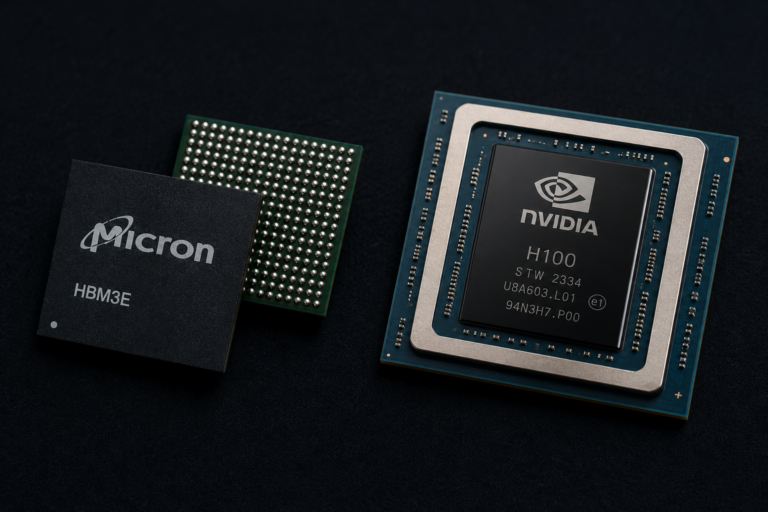
The chip that could make or break Wall Street’s confidence in artificial intelligence no longer lives inside a flashy graphics processor.

Increasingly, it sits inside a memory module, and it is made by a company that started life in a Boise, Idaho, dental office basement in 1978.

For most of its four-decade existence, Micron Technology was the kind of stock serious investors avoided.

Memory chips, dynamic random-access memory, or DRAM, and its derivatives were a commodity.

The business ran in brutal cycles: a shortage would lift prices and profits, manufacturers would race to add capacity, supply would overshoot demand, prices would collapse, and the cycle would repeat.

MU was a trade, not an investment. Wall Street treated it accordingly. That story is being rewritten at speed.

Over the past year, Micron’s shares have surged roughly 700%, with 200% of those gains arriving in 2026 alone.

Last month, the company crossed a $1 trillion market capitalisation for the first time.

Its latest quarterly earnings delivered a 346% surge in revenue and gross margins of 84.9% surpassing, remarkably, those of Nvidia.

And in a stretch when AI and technology stocks were nursing heavy losses after questions over bubble-territory valuations began circulating on Wall Street, it was Micron’s blowout results that steadied nerves and reignited confidence that the AI trade still has runway.

Two years ago, that role belonged to Nvidia.

The question investors are now asking is whether it has quietly passed the baton.

How Nvidia wrote the bellwether playbook

To understand what Micron may be becoming, it helps to understand what Nvidia became.

In November 2022, when OpenAI launched ChatGPT and set off the current AI frenzy, Nvidia’s graphics processing units, originally designed for computer games, found themselves identified as the workhorses for training AI models.

Demand exploded. Between its October 2022 low and June 2024, Nvidia’s shares surged approximately 1,100%.

By mid-2024, it had briefly become the world’s most valuable company, with a market capitalisation of $3.34 trillion, and had joined the select grouping of mega-cap technology companies known as the Magnificent Seven alongside Alphabet, Meta, and others.

But Nvidia’s significance went beyond its own price. It became a barometer.

Investors read Nvidia’s earnings reports the way they read blockbuster economic releases, not just for what they said about one company, but for what they implied about the pace and health of the entire AI buildout.

Even when Nvidia itself traded flat after reporting, its supply chain partners, Taiwan Semiconductor, SK Hynix, and ASML, would often move sharply in anticipation or in the immediate aftermath of its numbers.

“It’s not just a single stock,” Arun Sai, multi-asset portfolio manager at Pictet Asset Management, told the Financial Times last year.

“It’s very unusual for people to read through it to the economy as a whole.” That power has not vanished.

In its latest first-quarter results, Nvidia posted revenue of $81.6 billion, up 85% on the year, while net income more than tripled to $58.3 billion.

Those are not the numbers of a company in decline.

But its shares fell 1.6% in after-hours trading following the release.

The market has become accustomed to Nvidia delivering stellar figures and was pricing in something closer to perfection.

Year to date, Nvidia’s shares have risen a modest 3%.

Over the past 12 months, the gain is approximately 22%, a respectable figure for most companies, but underwhelming by the standards of what the market has come to expect.

The Nvidia era of market-moving earnings is not over; it has simply become less dramatic.

How scarcity of memory birthed the Micron of today

Micron’s rise as a new bellwether flows from a structural shift in what AI actually needs to run.

Modern AI systems require enormous amounts of data positioned directly alongside the processors crunching it.

That makes memory, specifically high-bandwidth memory, or HBM, one of the scarcest and most valuable components in an AI server.

Without enough of it, even the fastest GPU becomes a bottleneck.

As that realisation spread through 2025, Micron stopped being valued as a commodity memory producer and began being treated as a strategic supplier to the AI ecosystem.

Only three companies in the world can manufacture HBM at scale: Micron, South Korea’s Samsung, and SK Hynix.

That oligopoly, combined with the surge in AI-related demand, has produced something unfamiliar for the memory industry: sustained pricing power.

Micron’s gross margins in its latest quarter stood at 84.9%, up from 74.9% the prior period and from just 39% a year earlier.

The company expects the HBM market it serves to grow to approximately $100 billion by 2028.

Where large technology companies once faced what commentators called an “Nvidia tax”, paying a premium for indispensable chips, some now speak of a “Micron tax,” a memory toll that hyperscalers and AI infrastructure builders simply have to absorb.

Apple has been an example on that front after it had to raise the prices of its devices due to surging memory costs.

How Micron stabilised markets

The significance of Micron’s new role crystallised earlier this month.

Markets had been rattled by concerns that AI spending was outpacing any near-term revenue visibility.

SpaceX’s $25 billion bond sale, arriving so soon after its IPO, led investors to wonder if Wall Street might be entering AI bubble territory.

Ludovic Subran, chief investment officer of Germany’s Allianz, which manages €800 billion in assets, warned that markets may be shifting from “a healthy boom, a stretched boom into bubble territory.”

AI and technology stocks sold off sharply.

Then Micron reported that revenue surged 346% for the quarter.

Profit came in at $28.2 billion, almost 15 times the figure posted in the same quarter a year earlier.

The company blew past analyst expectations on every key metric, sending its stock nearly 16% higher in after-hours trading.

The results did not just lift Micron.

They stabilised the broader AI trade.

Investors took them as confirmation that the demand underpinning the entire AI infrastructure buildout, however stretched valuations may have remained real and accelerated.

A cautionary tale, and what Micron is doing about it

Nvidia’s trajectory does, however, offer a warning.

Its dominant position in AI chips, once a near-monopoly, is under pressure.

OpenAI has unveiled a custom AI chip developed with Broadcom.

Qualcomm has struck supply deals with Microsoft and Meta.

Competition is arriving from several directions simultaneously.

Micron’s shareholders would do well to hold that lesson in mind.

The more immediate risk is the one built into memory’s DNA.

Micron’s latest revenue surge was driven substantially by dramatically higher prices, margins of 85% compared to 38% a year ago, telling that story plainly.

Nvidia’s 85% revenue growth, by contrast, is not similarly dependent on elevated pricing.

As analyst David Jagielski of The Motley Fool has noted, if demand were to slow or if memory supply were to catch up with demand, Micron’s valuation, which has risen sharply over the past year, would face a steep correction.

Micron’s management is aware of the history and is attempting to break it.

The company is pursuing long-term supply contracts that lock customers in and reduce exposure to spot-market pricing swings.

CEO Sanjay Mehrotra has argued that the supply crunch is structurally different this time, as new semiconductor fabrication plants take years to build, and next-generation memory has become significantly more complex to manufacture, meaning capacity cannot be added quickly enough to produce the oversupply gluts of previous cycles.

To back that argument, Micron is investing approximately $200 billion in manufacturing and research and development, including new memory fabrication plants in Boise, Idaho, and Syracuse, New York.

Whether Micron can hold Nvidia’s former position as Wall Street’s preferred instrument for reading the AI boom will depend on whether those structural arguments prove correct.

For now, the market has decided that the most important number in AI is not measured in teraflops. It is measured in gigabytes.

The post From a dental office basement to a trillion dollars: Is Micron the next Nvidia? appeared first on Invezz


Shares of AI infrastructure developer TeraWulf WULF jumped more than 17% in premarket trading on Monday after Anthropic signed a 20-year lease for a large-scale data center in Kentucky.

The agreement is expected to generate approximately $19 billion in revenue over its initial term and further strengthens TeraWulf’s position as one of several former Bitcoin miners capitalizing on booming demand for AI computing capacity.

Under the agreement announced Monday, Anthropic will lease a data center located about an hour southwest of Louisville, Kentucky.

The facility is expected to provide roughly 400 megawatts of capacity, with first power delivery scheduled for the second half of 2027.

The campus will ramp to the full 401 MW by early 2028.

The deal represents one of the largest long-term AI infrastructure commitments announced this year and is expected to generate about $19 billion in revenue over the lease period.

Separately, TeraWulf said it had entered into a definitive agreement to sell its 50.1% ownership interest in the Abernathy Joint Venture to an investor group led by its joint venture partner, Fluidstack.

The company said the transaction monetizes its approximately $450 million investment at a premium to invested capital, freeing up additional funds for expansion of wholly owned AI infrastructure projects.

AI pivot gains momentum

TeraWulf has increasingly shifted its focus away from cryptocurrency mining as falling Bitcoin mining economics have encouraged miners to repurpose their power infrastructure for artificial intelligence and high-performance computing workloads.

The company’s shares have climbed more than 66% this year and over 340% during the past 12 months as investors have embraced that strategy.

Signs that the transition is beginning to pay off emerged in the company’s first-quarter earnings released in May.

High-performance computing leases generated $21 million in revenue during the quarter, comfortably ahead of Wall Street estimates of $18.6 million.

A year earlier, the company generated no AI lease revenue.

Overall quarterly revenue, however, edged lower to $34 million from $34.4 million a year ago, while TeraWulf reported a wider-than-expected loss of $1.01 per share, compared with a loss of 16 cents a year earlier.

Analysts had expected a loss of about 20 cents.

Analysts see further upside

Despite the earnings miss, encouraging numbers related to its HPC lease revenue have prompted several Wall Street firms to initiate bullish coverage in recent weeks.

Citi recently launched coverage with a Buy rating and a $36 price target, implying roughly 39% upside from Friday’s closing price.

According to CNBC, Citi analyst Michael Rollins believes TeraWulf remains well-positioned as demand for high-performance computing continues to outstrip available infrastructure.

“The challenge is that supply constraints for large-scale deployments are not immediately abating, as power transmission remains restrained in key metro markets and community resistance to data centers (aka NIMBY-ism) has picked up. TeraWulf is one of several companies that are addressing the potential bottleneck,” Rollins said.

Citi noted that while AI deployments remain in the early stages, TeraWulf is building a framework capable of developing between 250 MW and 500 MW of new data center capacity annually by converting industrial sites with existing grid access into hyperscale AI facilities.

Rollins acknowledged execution and funding risks, including the challenge of completing large projects on tight timelines, but argued that “the valuation still doesn’t reflect WULF’s multi-year growth opportunities.”

Other analysts have also turned positive on the stock.

BofA Securities initiated coverage last month with a Buy rating and a $34 price target, arguing that the company’s move from traditional Bitcoin mining into AI infrastructure positions it to benefit from accelerating demand for high-performance computing.

According to Investing.com, BofA analyst Michael Funk said the company is well placed within the rapidly expanding AI infrastructure market and highlighted upcoming catalysts including completion of the Lake Mariner project later this year and the expected announcement of a customer for the Kentucky campus.

Bernstein previously began coverage with an Outperform rating and a $46 price target, citing the company’s growing project pipeline and capital-light leasing model, while Citizens has reiterated a Market Outperform rating with a $32 target.

TeraWulf has also continued to strengthen its balance sheet to support its AI ambitions.

The company recently completed a $3.2 billion high-yield bond sale to finance expansion of its Lake Mariner campus in New York.

The financing is backed by Google as guarantor once the facility becomes operational, adding credibility to TeraWulf’s infrastructure platform.

The post TeraWulf stock surges as Anthropic signs $19B AI data center lease appeared first on Invezz

Micron stock price has plunged and entered a local bear market after falling by over 22% from its all-time high.

It slipped to $975 on Thursday, its lowest level since June 11, after a series of negative news. So, is this the start of a new downtrend or just an overreaction?

Micron stock dived after a series of negative news

MU stock price has pulled back sharply after some negative AI news. Major news came from Bloomberg, which reported that Meta Platforms was planning to sell its excess computing capacity.

This report implied a few things. For example, it could be a sign that its vast AI spending is not leading to strong revenue and profitability growth.

If this is the case, the company will likely slow its expansion, a major move since it is one of the top hyperscalers.

It could also mean that the company has identified a new business opportunity of building data centers and leasing the extra space. Such a move would be highly opportunistic and would possibly lead to more spending over time. 

SpaceX has perfected this business model and has inked several major deals recently. It will receive over $1.2 billion a month from Anthropic, $150 million from Reflection AI, and $925 million from Google. Meta may see a similar windfall over time.

Micron stock also sank after a group of PC makers launched a lawsuit accusing the company and its peers of price manipulation.

At the same time, Apple is putting pressure on the US government to allow it to buy memory from Chinese companies. 

Apple argues that such a move will help it maintain the same prices of its products instead of hiking.

Still, it is unclear whether it will receive this authorization as memory companies will likely boost their lobbying efforts. Some Senators, including Tom Cotton, have warned about such a move.

Micron’s fundamentals and valuation are attractive

On the positive side, Micron has the fundamentals that may help it continue doing well. For example, its recent earnings showed that its revenue jumped by over 300% in its third quarter, reaching over $40 billion. These are huge numbers considering that the company made over $37 billion in annual revenue last year.

The company also boosted its forward guidance and expects to make $50 billion in its fourth quarter.

Analysts predict that its annual revenue will reach over $129 billion this year, followed by $236 billion in the next financial year.

This growth has coincided with its strong margins, with the gross margin now exceeding 80%.

As such, one would expect such a company to trade at a premium. Instead, Micron trades at a forward PE multiple of 13.30, lower than the sector median of 24.

This multiple is likely because investors remember what happened in 2023 when its revenue dropped by more than half as memory prices plunged.

MU stock price technical analysis

Micron stock chart | Source: TradingView

Technicals suggest that the Micron stock price has some more downside to go. It peaked at $1,246 recently and formed a shooting star candlestick pattern. 

At the same time, the Relative Strength Index (RSI) has dived from the overbought level of 82 to the current 48. That is a sign that the stock has formed a bearish divergence pattern.

The stock is substantially higher than the 100-day moving average of $706.

Therefore, there is a risk that mean reversion will drive it lower in the near term. If this happens, the stock may drop to $800 and then resume the uptrend as the fear eases.

The post Micron stock has lost momentum on AI bubble fears: buy, sell, or hold? appeared first on Invezz

US stocks opened higher on Monday, with the S&P 500 and Nasdaq looking to extend last week’s rally.

Investors welcomed a rebound in semiconductor shares while preparing for the release of Federal Reserve meeting minutes and the start of the second-quarter earnings season later this week.

The Dow Jones Industrial Average gained 83 points as the blue-chip index closed at a record high before the Independence Day holiday, putting it within the reach of the 53,000 level for the first time.

The S&P 500 gained 0.48%, while the Nasdaq Composite advanced 0.87%.

The major indexes each gained around 2% last week, even as semiconductor stocks lost momentum.

Investors instead rotated into sectors such as healthcare, industrials and financials, supporting a broader market advance.

Chip stocks rebound after recent weakness

Technology shares led gains on Monday, with semiconductor and storage companies recovering after recent declines.

Broadcom rose 5.8% after the chipmaker and Apple agreed to expand their partnership through 2031 to develop and supply a range of custom chips.

Memory chipmakers also rallied, with Western Digital climbing 8.6%, Seagate advancing 5.7%, and Micron Technology gaining 1.7%.

The broader technology sector strengthened as well.

The Technology Select Sector SPDR ETF rose more than 1%, helped by a 5.22% gain in Teradyne, while Marvell Technology and Oracle rose more than 2.88% and 1.28%, respectively.

The rebound followed two consecutive weekly declines for the VanEck Semiconductor ETF, which fell 3.2% last week as investors trimmed exposure to chipmakers after their strong gains earlier this year.

Elsewhere, South Korean memory chipmaker SK Hynix is set to begin trading its US listing on Monday in a deal expected to raise about $28 billion.

SpaceX shares also edged 1.6% higher ahead of the company’s planned inclusion in the Nasdaq-100 on Tuesday.

Earnings season and Fed remain in focus

Investor attention is also turning toward the second-quarter earnings season, which begins to gather pace later this week.

Delta Air Lines and PepsiCo are among the companies scheduled to report results in the coming days.

According to LSEG data, S&P 500 companies are expected to post year-over-year earnings growth of 24.4% during the second quarter.

Markets are also awaiting the minutes from the Federal Reserve’s June meeting, the first chaired by Kevin Warsh, due for release on Wednesday.

Rate hike expectations eased following last week’s weaker-than-expected US jobs report.

According to CME FedWatch data, traders now see a 24% chance of a 25-basis-point rate increase at the Fed’s July meeting, down from about 30% a week earlier. Expectations for a September rate hike have also eased.

Fed Governor Christopher Waller is also scheduled to speak later on Monday, while investors will monitor the latest ISM services survey, which is expected to show only a modest easing in activity to a still-expansionary reading of 54.0.

Global markets mixed as investors assess outlook

Outside the United States, trading was more subdued.

Europe’s STOXX 600 slipped 0.5%, while Asia-Pacific markets finished mixed. Japan’s Nikkei 225 ended little changed and the broader Topix rose 0.92%. South Korea’s Kospi fell 0.46%, while the Kosdaq declined 2.46%.

Australia’s S&P/ASX 200 slipped 0.15%, China’s CSI 300 finished flat, and Hong Kong’s Hang Seng traded 0.81% higher.

The mixed global performance reflected cautious positioning as investors balanced expectations for corporate earnings, monetary policy and continued sector rotation following Wall Street’s strong performance last week.

The post Dow rises 80 points as chip stocks rebound ahead of Fed minutes, earnings season appeared first on Invezz

Sandisk stock price has suffered a harsh reversal recently as the recent bull run hits a wall. SNDK dropped by 14% on Friday, reaching its lowest level since June 11. It has now slumped by 25% this year, even as top Wall Street analysts have maintained their bullish outlook.

Top analysts are bullish on Sandisk stock

Sandisk stock has done well in the past 18 months, making it the best gainer in the S&P 500 Index. It jumped by 4,000% in the last 12 months, with its market capitalization crossing the $300 billion mark.

Despite these gains, analysts are highly bullish on the stock, with most of them hiking their forecasts. In a recent note, Bernstein hiked its target from $2,100 to $2,500, citing the strong demand for memory products after the robust Micron earnings.

Bank of America hiked its target from $1,700 to $3,400, noting that its multi-year contracts were helping it avoid the cyclical issues that have affected the industry in the past. With SNDK trading at $1,745, a surge to $3,000 implies a 71% jump. 

Citigroup has also hiked the target price from $2,025 to $2,500, while Cantor Fitzgerald boosted from $1,800 to $2,900. Other companies that have hiked their targets are Mizuho and Morgan Stanley.

Sandisk’s growth to continue but risks remain

There is a possibility that Sandisk’s revenue growth will accelerate in the coming months as memory prices rise. A recent report showed that DRAM and NAND contract prices rose by 18% and 15% in the second quarter, respectively. While this was a strong growth, it was lower than the 60% experienced in Q1.

Sandisk primarily sells memory equipment like SSDs, memory cards, and USB flash drives. Yet, the cooling DRAM and NAND prices mean that its business too may be affected.

Data shows that analysts are predicting that its revenue jumped by 335% in the last quarter to $8.29 billion. For the year, the revenue is expected to grow by 168% to $19 billion, followed by 141% to $47 billion. These are strong numbers for a company that was spun out by Western Digital last year.

READ MORE: Sandisk stock is firing on all cylinders: is a day of reckoning coming?

The risk, however, is that the soaring memory prices may lead to overproduction, which will affect the global supply. Historically, the memory industry has experienced such periods of strong growth followed by slumps.

On the positive side for Sandisk, its stock is not highly overvalued. Ideally, you would expect a high-margin company growing by triple digits to have high price-to-earnings multiples. In its case, it trades at a forward PE ratio of 26, slightly higher than S&P 500 Index’s 22.

The challenge for Sandisk is that any sign that memory prices are cooling will have a negative impact on its stock. 

Sandisk stock faces technical risks

SNDK stock chart | Source: TradingView

The other risk facing SNDK stock is that its technicals have worsened recently, a sign that it has moved to the distribution phase of the Wyckoff Theory. This phase is then followed by the markdown stage.

The stock’s Relative Strength Index (RSI) has formed a bearish divergence pattern, moving from a high of 81 to 46 today. It also remains much higher than the 100-day moving average, which is at $1,285.

The bearish divergence and a potential mean reversion may push it lower in the near term. On the other hand, a move above the key resistance at $2,360 will invalidate the bearish outlook.

The post Sandisk stock forms a bearish divergence, enters a risky Wyckoff phase appeared first on Invezz

Broadcom Inc. AVGO shares rose 5.3% in trading on Monday after the semiconductor company announced an extension of its long-standing partnership with Apple Inc. through 2031.

The agreement reinforces Broadcom’s position as one of the iPhone maker’s key chip suppliers.

The new multi-year agreement expands the companies’ collaboration on custom silicon products and provides Broadcom with long-term revenue visibility from one of its largest customers.

Apple accounts for about 20% of Broadcom’s annual revenue, according to analysts, making the partnership strategically important for the chipmaker.

Broadcom secures long-term Apple partnership

Broadcom said it has agreed to expand its partnership with Apple through 2031 to develop and supply custom chips, easing concerns over the iPhone maker’s reliance on the semiconductor company.

According to Broadcom’s recent SEC filing:

“Broadcom Inc. (“Broadcom”) and Apple Inc. (“Apple”) have agreed to expand their long-standing technology collaboration through 2031 by entering into new multi-year long-term agreements for Broadcom to develop and supply a range of custom ASIC silicon products for use in multiple generations of Apple products.”

The agreement covers a range of custom silicon products that will be used across multiple generations of Apple devices.

Financial terms of the extension were not disclosed.

Broadcom has supplied Apple with key components for years, including radio frequency chips that enable iPhones to connect to cellular networks, Wi-Fi and Bluetooth connectivity chips, and other networking semiconductors.

Although Apple has developed several in-house chips, including its C1 modem, it continues to rely on Broadcom for wireless and radio-frequency components.

The companies had previously announced a multibillion-dollar agreement in 2023 for Broadcom to develop and manufacture 5G radio frequency components.

The latest extension builds on that relationship and secures Broadcom’s role in Apple’s supply chain through the end of the decade.

Apple navigates chip supply challenges

The extended partnership aligns with Apple’s strategy of securing long-term supply agreements with key semiconductor companies to strengthen the resilience of its supply chain.

Apple relies on Taiwan’s TSMC, the world’s largest contract chipmaker, to manufacture its in-house processors, including the M-series chips used in Mac computers and the A-series processors that power iPhones.

Demand for advanced chips has intensified as artificial intelligence adoption accelerates.

The growth of AI inference—the process by which models respond to user queries—has increased demand for custom chips and advanced processors, creating greater competition for manufacturing capacity.

TSMC has faced heavy demand from AI chipmakers such as Nvidia. Apple Chief Executive Tim Cook said in April that these capacity constraints had affected iPhone sales.

Apple is also in discussions with Intel to manufacture some chips in the United States, although analysts have said volume production is unlikely before late 2027.

AI demand drives semiconductor market

The broader semiconductor industry has experienced rising component costs as AI infrastructure spending continues to expand.

Prices for memory and storage chips have climbed sharply in recent months, driven by increasing demand from AI hyperscalers.

Apple raised prices for its MacBooks and iPads in June after memory chip costs surged as much as 98% during the first half of 2026.

Beyond its relationship with Apple, Broadcom has been expanding its presence in the artificial intelligence market by developing AI-specific chips for other major technology companies, including Alphabet and Meta Platforms.

The post Broadcom extends Apple chip partnership through 2031, stock climbs 5% appeared first on Invezz

The satirical news site The Onion isn’t waiting to take possession of Infowars to launch a parody of Alex Jones ’ conspiracy platform.

More than a year after first trying to buy Infowars, The Onion on Thursday will debut a send-up under its own website with plans to give some of the revenue to families of the victims in the Sandy Hook Elementary School shooting.

The families have still received no money from Jones since courts ordered him to pay more than $1 billion for falsely calling the 2012 shooting a hoax.

The Onion will start by sending the families $100,000 from merchandise sales that combine the conspiracy empire’s brand with the The Onion’s logo in rainbow colors, according to CEO Ben Collins, whose company is still in court trying to take control of Infowars.

“Don’t give comedy writers a grudge for 18 months,” Collins said.

The parody will include a series of shows and other content under Infowars branding that spoof Jones’ aggressive mashup of conspiracies linking major news events, dubious scientific claims, attacks on people suffering in tragedies and sales of supplements and survival gear.

Alex Jones in Houston in 2024.David J. Phillip / AP file

Jones’ claims that the 2012 shooting that killed 20 first graders and six adults at Sandy Hook Elementary School in Connecticut is a hoax have no truth, but Jones continued to amplify them. His followers started to harass victims’ families, suggesting they were “crisis actors” and even making death threats.

Jones’ Infowars empire had 10 million visitors a month and generated more than $50 million in annual revenues at its peak, according to the company. But the $1.4 billion judgments in defamation cases in Connecticut and Texas, where Jones is based, forced him into bankruptcy and broke Infowars apart.

“All he’s been left with is an iPhone and a fancy microphone,” said Chris Mattei, an attorney for nine of the Sandy Hook families.

Jones has moved his show to a different website. An email sent to an address to request interviews went unanswered.

The families knew they could never stop Jones from getting his message out, and he has managed to avoid paying the judgment so far. But they could expose what he said and assure he can never profit again, Mattei said.

“Every dime Alex Jones makes from here until the end of eternity is going to be claimed by the families,” Mattei said.

The Onion stepped in when Collins saw Infowars’ assets were going to be sold at auction.

Collins spoke to Sandy Hook families, who said they were briefly skeptical, but then saw how The Onion’s staff could use the Infowars style and branding to take the moral high ground and make fun of the people who not only caused them so much pain but they felt also poisoned society.

Collins didn’t want to give away too much of the new stuff before it goes live Thursday.

But the new Infowars will maintain The Onion’s sharp satire sprinkled with shock value. Collins said there will be a section selling a penis flattening device, a fake “pro oxygen” supplement pill that the host claims can replace breathing, as well as an extended debate on how many Bozo the Clowns there are.

“It’s old-fashioned Infowars — using the tricks that they use to get people addicted to outrage and, I would say, addicted to anticipation, trying to find the thing that’s around the corner that’s going to save your life,” Collins said.

The Onion will keep chasing Jones’ property. Collins thinks they will soon get control of the Austin, Texas, studio Infowars once used.

Some families can’t wait for that day. Collins said that Robbie Parker, whose daughter died at Sandy Hook, plans to read his book about fighting Jones while dealing with so much grief in the place Jones once sat.

The families at first wanted Infowars shut down forever and Jones never heard from again. But they are now looking forward to seeing what The Onion has planned, attorney Mattei said.

“The idea that it could be turned to some social good. I think it’s even better,” Mattei said. “So, yeah, I think the families are both pleased and amused with what they’ve been able to achieve here.”