Archive

June 30, 2026

Browsing

Britain’s competition regulator on Tuesday proposed measures that would allow app developers to direct users to alternative payment options outside Apple and Google app stores.

The move is aimed at reducing fees for developers and promoting greater competition in the digital marketplace.

CMA seeks to remove payment restrictions

The UK Competition and Markets Authority (CMA) said its proposals would remove existing barriers that prevent developers from guiding users to off-platform payment methods.

According to the regulator, Apple currently prohibits developers from directing users to external payment options.

Google allows the practice only under limited conditions.

The CMA said removing these restrictions would give developers greater flexibility in how they process payments and could increase competition within the app ecosystem.

Lower fees are proposed for external payments

The regulator also outlined its expectations if Apple or Google decides to charge developers for enabling links to alternative payment platforms.

According to the CMA, any such fees should be reasonable and significantly lower than the commissions currently charged through their respective app stores.

The regulator added that these charges should ultimately benefit consumers or encourage further innovation within the app economy.

The proposal is intended to ensure that developers are not discouraged from offering alternative payment options because of high costs.

NFC access under consideration

In addition to payment-related changes, the CMA is considering a proposal that would require Apple to provide broader access to its near-field communication (NFC) technology.

If implemented, the measure would allow developers to integrate contactless payment functionality directly into their own iOS applications.

The proposal could reduce developers’ reliance on Apple’s existing payment system by enabling them to offer their own contactless payment services.

Google says recent policy changes address proposals

In an emailed statement to Reuters, Google said it has already implemented many of the changes proposed by the regulator.

The company said revised Google Play Store policies introduced earlier this month now allow developers to direct users to complete purchases outside the platform, although certain conditions continue to apply.

Google also said it has updated its app store fee structure as part of those policy changes.

Earlier this year, Britain’s Competition and Markets Authority (CMA) secured commitments from Apple and Google to make their mobile app stores fairer and more transparent for developers as part of the UK’s strengthened oversight of dominant digital platforms.

Under the agreement, Apple and Google pledged to ensure app review processes are fair, objective, and transparent, while giving developers clearer guidance on approval decisions and improved channels to raise concerns.

The CMA said the measures are intended to reduce uncertainty for developers and promote competition in a market where Apple’s iOS and Google’s Android operating systems dominate app distribution and mobile browsing.

The post UK regulator tightens focus on Apple and Google's app store ecosystem appeared first on Invezz

Magnificent 7 stocks have retreated sharply this year and erased over $2.3 trillion in value. The closely-watched Roundhill Magnificent 7 ETF (MAGS) dropped to $60.80 from the year-to-date high of $71.17. 

Most companies in the group have dived in the past few months. Nvidia, the world’s largest company, has dropped by nearly 20% from its year-to-date high.

Similarly, Microsoft stock has dived by 33%, while Meta Platforms, Amazon, and Tesla have fallen by 30%, 14%, and 16%, respectively from their highest levels this year. Apple has also dropped modestly from its year-to-date high, down from $317 to $280 today.

Profit-taking and rotation to memory companies

One possible reason behind the ongoing Magnificent 7 stocks retreat is that investors are taking profit after their surge. At its peak this year, Apple was up by over 150% from its lowest level in 2023. Nvidia was up by 43% from the lowest level last year. 

Most notably, these stocks are retreating because of the sector rotation towards companies in the memory industry. A closer look at data shows that memory companies are among the top gainers this year. This includes companies like Micron, Sandisk, Western Digital, and Seagate. Most recently, the Roundhill Memory ETF (DRAM) has accumulated over $24 billion in assets since its launch in April.

The companies have done well amid the ongoing supply shortage that has pushed their prices to the highest level on record. As a result, hyperscalers, who are their biggest clients, are having to spend billions of dollars more. 

For example, the top hyperscalers are planning to spend over $750 billion in capital expenditures this year, much higher than what they spent last year. This surge is driven by both new data center launches and soaring memory prices.

Just last week, Apple made headlines last week when it said that it would hike prices of its MacBooks because of higher prices. It is also considering hiking iPhone prices. 

ROI on data center spending

Some Magnificent 7 stocks are also falling amid fears of return on investment (RoI) as they boost their data center spending. The most affected companies in this are the top hyperscalers like Microsoft, Meta, and Google.

At the same time, they have now started raising capital in highly dilutive ways to fund their ambitions. For example, Google recently raised over $80 billion in a combination of debt and equity, diluting its shareholders. 

Meta Platforms is considering such a move, while Nvidia recently raised over $25 billion in debt. Tesla has already warned that it will not generate positive cash flows this year because of its Terafab 

Therefore, some analysts are worried about whether they will achieve the return on investment any time soon. 

Still, on the positive side, these companies have now become bargains. For example, data shows that Nvidia is trading at a forward price-to-earnings (PE) multiple of 22, slightly lower than the S&P 500 Index’s 23. Meta Platform’s forward PE ratio has dropped to 16, while Google’s multiple has fallen to 23. 

Therefore, since these are some of the most profitable companies in the world, there is a likelihood that investors will rotate to these companies, potentially after the next earnings season.

The post Here’s why the Magnificent 7 stocks have crashed and erased $2.3 trillion appeared first on Invezz

The recent US Supreme Court ruling on IEEPA tariffs has created a potentially significant refund opportunity for exporters worldwide, including those in India.

While headline estimates suggest billions of dollars in duties could be reclaimed, the reality is far more complex, with eligibility hinging on shipping terms, importer status, and a multi-layered filing process.

For Indian exporters—particularly SMEs already strained by months of tariff uncertainty—the ruling raises both opportunities and challenges.

In this interview with Invezz, Ishita Chawla, Lead, E-Commerce Vertical at Skydo, explains the true scale of the opportunity, the practical hurdles exporters face, and how shifting US trade policies continue to reshape export strategies.

Invezz: The US Supreme Court ruling has opened up what could be a massive refund opportunity globally. How large do you estimate the opportunity is specifically for Indian exporters, and which sectors are most exposed?

The headline number is $166 billion globally, and GTRI estimates India’s linked share at roughly $12 billion. But that figure overstates what Indian exporters can actually claim.

The $12 billion represents total IEEPA duties paid on Indian-origin goods.

However, only DDP shipments, where the Indian exporter paid the US customs duty themselves and is the Importer of Record, are eligible. Our rough estimate based on shipping volumes puts the realistic DDP-eligible pool at closer to $150 million. 

In terms of sectors, textiles and apparel, gems and jewellery, leather and footwear, marine products, chemicals, and automobile components collectively make up over 55% of India’s exports to the US, placing them as most exposed. 

Invezz: Many exporters may not even realize they are eligible for refunds. What are the biggest misconceptions or gaps in awareness you are seeing right now?

The biggest challenge is a basic uncertainty around eligibility. Many Indian exporters who shipped on DDP terms cannot confirm whether they are the Importer of Record on their shipments without checking their CBP entry summary document. 

Those who do confirm they’re the IOR face difficulties with the process itself: the CAPE portal requires ACE access, structured CSV uploads, and validation against CBP records, which is considerably more involved than a simple online form many expect. 

Lastly, exporters who find out they’re not the IOR – and that the designation sits with their US buyer or freight partner – face a harder problem altogether.

The refund is legally disbursed to the IOR, not the exporter, leaving them reliant on commercial negotiation with a party under no obligation to pass the money back. 

Invezz: How complicated is the CAPE filing process in practice? What are the most common mistakes exporters could make that may delay or jeopardize claims?

More involved than most exporters expect. Filers must upload a structured CSV of entry numbers through the ACE portal, which runs two rounds of validation – first on the declaration, then on each individual entry.

A common cause of rejection is formatting. But the complications start well before filing. 

Exporters need to locate their CBP Form 5106, which was filed when they first imported into the US – often years ago – and many don’t have it readily accessible.

The email address on that form matters: CBP sends an OTP to the email listed on the 5106, so if details don’t match or the address is outdated, the process stalls. 

Then there’s identifying which specific shipments had IEEPA duty codes applied – this is a largely manual exercise of going through entry summaries to isolate the relevant ones.

Beyond that, some filers discover that their original entry summaries were filed incorrectly during the tariff period, meaning the recalculated refund amount doesn’t match expectations.

Further, Indian exporters need a US bank account to receive the ACH refund, which most don’t have.

Invezz: One major hurdle appears to be the Importer of Record requirement. How difficult is coordination between exporters, freight partners, and US import entities proving to be?

Many Indian exporters don’t have their IOR documentation readily accessible – the CBP Form 5106, EIN, and copies of import entries typically sit with their freight forwarder, not with them.

If unsure, exporters should check their customs entry summary document: if their company name appears as the importer in field no. 26, they are the IOR. 

For exporters who shipped dozens of consignments over the April 2025 – February 2026 window across multiple logistics partners, simply compiling the paperwork is an operational burden.

The problem is worse when the freight partner is itself the IOR, which disqualifies the exporter entirely but often isn’t clear until the documents are pulled.

Larger exporters with their own customs bonds and clean records move through this relatively more smoothly. 

Invezz: A lot of Indian SMEs operate with thin margins and limited compliance bandwidth. How financially painful were these tariffs for smaller exporters over the last year?

For SMEs that export to the US, the pain was disproportionate. Most operate on thin margins with limited working capital – a 26% tariff compresses those margins severely, and the escalation to 50% in August 2025 made many product categories uncompetitive overnight. 

The practical response for most was simply to stop shipping to the US during the high-tariff window, which meant lost revenue with no immediate alternative.

The refund process now adds a second layer of difficulty: per-exporter refund amounts for smaller shippers are modest, but the filing costs and documentation burden are essentially fixed regardless of claim size. 

Invezz: The broader issue here is policy unpredictability. How much damage has the stop-start nature of US trade policy caused to exporter confidence, pricing strategies, and long-term planning?

The rate on Indian goods changed five times in ten months: 26% in April 2025, 50% in August, 18% under the interim deal in November, zero when IEEPA was struck down in February 2026, then 10% under Section 122 the same week.

Export contracts are typically negotiated 3-6 months ahead – every contract signed during this period was mispriced in one direction or the other. 

The Section 122 replacement tariff expires around July 24, 2026, and is already being challenged by 24 US states, meaning exporters are pricing contracts today without knowing what the rate will be a month from now.

The damage goes beyond margins: long-term buyer-supplier relationships that took years to build were strained or broken as US buyers shifted sourcing away from India to Vietnam, Bangladesh, and Mexico during the high-tariff window.

Some of those relationships won’t come back even with tariffs reduced.

Invezz: The portal launched April 20. What are the known gaps in Phase 1, and what risks do exporters face if guidelines continue to evolve mid-filing?

The CAPE refund system launched on April 20 and is being rolled out in phases. Phase 1 — which covers the most straightforward entries is operational and has processed roughly $24 billion in approved refunds as of early June.

But that’s only a fraction of the $166 billion total. Phase 2 (covering more complex entry types) launches June 29, and Phase 3 is targeted for late July.

The core risk is that the US government is actively contesting how broadly refunds should be issued – particularly for older entries that have already been finalised in the customs system.

Depending on how that legal challenge plays out, some categories of entries may face significant delays or may require the importer to file an individual lawsuit to access their refund.

For Indian exporters, the practical takeaway is straightforward: file early on entries that are clearly eligible under Phase 1, but recognise that the process is still being built and the rules governing later phases are not yet settled.

Invezz: Have exporters become more cautious about relying heavily on the US market after the tariff episode, or do most still see America as indispensable despite the volatility?

Both. Indian exporters have diversified aggressively – seafood exports to Vietnam doubled, non-US markets are gaining share across textiles and engineering goods, and some larger companies have opened US-based manufacturing to sidestep tariffs entirely.

But the US still accounts for roughly 18% of India’s total exports, and for sectors like electronics (38% of exports), gems and jewellery (33%), and textiles (28-34%), there is no single replacement market of equivalent scale.

The more accurate picture is that exporters now treat the US as a high-return but high-volatility market rather than a stable baseline.

The largest ones are hedging through onshore US production. Mid-tier exporters are maintaining US relationships while building parallel channels to Europe, the Middle East, and Southeast Asia.

The smallest remain the most exposed, lacking the scale to diversify meaningfully or the compliance bandwidth to navigate rapid policy shifts.

The post Interview: Skydo's Ishita Chawla explains the hurdles of claiming US tariff refunds appeared first on Invezz

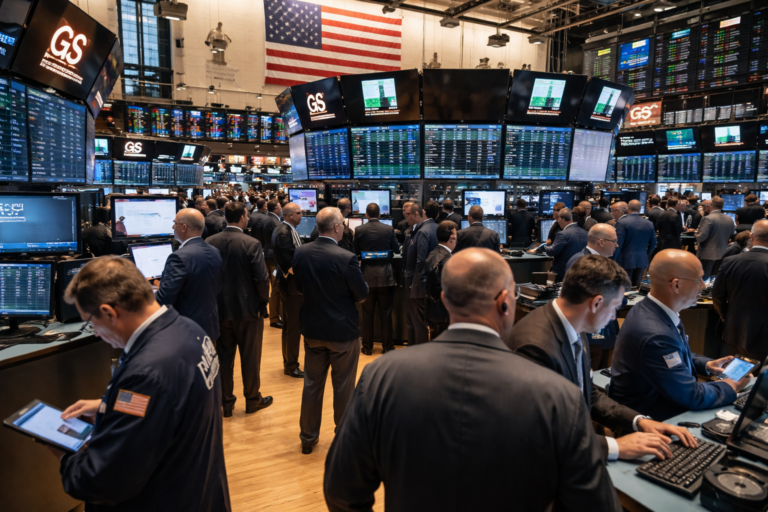
Wall Street opened little changed on Tuesday as investors entered the final trading session of the quarter.

Markets remained on track to wrap up one of their strongest quarterly performances in years despite lingering geopolitical tensions and concerns over artificial intelligence spending.

The Dow Jones Industrial Average was down 101 points while the S&P 500 was nearly flat with a 0.01% gain and the Nasdaq Composite was up by 0.27%.

Investors were also preparing for a series of key economic releases later in the day, including the JOLTS job openings report and the Conference Board’s consumer confidence index.

Market participants will also monitor comments from Federal Reserve Chair Kevin Warsh at a high-profile economic conference in Portugal.

Stocks poised for best quarter in years

Despite recent volatility, US equities remained on track to post their strongest quarterly gains in several years.

The S&P 500 and Nasdaq Composite were set for their best quarterly performances in six years, while the blue-chip Dow Jones Industrial Average was headed for its biggest quarterly gain since 2022.

The first half of the year has also been strong overall.

The Dow has climbed 8.6%, putting it on pace for its best first-half performance since 2021.

The S&P 500 has gained more than 8%, while the Nasdaq has advanced 11.1%.

The small-cap Russell 2000 has surged more than 21%, positioning it for its strongest first half since 1991.

The second quarter has been particularly robust.

The S&P 500 and Nasdaq were on track to rise about 14% and 19.6%, respectively, marking their biggest quarterly gains since the second quarter of 2020.

The Dow has climbed 12.6% during the quarter, its strongest performance since the fourth quarter of 2022.

Markets have remained resilient despite a challenging backdrop that included geopolitical tensions, an oil price shock, and questions about the sustainability of AI-related spending.

However, recent weakness has left the S&P 500 and Nasdaq on course to snap their two-month winning streaks in June, while the Dow is poised to record a third consecutive monthly gain.

Oil, AI concerns and Fed outlook stay in focus

Oil prices edged higher on Tuesday, with US West Texas Intermediate crude trading around $71 per barrel and Brent crude near $73 per barrel, as uncertainty surrounding the Middle East conflict continued to influence sentiment.

Monday’s rally came after the United States and Iran agreed to halt attacks and allow commercial vessels to move freely through the Strait of Hormuz, boosting investor confidence.

The S&P 500 gained 1.18% and the Nasdaq Composite rose 2.07% during the previous session.

Some market observers cautioned that further gains in the second half of the year may depend on progress in negotiations aimed at ending the US-Iran conflict.

Meanwhile, traders are pricing in at least one Federal Reserve rate hike by the end of 2026, according to LSEG data.

Market movers reflect mixed sentiments

Among individual stocks, customer experience company Concentrix plunged 18% in trading after lowering its full-year revenue and adjusted profit forecasts.

Defense technology company AeroVironment jumped 19% after reporting a sharp increase in quarterly revenue.

Financial stocks also came under pressure after Oppenheimer downgraded several major Wall Street investment banks.

Morgan Stanley fell 1.2% and Goldman Sachs declined 1.24% in trading after being downgraded to “underperform” from “perform.”

Bank of America and Citigroup also slipped 1.6% after their ratings were lowered to “perform” from “outperform.”

The post Dow slips 100 points as Wall Street looks to wrap up a standout quarter appeared first on Invezz

Investors ended June on an uneasy note as concerns over the sustainability of the artificial intelligence boom, elevated interest rates and fears of rising inflation sparked sharp swings across US equities.

But while the recent pullback dented sentiment, several strategists believe July could mark the beginning of a fresh leg higher for stocks, supported by strong seasonal trends, robust corporate earnings, delayed AI listings and renewed investment flows.

The benchmark S&P 500 has still gained more than 8% so far this year, while the technology-heavy Nasdaq Composite has advanced about 11%, extending a bull market that has lasted more than three years.

Despite the recent turbulence, analysts say the backdrop entering July appears considerably more supportive.

Wells Fargo bets on a strong July rally

Wells Fargo is among the most optimistic voices heading into the new month, arguing that July has historically been one of the strongest periods for US equities and that several additional catalysts could reinforce that pattern this year.

In a strategy note led by Ohsung Kwon, the bank described a “strong summer rally ahead,” pointing to seasonality, improving investor positioning, expected earnings growth, fresh inflows from so-called Trump accounts and delays to major artificial intelligence-related public offerings.

The bank expects investor sentiment to reset after June’s volatility, which it largely attributes to quarter-end portfolio rebalancing.

It also expects uncertainty surrounding the US midterm elections later this year to become a bigger market factor only in September.

According to Wells Fargo, the first half of July has produced the strongest seasonal performance of any comparable period over the past century, with the S&P 500 delivering an average return of 1.35%.

The bank also noted that its proprietary investor sentiment indicator has returned to neutral territory after triggering a sell signal in May.

Quantitative investment funds, which suffered losses during the final week of June, are also entering July with far more neutral positioning than before the recent selloff, potentially creating room for renewed buying.

Reflecting its optimism, Wells Fargo raised its year-end target for the S&P 500 to 7,950 from 7,300 two weeks ago.

Recent pullback driven by AI spending concerns

Much of June’s weakness centred on the technology sector, particularly the so-called Magnificent Seven stocks that have powered markets higher over the past two years.

Matthew Timpane, senior market strategist at Schaeffer’s Research, said the broader market had remained relatively resilient despite pressure on the largest technology companies.

“I think June has held up relatively well despite pressure from the Magnificent 7, especially as both the dollar and yields moved higher this month,” he said.

Timpane noted that the US dollar had broken out of a year-long trading range before retreating from its May 2025 highs, while Treasury yields also remained elevated.

According to Schaeffer’s data, the Roundhill Magnificent Seven ETF has declined roughly 12.7% over the past month.

“Traders and investors do not appear to be in love with the large hyperscalers right now, as they continue to spend aggressively on AI capex. In some cases, these companies are even willing to issue debt and equity in size to continue the AI buildout,” Timpane said.

Even so, historical trends suggest the weakness may not persist.

Schaeffer’s analysis shows July has generated positive returns 80% of the time over the past two decades, with average gains of 2.67%.

Over the last 10 years, July has delivered positive returns every year, averaging gains of 3.51%.

Timpane said investors should continue monitoring the US dollar and Treasury yields closely.

“If July’s bullish seasonality is going to play out, we want to see the dollar remain contained. Likewise, we want to see rates fall,” he said.

AI IPO delays could extend the technology cycle

One of the more surprising bullish arguments comes from the delayed public listings of several high-profile AI companies.

Recent reports suggesting that OpenAI and Anthropic may postpone their public market debuts have weighed on sentiment across the technology sector, with investors initially viewing the delays as a sign of weakening market conditions.

Wells Fargo, however, argues the opposite.

The bank believes postponing these listings reduces new equity supply, providing support for existing technology shares.

It also argues that delayed IPOs could have a second-order benefit for the broader AI ecosystem.

According to Wells Fargo, companies preparing for public listings had been under pressure to improve profitability by raising token prices charged to enterprise customers using their AI models.

If IPOs are delayed, that pressure could ease, allowing token prices to remain lower.

Lower pricing could stimulate demand for computing power, ultimately extending the AI investment cycle rather than shortening it.

“Buy the AI dip: IPO delays are bullish,” Wells Fargo said.

Earnings and fund flows could provide additional support

Analysts also expect corporate earnings to provide another catalyst for equities during July.

Wells Fargo projects second-quarter earnings per share growth of 22% year over year, accelerating from the 19% growth recorded during the first quarter.

The bank expects part of that improvement to come from tariff refunds issued to companies.

It estimates approximately $36 billion has already been distributed, with another $90 billion potentially still to come.

Consumer staples and industrial companies are expected to be among the biggest beneficiaries, with many businesses indicating that potential refunds have not yet been incorporated into earnings guidance, leaving room for upside surprises.

Fresh investment flows may also support markets.

Wells Fargo estimates newly created “Trump accounts” for qualifying children could generate roughly $20 billion of price-insensitive buying concentrated in large-cap US equities.

Although the amount represents only a small fraction of annual retirement account inflows, the bank argues these accounts could have an outsized impact because they are expected to invest primarily in US stocks rather than diversified portfolios.

After a volatile finish to June, analysts believe these combined forces could help shift investor attention away from recent concerns over AI spending and toward the stronger seasonal backdrop that has historically favoured US equities in July.

The post July stock market outlook: Analysts see strong rally after AI-driven June volatility appeared first on Invezz

Digital Realty stock (NYSE: DLR) fell about 5% in premarket trading on Tuesday after the data-centre landlord announced a $3.5 billion deal to buy out Blackstone’s interests in three Northern Virginia assets.

At first glance, the reaction looks expected as the transaction is large, part-funded with stock, and comes after several other capital moves.

But the selloff also raises a fair question: is the market focusing too much on near-term dilution and not enough on the quality of what Digital Realty is buying?

Digital Realty stock: Deal that spooked investors

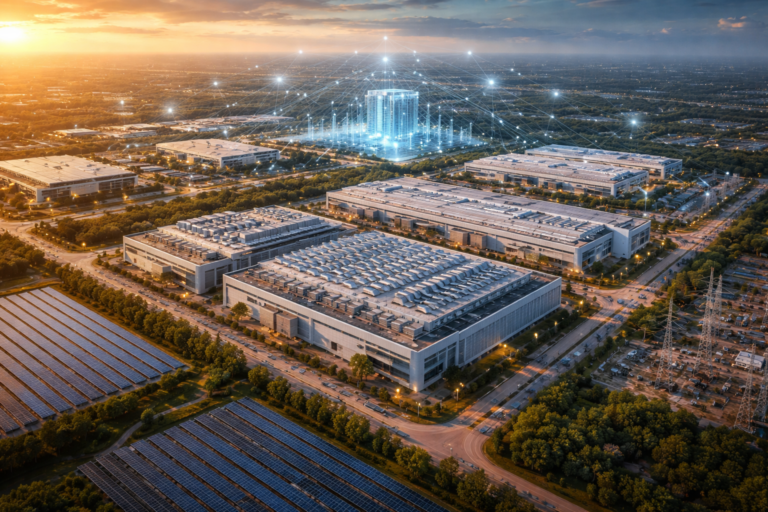
Digital Realty is paying $3.5 billion to acquire Blackstone’s blended 64% equity interest in three hyperscale data centres in Northern Virginia.

The consideration includes $1.2 billion in cash and $2.3 billion in Digital Realty shares. The assets have a gross value of $7.8 billion, including debt and remaining development capital expenditure.

The properties include Blackstone’s 80% interest in two 96-megawatt data centres in Manassas, Virginia, and its 50% interest in a 96-megawatt facility in Sterling.

The investors clearly didn’t like the move and the obvious reason is dilution.

Paying $2.3 billion in stock means more shares in circulation, which can weigh on per-share metrics in the short term.

The $1.2 billion cash component also adds to investor concerns about capital intensity at a time when data-centre development is already expensive.

The timing is also a factor as Digital Realty recently raised about $1.2 billion through an at-the-market share sale and bought roughly 1,440 acres near Kansas City for future hyperscale development.

The company is also increasing its stake in Teraco and buying Columbia Capital.

Why the fundamentals tell a different story

The assets themselves look strong as the three data centres are fully leased to investment-grade hyperscale customers under 15-year leases.

They carry a blended average customer credit rating of AA- and include 3.6% annual rent escalators.

That is valuable in the data-centre world. Long leases with high-quality customers can provide predictable cash flow, while built-in rent increases help protect returns over time.

The analysts noted that the deal also carries an initial stabilised cap rate above 6.5%. For fully leased hyperscale assets in Northern Virginia, that is not a weak number.

If cap rates continue to compress because AI and cloud demand remain strong, Digital Realty may be buying into a very attractive long-term cash-flow stream.

“This transaction is expected to be accretive to Core FFO per share in each of 2027 and 2028, as development is completed and rents commence,” Digital Realty CFO Matt Mercier said.

That is the key line for investors. The deal may pressure the stock today because of dilution and funding concerns, but the company expects it to add to core funds from operations per share once the assets stabilise.

Greg Wright, Digital Realty’s chief investment officer, also framed the acquisition as the next stage of an existing Blackstone partnership, saying it allows the company to increase ownership in “fully leased, high-quality hyperscale assets.”

The post Digital Realty stock drops 4%, but here's why market may be wrong appeared first on Invezz

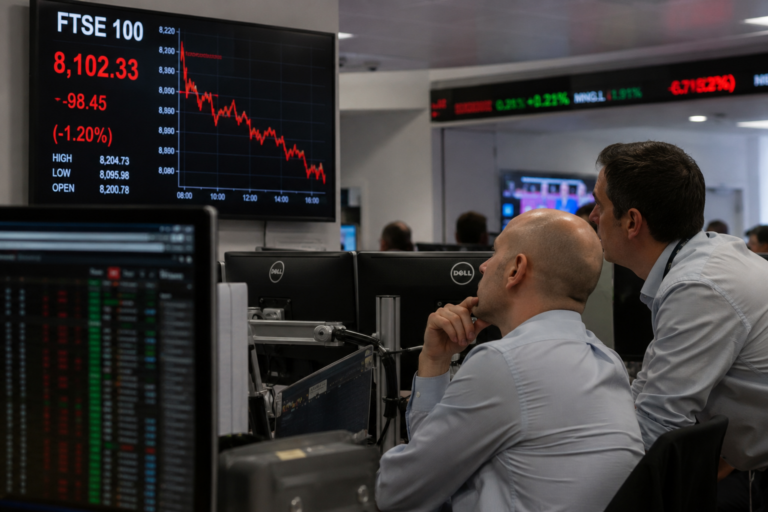
The UK’s benchmark FTSE 100 index edged higher on Tuesday, supported by gains in industrial mining, and financial stocks, as investor sentiment improved on optimism surrounding a ceasefire in the Middle East.

The blue-chip index was also on course to register its sixth consecutive quarterly gain.

By 0904 GMT, the internationally focused FTSE 100 was up 0.5%, while the domestically focused FTSE 250 gained 0.1%.

The FTSE 100 has recorded gains in 11 of the past 12 months, with March being the only exception.

Market sentiment had previously come under pressure after the United States and Israel launched military action against Iran.

Financial and mining stocks lead gains

Banking stocks were among the strongest performers during the session.

The banking index advanced 1.2% and was up more than 20% for the quarter.

Shares of Lloyds gained 1.8%, while NatWest rose 2.4%, contributing to the broader market’s advance.

Industrial metal mining stocks also performed strongly, rising 2.1% in line with higher metal prices.

Rio Tinto, Anglo American, and Glencore gained between 1.7% and 2.8%.

The gains in mining and banking shares helped offset weakness in other sectors.

UK economy expands in the first quarter

Fresh economic data showed that Britain’s economy grew 0.6% during the January-to-March quarter of 2026, matching expectations.

According to figures released by the Office for National Statistics (ONS), UK real gross domestic product increased by an unrevised 0.6% in the first quarter.

The growth followed a revised expansion of 0.1% in the final quarter of 2025.

The ONS estimated that all major sectors of the economy contributed to growth, with the services sector making the largest contribution.

Despite the stronger quarterly growth, the data also indicated that households experienced financial pressure before the additional price pressures linked to the Middle East conflict.

Business confidence weakens

Separate data from a Lloyds survey indicated that UK business confidence regarding the economic outlook declined during the month.

The survey suggested that persistent cost pressures and ongoing global uncertainty continued to weigh on corporate sentiment despite the stronger economic growth recorded in the first quarter.

Meanwhile, data from the British Retail Consortium showed that annual shop price inflation remained unchanged in June.

Food inflation moderated during the month, while consumers benefited from seasonal summer discounts.

Housebuilders under pressure

Housebuilding stocks were among the weakest performers after reports of a potential multi-billion-pound class action lawsuit over alleged anti-competitive conduct.

The home construction index fell 2.8%, making it the weakest-performing sector within the FTSE 100.

Shares of Persimmon, Barratt Redrow and Taylor Wimpey declined between 2.4% and 3.3%.

Among individual stocks, supermarket group Sainsbury’s rose 2.1% after reporting its first-quarter results.

However, the company cautioned that the conflict in the Middle East could contribute to higher food inflation.

British holiday and insurance group Saga fell 3%, making it the biggest decliner on the FTSE 250 after reporting its first-half results.

The FTSE 250 remained on track to post a quarterly gain despite being set for a monthly decline, reflecting a mixed performance across domestic equities as political developments remained in focus.

The post UK stocks edge higher as mining and financial shares lift FTSE 100 appeared first on Invezz

Britain’s competition regulator on Tuesday proposed measures that would allow app developers to direct users to alternative payment options outside Apple and Google app stores.

The move is aimed at reducing fees for developers and promoting greater competition in the digital marketplace.

CMA seeks to remove payment restrictions

The UK Competition and Markets Authority (CMA) said its proposals would remove existing barriers that prevent developers from guiding users to off-platform payment methods.

According to the regulator, Apple currently prohibits developers from directing users to external payment options.

Google allows the practice only under limited conditions.

The CMA said removing these restrictions would give developers greater flexibility in how they process payments and could increase competition within the app ecosystem.

Lower fees are proposed for external payments

The regulator also outlined its expectations if Apple or Google decides to charge developers for enabling links to alternative payment platforms.

According to the CMA, any such fees should be reasonable and significantly lower than the commissions currently charged through their respective app stores.

The regulator added that these charges should ultimately benefit consumers or encourage further innovation within the app economy.

The proposal is intended to ensure that developers are not discouraged from offering alternative payment options because of high costs.

NFC access under consideration

In addition to payment-related changes, the CMA is considering a proposal that would require Apple to provide broader access to its near-field communication (NFC) technology.

If implemented, the measure would allow developers to integrate contactless payment functionality directly into their own iOS applications.

The proposal could reduce developers’ reliance on Apple’s existing payment system by enabling them to offer their own contactless payment services.

Google says recent policy changes address proposals

In an emailed statement to Reuters, Google said it has already implemented many of the changes proposed by the regulator.

The company said revised Google Play Store policies introduced earlier this month now allow developers to direct users to complete purchases outside the platform, although certain conditions continue to apply.

Google also said it has updated its app store fee structure as part of those policy changes.

Earlier this year, Britain’s Competition and Markets Authority (CMA) secured commitments from Apple and Google to make their mobile app stores fairer and more transparent for developers as part of the UK’s strengthened oversight of dominant digital platforms.

Under the agreement, Apple and Google pledged to ensure app review processes are fair, objective, and transparent, while giving developers clearer guidance on approval decisions and improved channels to raise concerns.

The CMA said the measures are intended to reduce uncertainty for developers and promote competition in a market where Apple’s iOS and Google’s Android operating systems dominate app distribution and mobile browsing.

The post UK regulator tightens focus on Apple and Google's app store ecosystem appeared first on Invezz

Magnificent 7 stocks have retreated sharply this year and erased over $2.3 trillion in value. The closely-watched Roundhill Magnificent 7 ETF (MAGS) dropped to $60.80 from the year-to-date high of $71.17. 

Most companies in the group have dived in the past few months. Nvidia, the world’s largest company, has dropped by nearly 20% from its year-to-date high.

Similarly, Microsoft stock has dived by 33%, while Meta Platforms, Amazon, and Tesla have fallen by 30%, 14%, and 16%, respectively from their highest levels this year. Apple has also dropped modestly from its year-to-date high, down from $317 to $280 today.

Profit-taking and rotation to memory companies

One possible reason behind the ongoing Magnificent 7 stocks retreat is that investors are taking profit after their surge. At its peak this year, Apple was up by over 150% from its lowest level in 2023. Nvidia was up by 43% from the lowest level last year. 

Most notably, these stocks are retreating because of the sector rotation towards companies in the memory industry. A closer look at data shows that memory companies are among the top gainers this year. This includes companies like Micron, Sandisk, Western Digital, and Seagate. Most recently, the Roundhill Memory ETF (DRAM) has accumulated over $24 billion in assets since its launch in April.

The companies have done well amid the ongoing supply shortage that has pushed their prices to the highest level on record. As a result, hyperscalers, who are their biggest clients, are having to spend billions of dollars more. 

For example, the top hyperscalers are planning to spend over $750 billion in capital expenditures this year, much higher than what they spent last year. This surge is driven by both new data center launches and soaring memory prices.

Just last week, Apple made headlines last week when it said that it would hike prices of its MacBooks because of higher prices. It is also considering hiking iPhone prices. 

ROI on data center spending

Some Magnificent 7 stocks are also falling amid fears of return on investment (RoI) as they boost their data center spending. The most affected companies in this are the top hyperscalers like Microsoft, Meta, and Google.

At the same time, they have now started raising capital in highly dilutive ways to fund their ambitions. For example, Google recently raised over $80 billion in a combination of debt and equity, diluting its shareholders. 

Meta Platforms is considering such a move, while Nvidia recently raised over $25 billion in debt. Tesla has already warned that it will not generate positive cash flows this year because of its Terafab 

Therefore, some analysts are worried about whether they will achieve the return on investment any time soon. 

Still, on the positive side, these companies have now become bargains. For example, data shows that Nvidia is trading at a forward price-to-earnings (PE) multiple of 22, slightly lower than the S&P 500 Index’s 23. Meta Platform’s forward PE ratio has dropped to 16, while Google’s multiple has fallen to 23. 

Therefore, since these are some of the most profitable companies in the world, there is a likelihood that investors will rotate to these companies, potentially after the next earnings season.

The post Here’s why the Magnificent 7 stocks have crashed and erased $2.3 trillion appeared first on Invezz

The recent US Supreme Court ruling on IEEPA tariffs has created a potentially significant refund opportunity for exporters worldwide, including those in India.

While headline estimates suggest billions of dollars in duties could be reclaimed, the reality is far more complex, with eligibility hinging on shipping terms, importer status, and a multi-layered filing process.

For Indian exporters—particularly SMEs already strained by months of tariff uncertainty—the ruling raises both opportunities and challenges.

In this interview with Invezz, Ishita Chawla, Lead, E-Commerce Vertical at Skydo, explains the true scale of the opportunity, the practical hurdles exporters face, and how shifting US trade policies continue to reshape export strategies.

Invezz: The US Supreme Court ruling has opened up what could be a massive refund opportunity globally. How large do you estimate the opportunity is specifically for Indian exporters, and which sectors are most exposed?

The headline number is $166 billion globally, and GTRI estimates India’s linked share at roughly $12 billion. But that figure overstates what Indian exporters can actually claim.

The $12 billion represents total IEEPA duties paid on Indian-origin goods.

However, only DDP shipments, where the Indian exporter paid the US customs duty themselves and is the Importer of Record, are eligible. Our rough estimate based on shipping volumes puts the realistic DDP-eligible pool at closer to $150 million. 

In terms of sectors, textiles and apparel, gems and jewellery, leather and footwear, marine products, chemicals, and automobile components collectively make up over 55% of India’s exports to the US, placing them as most exposed. 

Invezz: Many exporters may not even realize they are eligible for refunds. What are the biggest misconceptions or gaps in awareness you are seeing right now?

The biggest challenge is a basic uncertainty around eligibility. Many Indian exporters who shipped on DDP terms cannot confirm whether they are the Importer of Record on their shipments without checking their CBP entry summary document. 

Those who do confirm they’re the IOR face difficulties with the process itself: the CAPE portal requires ACE access, structured CSV uploads, and validation against CBP records, which is considerably more involved than a simple online form many expect. 

Lastly, exporters who find out they’re not the IOR – and that the designation sits with their US buyer or freight partner – face a harder problem altogether.

The refund is legally disbursed to the IOR, not the exporter, leaving them reliant on commercial negotiation with a party under no obligation to pass the money back. 

Invezz: How complicated is the CAPE filing process in practice? What are the most common mistakes exporters could make that may delay or jeopardize claims?

More involved than most exporters expect. Filers must upload a structured CSV of entry numbers through the ACE portal, which runs two rounds of validation – first on the declaration, then on each individual entry.

A common cause of rejection is formatting. But the complications start well before filing. 

Exporters need to locate their CBP Form 5106, which was filed when they first imported into the US – often years ago – and many don’t have it readily accessible.

The email address on that form matters: CBP sends an OTP to the email listed on the 5106, so if details don’t match or the address is outdated, the process stalls. 

Then there’s identifying which specific shipments had IEEPA duty codes applied – this is a largely manual exercise of going through entry summaries to isolate the relevant ones.

Beyond that, some filers discover that their original entry summaries were filed incorrectly during the tariff period, meaning the recalculated refund amount doesn’t match expectations.

Further, Indian exporters need a US bank account to receive the ACH refund, which most don’t have.

Invezz: One major hurdle appears to be the Importer of Record requirement. How difficult is coordination between exporters, freight partners, and US import entities proving to be?

Many Indian exporters don’t have their IOR documentation readily accessible – the CBP Form 5106, EIN, and copies of import entries typically sit with their freight forwarder, not with them.

If unsure, exporters should check their customs entry summary document: if their company name appears as the importer in field no. 26, they are the IOR. 

For exporters who shipped dozens of consignments over the April 2025 – February 2026 window across multiple logistics partners, simply compiling the paperwork is an operational burden.

The problem is worse when the freight partner is itself the IOR, which disqualifies the exporter entirely but often isn’t clear until the documents are pulled.

Larger exporters with their own customs bonds and clean records move through this relatively more smoothly. 

Invezz: A lot of Indian SMEs operate with thin margins and limited compliance bandwidth. How financially painful were these tariffs for smaller exporters over the last year?

For SMEs that export to the US, the pain was disproportionate. Most operate on thin margins with limited working capital – a 26% tariff compresses those margins severely, and the escalation to 50% in August 2025 made many product categories uncompetitive overnight. 

The practical response for most was simply to stop shipping to the US during the high-tariff window, which meant lost revenue with no immediate alternative.

The refund process now adds a second layer of difficulty: per-exporter refund amounts for smaller shippers are modest, but the filing costs and documentation burden are essentially fixed regardless of claim size. 

Invezz: The broader issue here is policy unpredictability. How much damage has the stop-start nature of US trade policy caused to exporter confidence, pricing strategies, and long-term planning?

The rate on Indian goods changed five times in ten months: 26% in April 2025, 50% in August, 18% under the interim deal in November, zero when IEEPA was struck down in February 2026, then 10% under Section 122 the same week.

Export contracts are typically negotiated 3-6 months ahead – every contract signed during this period was mispriced in one direction or the other. 

The Section 122 replacement tariff expires around July 24, 2026, and is already being challenged by 24 US states, meaning exporters are pricing contracts today without knowing what the rate will be a month from now.

The damage goes beyond margins: long-term buyer-supplier relationships that took years to build were strained or broken as US buyers shifted sourcing away from India to Vietnam, Bangladesh, and Mexico during the high-tariff window.

Some of those relationships won’t come back even with tariffs reduced.

Invezz: The portal launched April 20. What are the known gaps in Phase 1, and what risks do exporters face if guidelines continue to evolve mid-filing?

The CAPE refund system launched on April 20 and is being rolled out in phases. Phase 1 — which covers the most straightforward entries is operational and has processed roughly $24 billion in approved refunds as of early June.

But that’s only a fraction of the $166 billion total. Phase 2 (covering more complex entry types) launches June 29, and Phase 3 is targeted for late July.

The core risk is that the US government is actively contesting how broadly refunds should be issued – particularly for older entries that have already been finalised in the customs system.

Depending on how that legal challenge plays out, some categories of entries may face significant delays or may require the importer to file an individual lawsuit to access their refund.

For Indian exporters, the practical takeaway is straightforward: file early on entries that are clearly eligible under Phase 1, but recognise that the process is still being built and the rules governing later phases are not yet settled.

Invezz: Have exporters become more cautious about relying heavily on the US market after the tariff episode, or do most still see America as indispensable despite the volatility?

Both. Indian exporters have diversified aggressively – seafood exports to Vietnam doubled, non-US markets are gaining share across textiles and engineering goods, and some larger companies have opened US-based manufacturing to sidestep tariffs entirely.

But the US still accounts for roughly 18% of India’s total exports, and for sectors like electronics (38% of exports), gems and jewellery (33%), and textiles (28-34%), there is no single replacement market of equivalent scale.

The more accurate picture is that exporters now treat the US as a high-return but high-volatility market rather than a stable baseline.

The largest ones are hedging through onshore US production. Mid-tier exporters are maintaining US relationships while building parallel channels to Europe, the Middle East, and Southeast Asia.

The smallest remain the most exposed, lacking the scale to diversify meaningfully or the compliance bandwidth to navigate rapid policy shifts.

The post Interview: Skydo's Ishita Chawla explains the hurdles of claiming US tariff refunds appeared first on Invezz