
Archive

June 2026

Browsing

Apple Inc. (AAPL) shares have come under pressure after the company raised prices on several MacBook and iPad models.

But some Wall Street analysts believe the pullback could present a buying opportunity as the company leverages its pricing power and loyal customer base.

Apple stock fell 6.1% on Thursday after the company announced price increases of roughly 15% to 25% on select Mac and iPad products.

The company has pointed to rising component costs, particularly for memory and storage, as demand for semiconductors used in artificial intelligence applications continues to outpace supply.

The stock recovered modestly on Friday, rising 1.95%.

However, Apple shares remain down about 8% this month and are on pace for their weakest monthly performance since December 2022, according to Dow Jones Market Data.

Rising component costs fuel pricing adjustments

The recent price increases come as technology companies grapple with surging costs for memory and storage components that are increasingly required to support artificial intelligence capabilities.

Higher component costs have created margin pressures for hardware makers, prompting Apple to pass some of those costs on to consumers through higher pricing.

Investors initially reacted negatively, expressing concerns that more expensive consumer electronics could weaken demand, particularly as inflation remains elevated and consumers continue to prioritize essential spending over discretionary purchases.

However, some analysts believe Apple’s customer base and ecosystem position it differently from other hardware companies.

Morgan Stanley maintained its Overweight rating and $360 price target on Apple, arguing that the company’s ecosystem and financing options could help cushion any potential demand impact.

“If Apple’s demand remains relatively inelastic — as history would generally indicate given the stock ecosystem lock Apple has on customers — these price hikes could drive upside to both revenue and earnings vs. our current estimates,” Morgan Stanley analyst Erik Woodring wrote on Thursday.

Wall Street sees resilience in Apple’s customer base

Analysts note that Apple has built a highly integrated ecosystem that encourages customers to continue purchasing the company’s products and services.

Morgan Stanley said many consumers spread device purchases over several years through financing programs, reducing the monthly effect of higher prices.

The firm also suggested that Apple’s software and hardware ecosystem makes purchasing decisions less sensitive to moderate price increases.

Nancy Tengler, chief executive officer of Laffer Tengler Investments, shares a similar view.

“Consumers will spend less on something else if they absolutely must have a Mac Pro,” Tengler said in a Barron’s report on Friday.

Wedbush also reiterated its bullish stance on the stock.

The firm maintained its Outperform rating and $400 price target, implying substantial upside from Thursday’s closing price.

Wedbush’s Dan Ives said Apple remains well-positioned to raise product prices without materially damaging demand or increasing customer churn, citing the company’s growing emphasis on premium products and higher-income consumers.

Attention turns to the next iPhone launch

The company’s biggest pricing test may still lie ahead.

Apple has not raised prices on its most important product category, the iPhone.

Analysts believe future iPhone models could become more expensive as memory requirements increase to support advanced artificial intelligence features and rising component costs continue to pressure margins.

Even so, Morgan Stanley believes Apple will seek to balance profitability with maintaining demand.

“Apple prioritizes protecting gross profit dollar growth — rather than gross margins — on iPhones to limit demand elasticity on its core hardware product while also supporting installed base expansion,” Woodring said.

The post Apple stock gains on Friday as Wall Street sees buying opportunity appeared first on Invezz

The Dow Jones Industrial Average and the broader US stock market closed lower on Friday as investors continued rotating out of technology and semiconductor stocks while shifting into more defensive sectors such as healthcare, consumer staples, and utilities.

The S&P 500 slipped 0.27% to close at 7,337.68, while the Nasdaq Composite fell 0.48% to 25,236.88.

The Dow Jones Industrial Average lost 125.78 points, or 0.23%, to end at 51,794.84.

Despite Friday’s decline, the Dow posted a weekly gain of about 0.62%. The S&P 500 had a loss of more than 1% for the week, while the Nasdaq fell by 4%.

Chip stocks extend decline amid AI spending concerns

Semiconductor stocks remained under pressure as investors questioned whether the enormous investments being made in artificial intelligence infrastructure will generate returns quickly enough.

The PHLX Semiconductor Index tumbled, extending recent volatility across AI-related chipmakers that have powered much of Wall Street’s gains in recent years.

Micron Technology fell 4%, Advanced Micro Devices declined 2%, and Intel dropped more than 3%.

Sentiment was also hurt by a New York Times report that OpenAI is considering delaying its initial public offering until next year, partly due to SpaceX’s weak post-debut performance and broader volatility across AI-related stocks.

SpaceX stock closed 0.15% higher, after surging earlier on improved sentiment due to inclusion to the Russell 1000 index.

Defensive sectors outperform as healthcare rallies

As technology shares weakened, investors rotated into more defensive areas of the market.

The S&P 500 information technology sector fell 1%, while healthcare stocks continued to attract buying interest after outperforming in the previous session.

Shares of Eli Lilly surged 7%, Johnson & Johnson gained more than 3%, and AbbVie rose more than 1%.

Consumer staples advanced more than 1%, while financials and utilities gained 0.8% and 0.4%, respectively.

Moderna also rallied sharply, climbing to its highest level since 2024 after hosting an investor event that showcased its development pipeline.

Inflation concerns and global weakness shape sentiment

Fresh inflation concerns also influenced market sentiment.

Data released on Thursday showed US inflation climbed above 4% in May, driven by higher energy prices linked to the conflict in the Middle East.

Although oil prices retreated as geopolitical tensions eased, analysts said Apple’s recent price increases highlighted lingering inflation pressures.

Investors also weighed better-than-expected consumer sentiment data and an improved inflation outlook, even as Minneapolis Federal Reserve President Neel Kashkari said he expects one interest rate increase this year because of rising inflation pressures.

Interest-rate concerns persisted, with traders pricing in one 25-basis-point hike and a nearly 27% probability of another increase before year-end, according to LSEG data.

The technology selloff also spread globally.

SoftBank Group plunged more than 12%, while South Korea’s Kospi and Kosdaq indexes dropped 5.81% and 4.10%, respectively, as investors reassessed the outlook for AI-related spending and technology valuations.

The post Dow ends lower as AI selloff drags Nasdaq, defensive stocks gain appeared first on Invezz

The artificial intelligence boom has long been pitched as a transformative force that would boost productivity and eventually lower costs across the economy.

But this week, investors were confronted with a less discussed consequence of the AI race: higher prices.

Apple and Microsoft both announced product price increases on Thursday, citing soaring costs for memory and storage technologies that have become increasingly scarce as technology giants pour hundreds of billions of dollars into building AI infrastructure.

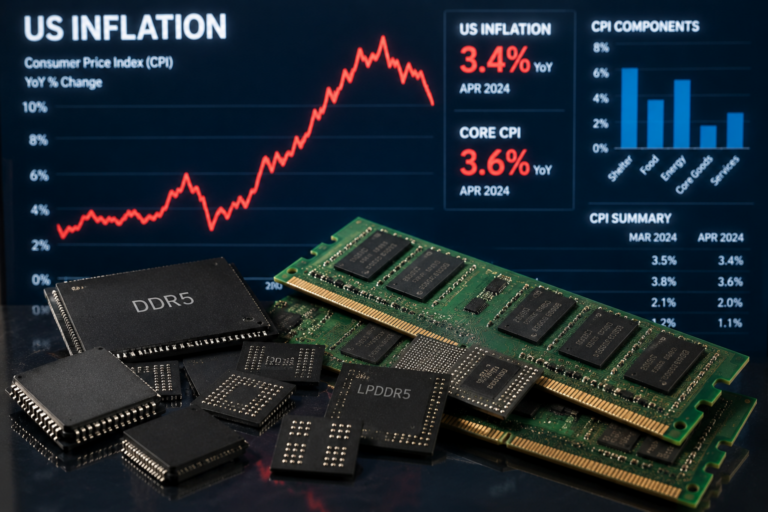
The moves reinforced growing concerns that, at least in the short term, AI may prove inflationary rather than disinflationary.

“Apple and Microsoft’s price rises have struck at the market’s fear of inflation, raising worries that, far from being deflationary, the AI boom might be inflationary, particularly for the hard-pressed consumer, hurting rather than aiding economic growth,” Chris Beauchamp, chief market analyst at IG, said.

Memory shortages hit consumer electronics

Apple raised prices on several MacBook and iPad models by between $100 and $300, though it left iPhone prices unchanged.

“The rapid expansion of AI data centers has created an extraordinary surge in demand for memory and storage. We have never seen a component price increase this much, this quickly,” Apple said in a statement.

The company added that it had “reached a point where we need to begin raising prices on a number of products,” while indicating that additional increases remain possible.

The market reaction was swift. Apple shares tumbled 6%, their worst single-day decline in more than a year.

Microsoft announced similar measures.

The software giant said prices of Xbox consoles would rise globally, with increases of $100 for 512-gigabyte models and $150 for one-terabyte versions effective Aug. 1.

The company also said it would discontinue its two-terabyte Xbox model.

The moves added to a growing list of technology manufacturers raising prices this year.

Dell, HP, Lenovo and Asus have all flagged higher prices, while Samsung increased prices on two variants of its Galaxy S26 smartphones in the United States by $100.

Shortage of memory chips and ‘chipflation’ fears

The price increases stem from an unprecedented shortage of memory chips.

Memory and storage components have become critical ingredients in the AI boom as hyperscalers race to build increasingly powerful data centres.

Suppliers have shifted production toward high-bandwidth memory chips used in AI servers, leaving consumer electronics manufacturers scrambling for supplies.

“The four largest US technology companies are forecast to spend $725 billion on data centers and AI equipment in 2026 alone. That level of demand for memory chips has created a shortage the supply chain cannot keep pace with,” said James Bull at RSM UK.

Bull said it had become increasingly evident that the costs of building the AI economy were being passed on to consumers and potentially to the broader inflation outlook.

Morgan Stanley analysts warned earlier this month that soaring memory prices could trigger “chipflation” across industries.

The brokerage said memory chip prices had risen six-fold over the past year.

“What began as an AI infrastructure bottleneck is now spreading into hardware margins, device affordability, cloud costs, inflation and policy,” the bank wrote in a note.

Areas where AI infrastructure is creating new inflation pressures

Some economists believe the inflationary impact of AI extends beyond semiconductors.

According to an April note by JPMorgan Asset Management’s Chief Global Strategist David Kelly, the enormous spending wave tied to AI development is likely to be inflationary in the near term rather than deflationary because demand is hitting the economy well before productivity gains materialise.

Kelly acknowledged that rising memory-chip prices are one channel through which AI investment could feed into higher prices, but said they do not yet represent a major source of economy-wide inflation.

Instead, he pointed to other emerging pressures. One of the clearest examples is electricity demand.

“One aspect of this demand is spending on electricity. After more than a decade of no growth, US electricity production rose by 2.5% in 2024, 2.4% in 2025 and was up by 3.0% year-over-year in March of 2026,” he said, noting that much of the increase was driven by data centre consumption and the growing use of AI models for training and inference.

Kelly said this likely contributed to a 4.6% year-over-year increase in consumer electricity prices in March.

However, because electricity carries a weight of only about 2.5% in the consumer price index basket, higher power costs accounted for just 0.1 percentage point of March’s 3.3% annual rise in headline inflation.

The construction boom linked to AI data centres is also creating labour pressures.

Construction workers saw wages rise 4.3% year-over-year in March, outpacing the 3.5% increase recorded across the broader private sector.

However, Kelly said this acceleration was probably driven more by labour shortages than by AI itself.

The total number of US construction workers increased only 0.7% over the past year, partly reflecting a sharp reversal in immigration trends in a sector that has historically relied heavily on immigrant labour.

AI productivity gains could eventually ease inflation, economists say

Kelly, however, said it was unlikely that most corporations had so far realised significant cost savings from deploying the latest AI models and even less likely that any savings had been passed on to consumers.

“There is a small but growing number of layoff announcements explicitly attributed to AI and there are some signs of diminished hiring of entry-level workers in the most AI-exposed industries,” he said.

He added that fears that AI will “take your job” could also be making workers more cautious, with economywide year-over-year wage growth falling to an almost five-year low in March.

However, more recent data from global outplacement firm Challenger, Gray & Christmas suggests AI’s impact on employment is becoming more pronounced, though.

US-based employers announced 97,006 job cuts in May, with artificial intelligence accounting for roughly 40% of all layoffs announced during the month.

It marked the third consecutive month in which AI was the leading reason cited for job reductions.

“Despite this labor market ‘scare’ effect, however, it does appear that AI is, on balance, adding slightly to inflation in the short run, although it will be far from the most important inflation driver. If this continues to be the case, over say, the next two years, then this alone would negate the idea that a disinflationary impulse from AI supports the need for short-term interest rate cuts,” Kelly said.

He expects AI to become a powerful disinflationary force over the longer term as productivity gains begin to emerge and spread across the economy.

Goldman Sachs has echoed that assessment, saying AI is currently adding to inflationary pressures even though it should ultimately lower production costs and lift economic growth.

“We expect artificial intelligence to deliver large productivity gains over the next several years, boosting the economy’s potential growth rate and putting downward pressure on production costs. So far, however, AI is boosting US inflation,” Goldman Sachs economists wrote last month.

The post Apple and Microsoft hike prices due to memory: is AI becoming an inflation machine? appeared first on Invezz

A growing chorus of China’s most influential hedge fund managers is sounding the alarm on what they describe as a dangerously overheated global AI trade.

After an explosive run-up in semiconductor and model‑development stocks from Seoul to Silicon Valley, several of Beijing’s money managers now argue the rally has detached from fundamentals – and that the first cracks are already visible.

Veteran managers are now calling AI a super bubble

Two of China’s best‑known hedge funds – Wealspring Asset and Shanghai Banxia Investment Management – have issued unusually blunt warnings that the AI boom has entered bubble territory, said a Bloomberg report.

Wealspring, founded by Yang Dong, who famously called China’s 2007 market top, told investors that global AI equities now resemble a “super bubble” inflated by momentum rather than durable business models, Bloomberg reported, citing an investor letter.

The firm, which oversees more than $1.4 billion, said many Chinese AI infrastructure companies lack defensible moats and rely on relentless capital expenditure to maintain growth.

In its view, valuations have been pushed to extremes by “brainless buying,” echoing the speculative frenzy of China’s 2015 bull market.

Wealspring cautioned that some of the most popular domestic AI names could ultimately fall more than 80% once sentiment turns.

Concerns extend beyond China, with Anthropic in focus

Banxia – which manages about $294 million – argues that the warning signs are “not” confined to China’s onshore markets.

The firm points to slowing revenue momentum at Anthropic PBC, one of the most closely watched US AI startups, as evidence that the global narrative of unstoppable growth is beginning to fray.

Banxia believes Anthropic’s annualized revenue run‑rate may undershoot market expectations as enterprise clients balk at soaring token costs and as rival model developers intensify competition for developers.

The fund also highlights a broader risk: that the AI ecosystem’s blistering revenue assumptions are colliding with the reality of rising infrastructure costs and tightening corporate budgets.

For Banxia, these pressures represent the early stages of a sentiment shift that could ripple across global AI valuations.

A booming market – and the cost of staying cautious

Despite the warnings, AI stocks have delivered extraordinary gains in 2026. China’s CSI Artificial Intelligence Index is up more than 35% year‑to‑date, far outpacing the 5% increase in the country’s main benchmark.

Overseas, the rally has been even more dramatic: South Korea’s Kospi has surged nearly 100% this year, powered by SK Hynix and Samsung Electronics – both beneficiaries of unprecedented demand for high‑bandwidth memory used in AI data centers.

Yet the very funds urging caution have paid a short‑term price for staying on the sidelines.

Wealspring’s Zhiyuan fund and Banxia’s low‑volatility macro strategy have posted small losses in early 2026, even though both remain strongly profitable over longer horizons.

Banxia founder Li Bei insists the discipline is worth it, advising investors to resist the temptation to chase parabolic AI trades and to prepare for a potential correction that could reset valuations across the sector.

The post Why China's top money managers believe the AI bubble is about to pop appeared first on Invezz

Shares of Rocket Lab (NASDAQ: RKLB) climbed in premarket trading after the space company announced that NASA had selected its Electron launch vehicle for two Earth and solar science missions.

The missions, known as Polarized Submillimeter Ice-cloud Radiometer Satellite (PolSIR) and Total and Spectral Solar Irradiance Sensor-2 (TSIS-2), will launch from Rocket Lab’s Launch Complex 1 in Mahia, New Zealand.

The awards fall under NASA’s Venture-Class Acquisition of Dedicated and Rideshare (VADR) program, a contract vehicle with a potential value of up to $300 million over a 10-year period.

NASA selects Electron for Earth and solar science missions

The PolSIR mission is designed to improve scientists’ understanding of tropical and subtropical ice clouds.

The project involves two small CubeSat satellites that will measure how these clouds interact with sunlight and heat.

Researchers expect the data to help improve climate and weather forecasting models.

Rocket Lab said the PolSIR project will require two dedicated Electron launches beginning no earlier than June 2027.

The TSIS-2 mission is scheduled for early 2027 and will launch on a separate Electron mission.

The project aims to measure the total amount of solar energy and the different wavelengths of sunlight reaching Earth.

According to NASA, the information gathered from TSIS-2 will help researchers track changes in weather patterns, ocean currents, and seasonal variations.

Both missions will launch from Rocket Lab’s New Zealand facility, reinforcing the company’s role as a provider of dedicated launch services for scientific payloads and small satellites.

Electron remains the company’s primary launch vehicle

Electron is Rocket Lab’s small orbital launch vehicle designed specifically for small satellite deployments and science missions.

The company said Electron has completed nearly 90 missions and deployed more than 260 satellites into orbit as of June 2026.

Earlier this week, Rocket Lab highlighted the efficiency of its manufacturing operations, noting that its Electron production system is currently capable of providing a new rocket approximately every 11 days.

The production pace supports Rocket Lab’s strategy of offering responsive and frequent launch services to commercial and government customers.

The latest NASA awards add to Electron’s growing list of scientific and government missions and demonstrate continued demand for dedicated small-launch capabilities.

Neutron development continues as delays persist

While Electron remains the company’s operational workhorse, Rocket Lab continues to develop its larger Neutron launch vehicle.

Neutron is intended to expand Rocket Lab’s capabilities beyond the small satellite market and allow it to compete for larger payload missions.

However, development of the rocket has encountered several delays and has yet to complete its inaugural flight.

The vehicle was originally slated to make its first launch in 2025.

Until Neutron becomes operational, Electron remains Rocket Lab’s sole active launch vehicle and the company’s primary source of launch services revenue.

Investors appeared to welcome NASA’s latest selection of Electron, with the stock gaining ground as the awards further strengthened Rocket Lab’s position in the growing market for dedicated science and small satellite missions.

The post Rocket Lab stock rises as NASA selects Electron for two missions appeared first on Invezz

The Vanguard S&P 500 ETF (VOO) stock has pulled back in the past seven consecutive days and is hovering at its lowest level since June 11. There is a risk that the recent stock market rally is about to take a breather. 

S&P 500 Index has fallen despite some major good news

The S&P 500 Index and its top ETFs, like VOO and SPY have pulled back despite some good news, including the recent US-Iran deal that has pushed crude oil pricesmuch lower than where they were a few months ago. Brent has dropped to $70, while the West Texas Intermediate (WTI) has moved to $69.

The falling oil prices are beneficial to the stock market because of its impact on consumer and producer inflation. Data released on Thursday showed that the headline PCE rose from 3.8% to 4.1% in May, moving higher than the 2% target. 

As such, with energy, metals, and fertilizer prices falling, there is hope that inflation will drop. This explains why the odds of the Federal Reserve hiking interest rates this year have dropped substantially in the past few days.

There are signs that corporate earnings are gaining momentum. A report released this week showed that Micron’s revenue jumped by over 300% in the last quarter, and the management believes it has more gains to go. 

Data compiled by FactSet shows that the average earnings growth for the second quarter is 22%. Historically, the real number is usually much higher than the estimates. For example, the estimate for the first quarter was 12%, and the real figure came out at 28%, the highest level in years.

Additionally, there are signs that the index is highly undervalued, with the forward price-to-earnings ratio being 22. While this is higher than the five-year average of 19, the index is seeing stronger revenue growth than it had in this period.

Potential risks may drag the VOO ETF stock in the near term

There is a risk that the S&P 500 Index will retreat in the coming weeks. One of the risks is that the current gains are being led by the memory industry. Sandisk stock has jumped by 855% this year, while Micron, Western Digital, and Seagate have soared by over 263%. 

The other top gainers this year are companies like Intel, Marvell, Dell, Corning, Applied Materials, and AMD. All these stocks have jumped because of the role in the artificial intelligence (AI) industry. They are all suppliers to hyperscalers like Microsoft, Meta Platforms, and Google.

The risk is that these companies will reverse if demand from hyperscalers starts falling. This is a possible thing since most of them have plunged in the past few weeks. Microsoft stock has dropped by 36% from its highest point in July last year, while Amazon has fallen by 18%. Google has fallen by over 15% from the year-to-date high.

VOO stock price technical analysis

Vanguard S&P 500 ETF | Source: TradingView

Technicals suggest that the VOO stock price may drop further in the near term. It has dropped below the 25-day Exponential Moving Average (EMA). 

A closer look shows that the fund formed a double-top pattern, a common bearish reversal sign. Also, it has formed a bearish divergence pattern as the Relative Strength Index (RSI) and the MACD have continued falling.

Therefore, the stock will likely continue falling as sellers target the 100-day moving average of $655. This retreat will likely happen before the earnings season starts and will be followed by more gains.

The post VOO stock: Here’s why the S&P 500 Index could be on the verge of a reversal appeared first on Invezz

US stocks opened lower on Friday as investors continued to rotate out of technology stocks, with chipmakers facing renewed selling pressure despite strong recent earnings and upbeat demand forecasts.

The Dow Jones Industrial Average was down 207 points points while the Nasdaq Composite dropped 0.95%. The S&P 500 declined 0.61%.

The latest weakness comes after a strong quarter for semiconductor stocks, as investors increasingly question lofty valuations and the sustainability of heavy spending on artificial intelligence infrastructure.

Chip stocks slide despite strong earnings

Semiconductor stocks led the premarket declines. Shares of Micron Technology fell more than 5.8% after soaring over 15% in the previous session following better-than-expected quarterly results and forecasts.

Advanced Micro Devices and Intel each declined more than 3.5%, while Nvidia lost about 1.7%. Oracle also dropped 0.38%.

The selloff reflects growing investor concerns about who ultimately bears the costs associated with massive investments in artificial intelligence infrastructure.

A New York Times report that OpenAI is considering delaying its initial public offering until next year also weighed on sentiment.

The report raised concerns about “sustainability of their infrastructure spending given the delay in funding from the capital markets,” wrote JPMorgan traders in a note.

Technology shares had already come under pressure in Thursday’s session.

Apple plunged 6% after announcing price increases for iPads and MacBooks due to rising memory and storage costs. Microsoft also declined after raising prices on its Xbox gaming consoles.

Apple recovered modestly on Friday, rising about 0.7%.

Inflation concerns and rate fears add pressure

The market’s concerns extend beyond technology spending. Fresh inflation data and changing expectations for Federal Reserve policy have also weighed on sentiment.

Data released on Thursday showed US inflation climbed above 4% in May for the first time in three years, driven by higher energy prices linked to tensions in the Middle East.

Although oil prices have recently retreated as geopolitical tensions eased, investors remain concerned that higher semiconductor costs could once again fuel broader inflationary pressures.

Interest rate concerns remain elevated, with traders pricing in one 25-basis-point rate increase and a nearly 27% chance of another hike before year-end, according to LSEG data.

Global technology selloff spreads across markets

The weakness in technology stocks extended beyond the United States.

SoftBank Group, a major backer of OpenAI, plunged more than 12% in Asia.

South Korea’s Kospi dropped 5.81%, while Japan’s Nikkei 225 declined 4.15%. Hong Kong’s Hang Seng Index and China’s CSI 300 also posted losses.

European stocks moved lower as well, with the pan-European Stoxx 600 falling 1%.

Among individual movers, Synaptics fell 0.95% after ON Semiconductor agreed to acquire the company in an all-stock deal valued at about $7 billion. Shares of ON Semiconductor fell 19.42%.

Investors are also preparing for heavy trading activity tied to Russell index changes, including the reclassification of several megacap stocks and the fast-track addition of SpaceX to the Russell 1000.

The post Dow falls 200 points as tech selloff deepens and chip stocks extend retreat appeared first on Invezz

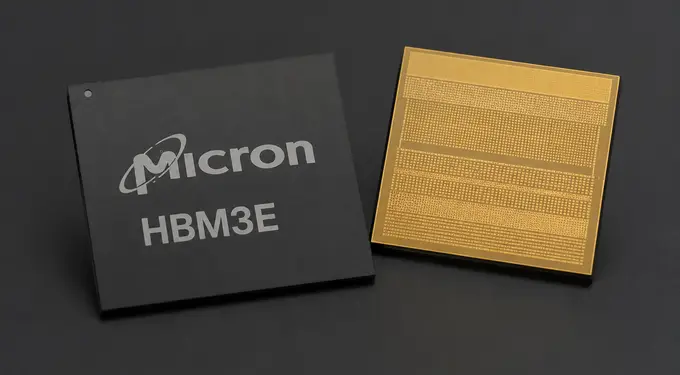
Micron Technology’s MU shares fell sharply on Friday, giving up part of the gains recorded earlier in the week despite the memory chipmaker reporting stronger-than-expected quarterly results.

The stock declined nearly 5% in premarket trading as weakness spread across the broader semiconductor sector.

Other US chipmakers also traded lower, with Intel down just over 3%, Sandisk falling 5%, Arm shedding 4%, and Marvell declining 3.7%.

The decline came as investors remained cautious about the rising costs associated with artificial intelligence infrastructure, triggering a broader sell-off across global semiconductor stocks.

Semiconductor stocks under pressure worldwide

The weakness extended beyond the United States.

In Europe, ASML fell 2.2%, Infineon declined 3.7%, ASM International lost 2.8%, ST Microelectronics dropped 3.3%, and Be Semiconductor slipped 2%.

In Asia, Japanese conglomerate SoftBank led regional losses, plunging more than 12%.

The broader pullback followed a strong rally in AI-related semiconductor companies, even as Micron delivered robust financial results and issued an optimistic outlook.

Revenue beats expectations

MU reported third-quarter revenue of $41.46 billion, compared with $9.3 billion in the same period a year earlier.

The result exceeded analysts’ expectations.

Adjusted earnings reached $25.11 per share on revenue of $41.5 billion, representing a 346% year-on-year increase.

Adjusted gross margin stood at 85%, while adjusted operating margin reached 81%.

The company also projected revenue of around $50 billion for the current quarter, compared with $11.3 billion in the corresponding period last year.

Micron also said customers had committed $22 billion to secure future memory chip supply.

Following the earnings announcement on Wednesday, Micron’s shares surged more than 15% in a single session.

The stock has gained approximately 863% over the past year.

Micron overtakes Meta briefly in market capitalisation

The rally briefly pushed Micron ahead of Meta Platforms and close to Tesla in terms of market capitalisation on Thursday.

Micron’s market value had peaked at $1.398 trillion on Thursday’s session compared with Meta Platforms at $1.392 trillion.

Tesla stood at around $1.4 trillion.

Micron currently has a market capitalisation of $1.37 trillion.

The company first crossed the $1 trillion market valuation mark on May 26, joining a group of semiconductor companies benefiting from investor enthusiasm surrounding artificial intelligence infrastructure.

Micron said second-quarter revenue quadrupled as demand for memory chips continued to outpace supply.

The company described the market as being supported by a demand-driven chip shortage that it expects to continue beyond 2027, marking a change from earlier expectations that supply constraints would ease sooner.

Micron now has 16 long-term chip supply agreements in place.

Growth was primarily driven by the company’s two data-centre business segments, which together generated $25 billion in revenue, up 415% from a year earlier.

The post Micron shares fall after AI-fuelled rally despite blowout earnings appeared first on Invezz

Michael Saylor’s STRC stock has made headlines this week as its implosion gained momentum amid the ongoing crypto market weakness. The Variable Rate Series A Perpetual Stretch Preferred Stock plunged from the par level of $100 to a record low of $72.60. Sadly, it is not the only crypto-related preferred stock that is imploding this week.

STRC, BMNP, and SATA stocks are plunging

The ongoing woes in the STRC stock price has spread to other similar assets. For example, the recently launched BitMine Immersion Technologies 9.5% Series A Perpetual Preferred Stock (BMNP) has slumped in all trading days. 

It ended the day at $81.40 from the monthly high of $92. This retreat is one of the top reasons why the BitMine stock price continued falling, reaching a low of $13. At its peak in 2025, the stock was trading at $160 as investors cheered its evolution from a Bitcoin mining company into an Ethereum accumulation one.

Meanwhile, Strive’s Variable Rate Series A Perpetual Preferred Stock (SATA) plunged to $83.53. Strive is an asset management company that was started by Vivek Ramaswamy, the healthcare billionaire. It is one of the top Bitcoin accumulation companies.

Other preferred stocks by Strategy have also imploded in the past few days. This includes stocks like STRK, STRD, and STRF. 

Crypto market weakness and need to raise cash

The ongoing retreat of preferred stocks is happening as the crypto market crash intensifies. Bitcoin dropped to $58,000 from a record high of $126,300, while Ethereum has slumped from nearly $5,000 to $1,500 today. 

The ongoing crypto market crash has led to billions of dollars in unrealized losses among these companies. Most of them have even seen their market net asset value (mNAV) drop below 1.

Therefore, there are concerns that the companies will need to raise cash to continue paying their dividends. Also, they may be forced to either pause or end their Bitcoin and Ethereum accumulation approach.

Strategy raised $300 million in cash last week by selling shares and diluting its shareholders. It now has $1.4 billion in cash, which is not enough to cover its dividend payouts for a year.

Strive has insisted that it has a two-year cover to pay its dividends, while BitMine has $601 million in cash and marketable securities and no debt. 

https://twitter.com/BitMNR/status/2070182232413573387

A major red flag in the industry happened a few months ago when Strategy changed its long-standing policy that it would never sell its Bitcoins. It made its first sale a few weeks ago, and this process may continue over time. If this happens, it will be selling at a loss s the average Bitcoin buying price was $68,000.

The hope among Tom Lee, Michael Saylor, and Ramaswamy is that the crypto market crash will end soon. Such a move will boost the value of their assets and boost confidence among investors.

The challenge, however, is that the crypto market is competing with stocks, which are in a prolonged bull run. As a result, investors have continued to dump crypto ETFs and rotating to stocks. For a crypto recovery to happen, a reversal in the stock market will need to happen.

The post It’s not just STRC: Top preferred stocks like SATA and BMNP are slumping appeared first on Invezz

Shares of Rocket Lab (NASDAQ: RKLB) climbed in premarket trading after the space company announced that NASA had selected its Electron launch vehicle for two Earth and solar science missions.

The missions, known as Polarized Submillimeter Ice-cloud Radiometer Satellite (PolSIR) and Total and Spectral Solar Irradiance Sensor-2 (TSIS-2), will launch from Rocket Lab’s Launch Complex 1 in Mahia, New Zealand.

The awards fall under NASA’s Venture-Class Acquisition of Dedicated and Rideshare (VADR) program, a contract vehicle with a potential value of up to $300 million over a 10-year period.

NASA selects Electron for Earth and solar science missions

The PolSIR mission is designed to improve scientists’ understanding of tropical and subtropical ice clouds.

The project involves two small CubeSat satellites that will measure how these clouds interact with sunlight and heat.

Researchers expect the data to help improve climate and weather forecasting models.

Rocket Lab said the PolSIR project will require two dedicated Electron launches beginning no earlier than June 2027.

The TSIS-2 mission is scheduled for early 2027 and will launch on a separate Electron mission.

The project aims to measure the total amount of solar energy and the different wavelengths of sunlight reaching Earth.

According to NASA, the information gathered from TSIS-2 will help researchers track changes in weather patterns, ocean currents, and seasonal variations.

Both missions will launch from Rocket Lab’s New Zealand facility, reinforcing the company’s role as a provider of dedicated launch services for scientific payloads and small satellites.

Electron remains the company’s primary launch vehicle

Electron is Rocket Lab’s small orbital launch vehicle designed specifically for small satellite deployments and science missions.

The company said Electron has completed nearly 90 missions and deployed more than 260 satellites into orbit as of June 2026.

Earlier this week, Rocket Lab highlighted the efficiency of its manufacturing operations, noting that its Electron production system is currently capable of providing a new rocket approximately every 11 days.

The production pace supports Rocket Lab’s strategy of offering responsive and frequent launch services to commercial and government customers.

The latest NASA awards add to Electron’s growing list of scientific and government missions and demonstrate continued demand for dedicated small-launch capabilities.

Neutron development continues as delays persist

While Electron remains the company’s operational workhorse, Rocket Lab continues to develop its larger Neutron launch vehicle.

Neutron is intended to expand Rocket Lab’s capabilities beyond the small satellite market and allow it to compete for larger payload missions.

However, development of the rocket has encountered several delays and has yet to complete its inaugural flight.

The vehicle was originally slated to make its first launch in 2025.

Until Neutron becomes operational, Electron remains Rocket Lab’s sole active launch vehicle and the company’s primary source of launch services revenue.

Investors appeared to welcome NASA’s latest selection of Electron, with the stock gaining ground as the awards further strengthened Rocket Lab’s position in the growing market for dedicated science and small satellite missions.

The post Rocket Lab stock rises as NASA selects Electron for two missions appeared first on Invezz