Archive

July 2026

Browsing

South Korean semiconductor giant SK Hynix made history on Wall Street, listing on Nasdaq today via American Depositary Receipts (ADRs) under the ticker SKHY.

The firm’s US initial public offering (IPO) priced at $149 was more than 7x oversubscribed – and raised a total of about $26.5 billion. This made it the largest-ever US listing by a foreign company.

SK Hynix stock is now better-positioned to compete for capital against its American rival, Micron. But is it really a better investment than MU for the long-term? Let’s find out!

SK Hynix stock owns the HBM market

SKHY shares may be a superior investment than Micron due to the company’s absolute dominance on the High-Bandwidth Memory (HBM) market.

The South Korean giant commands an impressive 56.4% share of the global HBM sector – which makes it the primary supplier of ultra-fast memory for artificial intelligence (AI) accelerators.

In fact, SK Hynix is already deeply integrated into Nvidia’s next-generation Vera Rubin platform with its advanced HBM4 architecture.

While Micron Technology is executing rather well and has sold out its capacity through the end of this year, it controls a much smaller 21% market share.

SK Hynix’s massive volume footprint grants it unparalleled pricing power and stronger, contracted multi-year revenue visibility with hyperscalers.

SKHY shares are more attractively priced than MU

In terms of profitability, SK Hynix shares seem to be in a whole another league.

In its latest reported quarter, the company’s operating margin stood at a staggering 72%, driven by high-value enterprise solid-state drives (eSSDs) and premium DRAM modules.

However, despite this world-class financial efficiency, a notable valuation disconnect persists. SK Hynix trades at a highly attractive forward price-to-earnings (P/E) multiple of just 8x, which makes it infinitely cheaper to own than Micron.

In other words, SKHY offers investors direct exposure to the booming artificial intelligence memory market at a much lower valuation than MU.

Here’s why it isn’t too late to invest in SK Hynix

Despite significant market debut gains, SKHY stock remains attractive as a long-term holding also because the company plans of using the IPO proceeds to future-proof its production moat.

Executives have earmarked substantial funds for extreme ultraviolet (EUV) lithography equipment and advanced packaging plants, including the Yongin semiconductor cluster.

This positions SK Hynix to significantly benefit as the global tech infrastructure shift from massive foundational model training toward real-time, continuous inference driven by agentic AI.

All in all, Icheon-headquartered SK Hynix Inc combines unrivaled HBM leadership, impressive profitability, compelling valuation, and an aggressive capacity expansion strategy all into one.

While Micron Technology remains a formidable competitor, SKHY appears better positioned to capture the next phase of AI-driven semiconductor demand, making it a more compelling long-term investment for growth-oriented investors in 2026.

The post Is SK Hynix stock a better pick to play AI memory market than Micron? appeared first on Invezz

US stocks ended higher on Friday, with the S&P 500 closing just shy of a record high as enthusiasm around artificial intelligence and semiconductor stocks offset concerns over renewed tensions in the Middle East.

Investors also turned their attention to the start of the second-quarter earnings season next week, when major US banks will begin reporting results.

The Dow Jones Industrial Average rose 148.28 points, or 0.28%, to 52,635.69. The S&P 500 gained 0.38% to close at 7,572.36, while the Nasdaq Composite added 0.25% to finish at 26,273.21.

The benchmark S&P 500 finished the week up roughly 1%, while the Nasdaq also advanced more than 1%. The Dow, however, ended the week slightly lower.

SK Hynix debut lifts AI optimism

Artificial intelligence remained a key driver of market sentiment after South Korean memory-chip maker SK Hynix made its Nasdaq debut.

The company opened at $170, about 14% above its American depositary receipt offering price of $149 after raising more than $26 billion in one of the world’s largest share sales.

The listing renewed investor optimism around memory-chip makers despite recent volatility across the semiconductor sector.

Nvidia rose more than 3% on Friday, helping lead gains in the S&P 500.

Meta Platforms jumped around 6%, marking its strongest weekly performance since early 2024 after Bank of America reiterated its Buy rating.

Investor sentiment was also supported by reports suggesting Meta could improve the cost efficiency of its artificial intelligence infrastructure.

Although chip stocks have faced profit-taking in recent weeks, they remain among the year’s strongest performers.

Micron Technology has surged more than 200% in 2026, while Lam Research, Marvell Technology and Intel have all more than doubled year to date.

Global markets also reflected mixed sentiment.

South Korea’s Kospi gained 2.5%, while Japan’s Nikkei 225 rose 1.2%. China’s CSI 300 declined 1.96%, weighed down by technology and industrial stocks. Europe’s Stoxx 600 index finished little changed.

Middle East tensions remain in focus

Investors continued to monitor developments in the Middle East after renewed military exchanges between the United States and Iran earlier this week raised concerns about higher energy prices and inflation.

Market sentiment improved after President Donald Trump said Iran had requested to continue negotiations and that the United States had agreed, although he also stated that the June ceasefire was over.

Officials from Qatar and Pakistan are also working to facilitate renewed discussions between the two sides, while an administration official told MS Now that technical talks would continue despite the latest military actions.

The easing in oil prices following those developments helped support equities after Thursday’s rally.

Attention turns to earnings and inflation

Investors are now preparing for the second-quarter earnings season, which begins next week with reports from major US banks.

According to LSEG I/B/E/S data, analysts expect S&P 500 earnings to increase 24% from a year earlier, with technology companies expected to account for much of the growth.

Despite the benchmark index trading near record highs, the S&P 500’s forward price-to-earnings ratio has eased to around 20 times expected earnings from 21 times in late May, reflecting stronger corporate earnings expectations.

Markets will also closely watch next week’s US inflation report and testimony from Federal Reserve Chair Kevin Warsh before the House Committee on Financial Services for further clues on the outlook for interest rates.

The post Dow rises as S&P 500 nears record, SK Hynix debut boosts AI chip stocks appeared first on Invezz

Illinois Tool Works (NYSE: ITW) stock has pulled back in the past few days as investors position themselves for the upcoming earnings report that will provide more color on its business. While growth expectations are low, the stock has formed the rare inverted head-and-shoulders pattern, pointing to a rebound.

Illinois Tool Works is a dividend king with slowing sales growth

Illinois Tool Works is a large American industrial company that makes products used directly and indirectly by millions of people globally. 

It makes automotive products that are used by large companies like General Motors and Ford, construction products like Paslode, Ramset, and Red Head, and food equipment like commercial dishwashers and ovens.

ITW has grown to become a dividend king, a company that has paid and raised its dividends for over 50 years. It now has a dividend yield of 2.43%, a five-year growth of 7.4%, and a payout ratio of 58%.

Illinois Tool Works stock has come under pressure in the past few months as the US-Iran war has led to a surge in key raw material costs. At the peak of this war, the stock dropped from $303 to $241 within weeks.

The next key catalyst for the ITW stock price is the upcoming earnings report, which will provide more color on its business. The report will come out on July 28th this year.

Yahoo Finance data shows that analysts expect the upcoming report will show that its revenue rose by 3.36% in the last quarter to $4.19 billion. Its guidance for the third quarter’s number will be $4.18 billion, up by 3%. Its annual revenue is expected to come in at $16.6 billion from the previous year’s $16 billion.

The most recent results showed that ITW delivered solid numbers, with its revenue rising by 5% in Q1, with its margin rising by 60 basis points to 25.4%. Its earnings per share (EPS) rose by 12% to $2.66.

READ MORE: Illinois Tool Works stock: why Josh Brown says ITW is the ‘best’ in market

Valuation concerns persist

A key concern now is on its valuation, which is a bit elevated for a slow-growing industrial company. 

Illinois Tool Works trades with a forward price-to-earnings ratio of 23.38, slightly higher than the sector median of 20. The S&P 500 Index has a multiple of 22.

Most notably, ITW now trades with a higher multiple than other faster-growing companies like Micron and Nvidia. Micron, whose revenue is growing by triple digits and has higher margins, trades with a forward multiple of 13, while Nvidia has a multiple of 21.

As such, the company will need to report stronger revenue and profits to convince investors.  This explains why analysts are not highly excited about the company, with most of them having hold or underweight ratings.

ITW stock price technical analysis

Illinois Tool Works stock chart | Source: TradingView

The daily chart shows that the Illinois Tool Works stock remains under pressure today. However, a closer look shows that it is in the process of forming an inverted head-and-shoulders pattern. It has already completed the formation of the left shoulder and head sections and is now in the right one.

This pattern suggests that it may need to rereat to the right shoulder section of $255 and then bounce back. In the future, the stock may jump to $303, its highest level in February this year.

The post ITW stock: New dividend king slowly forms a highly bullish pattern appeared first on Invezz

NY-headquartered Citigroup has been the perennial laggard of Wall Street for years, burdened by the legacy of the global financial crisis and an unmanageable corporate structure.

However, the narrative has flipped, with a renowned wealth manager, Josh Brown, recently calling Citi “one of the top bank stocks” to own – driven by a profound operational turnaround engineered by CEO Jane Fraser.

By aggressively divesting non-core international consumer operations and removing management layers, the bank has unlocked significant capital efficiency, he told CNBC.

Heading into its Q2 release, Citi shares C are up more than 30% versus its year-to-date low.

Why is Brown bullish on Citi stock

Brown’s bullish view on Citi stock is based on a combination of technical momentum and corporate restructuring.

According to him, the catalyst for change has been Fraser’s “shrinking to grow” strategy – exiting over a dozen overseas retail markets to focus on high-margin corporate services.

Brown particularly favours Citigroup’s global treasury and trade solutions franchise, which serves as the fundamental plumbing of international commerce.

Fraser’s visionary leadership has even helped Citi outperform its larger peers, JPMorgan and Bank of America, in the trailing 12 months.

A healthy 1.72% dividend yield makes Citigroup even more attractive to own in 2026.

Citi shares to rally after Q2 earnings

In the near-term, Citi’s upcoming earnings could prove a tailwind that unlocks the next leg higher.

Expectations are for the investment bank to report $23.4 billion in revenue – up 7.8% on a year-over-year basis – on as much as $2.72 a share of earnings, which will represent 39% growth over last year’s figure.

Crucially, options pricing is bullish heading into the company’s quarterly report. The put-to-call ratio on contracts expiring July 17, just days after the print, sits at 0.42 currently.

And the upper price on those contracts is set at about $145, indicating potential for a 4.2% increase in Citi shares from current levels.

How to play Citigroup at current levels?

Sentiment is structurally supported by the massive $30 billion share buyback program announced at Citi’s May Investor Day.

The aggressive compression of shares outstanding is mechanically lifting the EPS trajectory faster than organic growth alone.

Ultimately, Citigroup’s transformation is proving that sometimes a giant must lean down to leap forward.

By shedding the dead weight of its legacy structure and focusing squarely on its core strengths, the bank has successfully shifted market sentiment from skepticism to strong optimism.

If the upcoming Q2 earnings report validates these aggressive restructuring efforts and meets Wall Street’s heightened expectations, it will solidify the bank’s new trajectory.

For investors who once viewed Citi as a value trap, the combination of technical momentum, a robust buyback program, and disciplined leadership makes the stock a compelling comeback story for the rest of 2026.

The post Josh Brown reveals the best bank stock to own heading into Q2 earnings appeared first on Invezz

Microsoft’s warning that the quantum-security clock is moving faster has put a beaten-down quantum stock back on Wall Street’s radar.

Quantum Computing Inc. (NASDAQ: QUBT) was trading around $8.75 on Thursday, while an average analyst price target on the stock is $18.33, implying roughly 111% upside current levels.

The setup is compelling, but risky, as QUBT is a speculative quantum and security trade, not a proven winner.

Microsoft’s quantum warning changes the security clock

The latest catalyst is not coming from Quantum Computing itself, but from Microsoft.

Microsoft said it is accelerating its Quantum Safe Program and now aims to transition products and services to post-quantum cryptography by 2029.

Azure CTO Mark Russinovich wrote that advances in quantum research have “shifted the risk horizon” and that cryptographically relevant quantum computers could arrive sooner than previously expected.

In simple words, the risk is not that quantum computers are breaking encryption today, but attackers can steal encrypted data now and decrypt it later, once quantum machines become powerful enough.

Microsoft called this the “harvest now, decrypt later” problem and said organisations are already prioritising long-lived sensitive data for protection.

The company’s transition plan focuses on practical plumbing with TLS 1.3, crypto-agility, certificate trust chains, code signing, hardware-backed protections and data protection.

That matters for investors because it suggests quantum-safe security is moving from research debate to enterprise budget item.

Why QUBT is being linked to the quantum-security trade

Quantum Computing Inc. is being watched because it is not pitching itself only as a quantum-computing hardware story.

The portfolio spans integrated photonics, quantum optics, cybersecurity, sensing and secure communications.

Its March 2026 acquisition of NuCrypt added quantum communications technology, in a deal valued at $5 million.

NuCrypt brought systems, products and patents tied to quantum optics, RF-photonics and photonic signal processing.

QUBT then added more manufacturing depth in June by completing its acquisition of NHanced Semiconductors.

The company said the deal provides a foundation for scalable chip manufacturing of its quantum and photonics technologies, supporting commercialisation and a vertically integrated platform spanning research, development and manufacturing.

That is why the Microsoft warning matters. If enterprises, governments and cloud providers start spending more aggressively on post-quantum security, investors may look for smaller pure-play companies with exposure to quantum photonics, secure communications and related infrastructure.

Rosenblatt analyst John McPeake has made that bull case directly.

He said QCi has “legitimate quantum assets across photonics, compute, security, and sensing,” along with thin-film lithium niobate fabrication capabilities that could support integrated quantum photonics, nonlinear optics and optical waveguides.

Analysts see upside, but the stock remains speculative

The analyst math is where the projected upside comes from.

Benzinga lists a $18.33 consensus price target for QUBT, with a $30 high target from Ascendiant Capital and a $10 low target from Cantor Fitzgerald.

From a stock price near $8.75, that average target points to roughly 111% upside, while the Street-high target implies far more.

Ascendiant Capital’s Edward Woo has been among the more bullish analysts. He reiterated a Buy rating and raised his target to $30 from $27.

Woo said Wall Street’s revenue expectations for QUBT appear achievable, based partly on management conversations and the company’s acquisition-led revenue growth.

Lake Street also remains constructive as the firm reiterated a Buy rating and $16 target after the NHanced acquisition, saying the deal accelerates QUBT’s shift from research and prototyping toward scalable commercial production.

At the same time, the firm noted that the financial contribution from the deal has not yet been quantified, which is an important caveat.

The post This $8 quantum stock has 111% upside after Microsoft’s warning appeared first on Invezz

Wall Street will enter the July 6-10 week with less room for error after a choppy start to the second half.

The S&P 500 is still sitting near record territory, but the market is carrying a tricky mix of stretched valuations, a cooling labour market, fragile oil prices and fresh pressure in semiconductor stocks.

The centrepiece will be Wednesday’s FOMC minutes, the first deeper look at Kevin Warsh’s debut meeting as Federal Reserve chair.

With investors already debating whether the June jobs slowdown reduces the odds of a near-term rate hike, every data point next week could matter more than usual.

5 factors investors can’t ignore next week

1. FOMC minutes: First real read on Warsh’s Fed

The biggest event lands on Wednesday, when investors get the minutes from the Fed’s June meeting.

That meeting was Warsh’s first as chair, and it left markets with a hawkish dot-plot message: nine of 18 officials projected that rates would end 2026 above the current 3.5%-3.75% range.

The minutes will be parsed for how strongly officials debated inflation, oil prices and the timing of any hike.

The June jobs report gave the Fed some cover to wait, with payrolls rising by just 57,000 and rate-hike odds falling after the data.

Evercore ISI’s Krishna Guha said Warsh sounded “relaxed” about the labour market.

2. ISM Services PMI: Week’s first economic test

Before the Fed minutes, Monday’s ISM Services PMI will set the tone.

ISM has scheduled the June services report for 10 a.m. ET on Monday, July 6, after the July 3 market holiday shifted the calendar.

The May reading rose to 54.5, showing the services side of the economy was still expanding.

A softer print would support the argument that growth is slowing enough to keep the Fed patient.

A stronger reading, especially if prices remain firm, would make the minutes feel more dangerous for rate-sensitive stocks.

3. Chip-sector aftershocks: Reset or warning sign?

Semiconductors remain the market’s most crowded trade, and that makes next week important.

The sector has been rattled by sharp swings in Korean memory names and US chip stocks.

The Kospi index surged on Friday after a two-day decline, helped by bargain-hunting in chipmakers, while US tech weakness had weighed on sentiment earlier in the week.

Samsung and SK Hynix rebounded strongly on July 3 after Thursday’s selloff, while Micron remained under pressure following a sharp drop.

The question for investors is whether this is a healthy reset after a huge AI rally, or the first sign that positioning has become too leveraged.

4. Levi Strauss and PepsiCo: Early consumer checks

Q2 earnings season does not fully accelerate until mid-July, but Levi Strauss and PepsiCo will offer early signals on the US consumer.

Levi will discuss second-quarter results on Wednesday, July 8, while PepsiCo has confirmed it will release second-quarter results on Thursday, July 9.

Levi offers an early read on discretionary spending and demand for apparel, while PepsiCo provides a staples-side check on consumer tolerance for higher snack and beverage prices.

Together, they will help show whether earnings strength is broadening beyond AI and mega-cap technology.

5. Oil and the fragile Iran ceasefire

Oil’s retreat has helped ease inflation anxiety, but the market is not treating the calm as permanent.

Brent is trading around $71.87 and WTI near $68.63, with prices close to pre-conflict levels as peace efforts held and some Strait of Hormuz traffic resumed.

That cooling helps consumers and the Fed. But it also depends on the diplomacy holding.

The oil prices have returned to pre-war levels even though shipping disruption, insurance costs and geopolitical risk have not fully disappeared.

That is why next week matters as Goldman Sachs has lifted its year-end S&P 500 target to 8,000, but valuations are already rich by long-term standards.

With stocks priced for good news, a hawkish Fed surprise, weak consumer readout or renewed chip volatility could hit harder than usual.

The post Wall Street’s big test: 5 factors investors can’t ignore next week appeared first on Invezz

US stock funds saw their biggest weekly exit since March, raising fresh questions about the strength of Wall Street’s rally.

Investors pulled $17.2 billion from US stock funds in the week through July 1, according to Bloomberg, citing Bank of America strategists led by Michael Hartnett and EPFR Global data.

The move does not signal a market crash, but it does show investors are turning more cautious after a strong run in US equities.

The key question now is simple: is this routine profit-taking, or an early warning that confidence in the AI-led rally is starting to fade?

Wall Street’s rally loses its flow cushion

Fund flows work like a sentiment gauge as they show whether investors are adding fresh money to equity funds or quietly taking some risk off the table.

A $17.2 billion weekly exit does not mean the S&P 500 is collapsing, but it indicates that investors are becoming more cautious after a powerful run in US equities.

That matters because this rally has leaned heavily on megacap technology, AI optimism and confidence that corporate earnings can keep absorbing higher rates.

When money is still pouring in, expensive markets can keep climbing, but when flows turn patchier, valuations become more exposed to bad news.

The shift did not appear from nowhere as US equity funds already saw $3.5 billion of outflows in the week to June 24, as worries over debt-funded technology spending and hawkish Federal Reserve expectations weighed on sentiment.

Technology sector funds saw nearly $20 billion of withdrawals that week, reversing the previous week’s inflows.

That makes the latest BofA number less of a surprise and more of a continuation and a signal that investors are no longer buying every dip with the same confidence.

Tech fatigue is becoming harder to ignore

The pressure point remains technology. The AI trade has been the engine of Wall Street’s advance, but it is also where concentration risk is highest.

The MSCI World Index fell 2.07% last week amid worries over concentration risks and hyperscalers’ spending plans.

Those concerns matter because investors are watching whether cloud giants can turn massive AI capex into durable profits, not just bigger bills.

BNY’s Bob Savage told Reuters that the AI-led equity rally was showing signs of fatigue.

That is the kind of line that lands because it captures the market’s current mood: still bullish on AI in principle, but less willing to ignore every valuation warning.

Oliver Shale, investment specialist for the US at Ruffer, made the positioning risk clearer.

He said that through the lens of valuations, positioning and sentiment, risk measures are “flashing amber.”

Rotation, not full retreat

The more balanced reading is that investors are rotating, not giving up on equities altogether.

LSEG data showed global equity funds pulled in $10.4 billion in the week to July 1. Asian equity funds attracted $7 billion, their biggest inflow in seven weeks, while US funds saw a smaller $1 billion inflow.

Technology funds also rebounded with $8.9 billion in inflows after the previous week’s heavy selling.

That complicates the bearish case. Investors may be trimming crowded US exposure while still buying technology and other regional equity opportunities.

William Bratton, head of cash equity research for APAC at BNP Paribas, struck that tone in a note cited by Reuters.

He said the bank’s tech analysts saw “no reason” for the sector’s earnings momentum to slow or reverse in the near term, with the coming second-quarter earnings season expected to be supportive.

The post US stocks see biggest exit since March: is Wall Street’s rally at risk? appeared first on Invezz

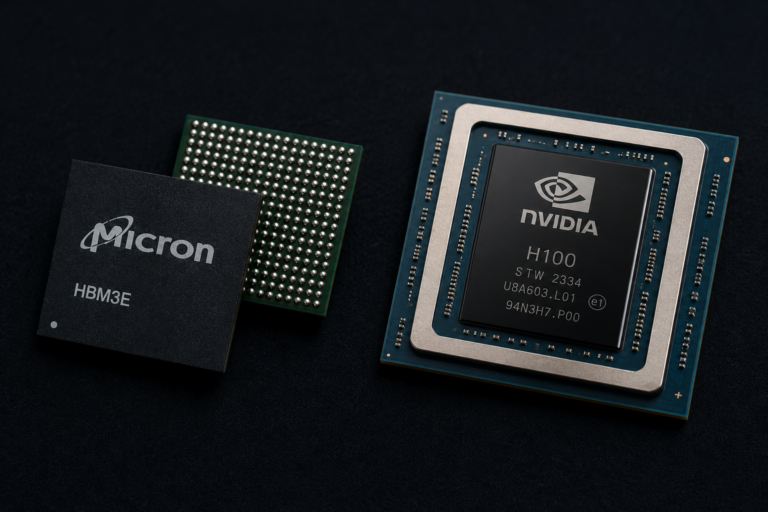
The chip that could make or break Wall Street’s confidence in artificial intelligence no longer lives inside a flashy graphics processor.

Increasingly, it sits inside a memory module, and it is made by a company that started life in a Boise, Idaho, dental office basement in 1978.

For most of its four-decade existence, Micron Technology was the kind of stock serious investors avoided.

Memory chips, dynamic random-access memory, or DRAM, and its derivatives were a commodity.

The business ran in brutal cycles: a shortage would lift prices and profits, manufacturers would race to add capacity, supply would overshoot demand, prices would collapse, and the cycle would repeat.

MU was a trade, not an investment. Wall Street treated it accordingly. That story is being rewritten at speed.

Over the past year, Micron’s shares have surged roughly 700%, with 200% of those gains arriving in 2026 alone.

Last month, the company crossed a $1 trillion market capitalisation for the first time.

Its latest quarterly earnings delivered a 346% surge in revenue and gross margins of 84.9% surpassing, remarkably, those of Nvidia.

And in a stretch when AI and technology stocks were nursing heavy losses after questions over bubble-territory valuations began circulating on Wall Street, it was Micron’s blowout results that steadied nerves and reignited confidence that the AI trade still has runway.

Two years ago, that role belonged to Nvidia.

The question investors are now asking is whether it has quietly passed the baton.

How Nvidia wrote the bellwether playbook

To understand what Micron may be becoming, it helps to understand what Nvidia became.

In November 2022, when OpenAI launched ChatGPT and set off the current AI frenzy, Nvidia’s graphics processing units, originally designed for computer games, found themselves identified as the workhorses for training AI models.

Demand exploded. Between its October 2022 low and June 2024, Nvidia’s shares surged approximately 1,100%.

By mid-2024, it had briefly become the world’s most valuable company, with a market capitalisation of $3.34 trillion, and had joined the select grouping of mega-cap technology companies known as the Magnificent Seven alongside Alphabet, Meta, and others.

But Nvidia’s significance went beyond its own price. It became a barometer.

Investors read Nvidia’s earnings reports the way they read blockbuster economic releases, not just for what they said about one company, but for what they implied about the pace and health of the entire AI buildout.

Even when Nvidia itself traded flat after reporting, its supply chain partners, Taiwan Semiconductor, SK Hynix, and ASML, would often move sharply in anticipation or in the immediate aftermath of its numbers.

“It’s not just a single stock,” Arun Sai, multi-asset portfolio manager at Pictet Asset Management, told the Financial Times last year.

“It’s very unusual for people to read through it to the economy as a whole.” That power has not vanished.

In its latest first-quarter results, Nvidia posted revenue of $81.6 billion, up 85% on the year, while net income more than tripled to $58.3 billion.

Those are not the numbers of a company in decline.

But its shares fell 1.6% in after-hours trading following the release.

The market has become accustomed to Nvidia delivering stellar figures and was pricing in something closer to perfection.

Year to date, Nvidia’s shares have risen a modest 3%.

Over the past 12 months, the gain is approximately 22%, a respectable figure for most companies, but underwhelming by the standards of what the market has come to expect.

The Nvidia era of market-moving earnings is not over; it has simply become less dramatic.

How scarcity of memory birthed the Micron of today

Micron’s rise as a new bellwether flows from a structural shift in what AI actually needs to run.

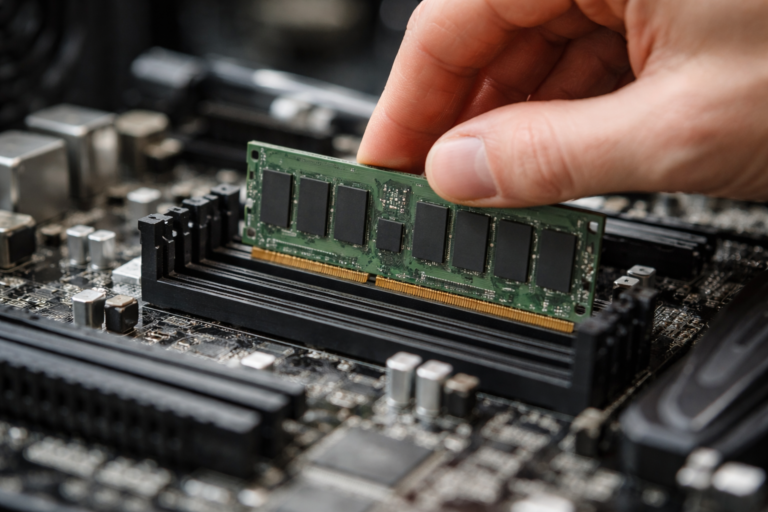
Modern AI systems require enormous amounts of data positioned directly alongside the processors crunching it.

That makes memory, specifically high-bandwidth memory, or HBM, one of the scarcest and most valuable components in an AI server.

Without enough of it, even the fastest GPU becomes a bottleneck.

As that realisation spread through 2025, Micron stopped being valued as a commodity memory producer and began being treated as a strategic supplier to the AI ecosystem.

Only three companies in the world can manufacture HBM at scale: Micron, South Korea’s Samsung, and SK Hynix.

That oligopoly, combined with the surge in AI-related demand, has produced something unfamiliar for the memory industry: sustained pricing power.

Micron’s gross margins in its latest quarter stood at 84.9%, up from 74.9% the prior period and from just 39% a year earlier.

The company expects the HBM market it serves to grow to approximately $100 billion by 2028.

Where large technology companies once faced what commentators called an “Nvidia tax”, paying a premium for indispensable chips, some now speak of a “Micron tax,” a memory toll that hyperscalers and AI infrastructure builders simply have to absorb.

Apple has been an example on that front after it had to raise the prices of its devices due to surging memory costs.

How Micron stabilised markets

The significance of Micron’s new role crystallised earlier this month.

Markets had been rattled by concerns that AI spending was outpacing any near-term revenue visibility.

SpaceX’s $25 billion bond sale, arriving so soon after its IPO, led investors to wonder if Wall Street might be entering AI bubble territory.

Ludovic Subran, chief investment officer of Germany’s Allianz, which manages €800 billion in assets, warned that markets may be shifting from “a healthy boom, a stretched boom into bubble territory.”

AI and technology stocks sold off sharply.

Then Micron reported that revenue surged 346% for the quarter.

Profit came in at $28.2 billion, almost 15 times the figure posted in the same quarter a year earlier.

The company blew past analyst expectations on every key metric, sending its stock nearly 16% higher in after-hours trading.

The results did not just lift Micron.

They stabilised the broader AI trade.

Investors took them as confirmation that the demand underpinning the entire AI infrastructure buildout, however stretched valuations may have remained real and accelerated.

A cautionary tale, and what Micron is doing about it

Nvidia’s trajectory does, however, offer a warning.

Its dominant position in AI chips, once a near-monopoly, is under pressure.

OpenAI has unveiled a custom AI chip developed with Broadcom.

Qualcomm has struck supply deals with Microsoft and Meta.

Competition is arriving from several directions simultaneously.

Micron’s shareholders would do well to hold that lesson in mind.

The more immediate risk is the one built into memory’s DNA.

Micron’s latest revenue surge was driven substantially by dramatically higher prices, margins of 85% compared to 38% a year ago, telling that story plainly.

Nvidia’s 85% revenue growth, by contrast, is not similarly dependent on elevated pricing.

As analyst David Jagielski of The Motley Fool has noted, if demand were to slow or if memory supply were to catch up with demand, Micron’s valuation, which has risen sharply over the past year, would face a steep correction.

Micron’s management is aware of the history and is attempting to break it.

The company is pursuing long-term supply contracts that lock customers in and reduce exposure to spot-market pricing swings.

CEO Sanjay Mehrotra has argued that the supply crunch is structurally different this time, as new semiconductor fabrication plants take years to build, and next-generation memory has become significantly more complex to manufacture, meaning capacity cannot be added quickly enough to produce the oversupply gluts of previous cycles.

To back that argument, Micron is investing approximately $200 billion in manufacturing and research and development, including new memory fabrication plants in Boise, Idaho, and Syracuse, New York.

Whether Micron can hold Nvidia’s former position as Wall Street’s preferred instrument for reading the AI boom will depend on whether those structural arguments prove correct.

For now, the market has decided that the most important number in AI is not measured in teraflops. It is measured in gigabytes.

The post From a dental office basement to a trillion dollars: Is Micron the next Nvidia? appeared first on Invezz

The satirical news site The Onion isn’t waiting to take possession of Infowars to launch a parody of Alex Jones ’ conspiracy platform.

More than a year after first trying to buy Infowars, The Onion on Thursday will debut a send-up under its own website with plans to give some of the revenue to families of the victims in the Sandy Hook Elementary School shooting.

The families have still received no money from Jones since courts ordered him to pay more than $1 billion for falsely calling the 2012 shooting a hoax.

The Onion will start by sending the families $100,000 from merchandise sales that combine the conspiracy empire’s brand with the The Onion’s logo in rainbow colors, according to CEO Ben Collins, whose company is still in court trying to take control of Infowars.

“Don’t give comedy writers a grudge for 18 months,” Collins said.

The parody will include a series of shows and other content under Infowars branding that spoof Jones’ aggressive mashup of conspiracies linking major news events, dubious scientific claims, attacks on people suffering in tragedies and sales of supplements and survival gear.

Alex Jones in Houston in 2024.David J. Phillip / AP file

Jones’ claims that the 2012 shooting that killed 20 first graders and six adults at Sandy Hook Elementary School in Connecticut is a hoax have no truth, but Jones continued to amplify them. His followers started to harass victims’ families, suggesting they were “crisis actors” and even making death threats.

Jones’ Infowars empire had 10 million visitors a month and generated more than $50 million in annual revenues at its peak, according to the company. But the $1.4 billion judgments in defamation cases in Connecticut and Texas, where Jones is based, forced him into bankruptcy and broke Infowars apart.

“All he’s been left with is an iPhone and a fancy microphone,” said Chris Mattei, an attorney for nine of the Sandy Hook families.

Jones has moved his show to a different website. An email sent to an address to request interviews went unanswered.

The families knew they could never stop Jones from getting his message out, and he has managed to avoid paying the judgment so far. But they could expose what he said and assure he can never profit again, Mattei said.

“Every dime Alex Jones makes from here until the end of eternity is going to be claimed by the families,” Mattei said.

The Onion stepped in when Collins saw Infowars’ assets were going to be sold at auction.

Collins spoke to Sandy Hook families, who said they were briefly skeptical, but then saw how The Onion’s staff could use the Infowars style and branding to take the moral high ground and make fun of the people who not only caused them so much pain but they felt also poisoned society.

Collins didn’t want to give away too much of the new stuff before it goes live Thursday.

But the new Infowars will maintain The Onion’s sharp satire sprinkled with shock value. Collins said there will be a section selling a penis flattening device, a fake “pro oxygen” supplement pill that the host claims can replace breathing, as well as an extended debate on how many Bozo the Clowns there are.

“It’s old-fashioned Infowars — using the tricks that they use to get people addicted to outrage and, I would say, addicted to anticipation, trying to find the thing that’s around the corner that’s going to save your life,” Collins said.

The Onion will keep chasing Jones’ property. Collins thinks they will soon get control of the Austin, Texas, studio Infowars once used.

Some families can’t wait for that day. Collins said that Robbie Parker, whose daughter died at Sandy Hook, plans to read his book about fighting Jones while dealing with so much grief in the place Jones once sat.

The families at first wanted Infowars shut down forever and Jones never heard from again. But they are now looking forward to seeing what The Onion has planned, attorney Mattei said.

“The idea that it could be turned to some social good. I think it’s even better,” Mattei said. “So, yeah, I think the families are both pleased and amused with what they’ve been able to achieve here.”

The chip that could make or break Wall Street’s confidence in artificial intelligence no longer lives inside a flashy graphics processor.

Increasingly, it sits inside a memory module, and it is made by a company that started life in a Boise, Idaho, dental office basement in 1978.

For most of its four-decade existence, Micron Technology was the kind of stock serious investors avoided.

Memory chips, dynamic random-access memory, or DRAM, and its derivatives were a commodity.

The business ran in brutal cycles: a shortage would lift prices and profits, manufacturers would race to add capacity, supply would overshoot demand, prices would collapse, and the cycle would repeat.

MU was a trade, not an investment. Wall Street treated it accordingly. That story is being rewritten at speed.

Over the past year, Micron’s shares have surged roughly 700%, with 200% of those gains arriving in 2026 alone.

Last month, the company crossed a $1 trillion market capitalisation for the first time.

Its latest quarterly earnings delivered a 346% surge in revenue and gross margins of 84.9% surpassing, remarkably, those of Nvidia.

And in a stretch when AI and technology stocks were nursing heavy losses after questions over bubble-territory valuations began circulating on Wall Street, it was Micron’s blowout results that steadied nerves and reignited confidence that the AI trade still has runway.

Two years ago, that role belonged to Nvidia.

The question investors are now asking is whether it has quietly passed the baton.

How Nvidia wrote the bellwether playbook

To understand what Micron may be becoming, it helps to understand what Nvidia became.

In November 2022, when OpenAI launched ChatGPT and set off the current AI frenzy, Nvidia’s graphics processing units, originally designed for computer games, found themselves identified as the workhorses for training AI models.

Demand exploded. Between its October 2022 low and June 2024, Nvidia’s shares surged approximately 1,100%.

By mid-2024, it had briefly become the world’s most valuable company, with a market capitalisation of $3.34 trillion, and had joined the select grouping of mega-cap technology companies known as the Magnificent Seven alongside Alphabet, Meta, and others.

But Nvidia’s significance went beyond its own price. It became a barometer.

Investors read Nvidia’s earnings reports the way they read blockbuster economic releases, not just for what they said about one company, but for what they implied about the pace and health of the entire AI buildout.

Even when Nvidia itself traded flat after reporting, its supply chain partners, Taiwan Semiconductor, SK Hynix, and ASML, would often move sharply in anticipation or in the immediate aftermath of its numbers.

“It’s not just a single stock,” Arun Sai, multi-asset portfolio manager at Pictet Asset Management, told the Financial Times last year.

“It’s very unusual for people to read through it to the economy as a whole.” That power has not vanished.

In its latest first-quarter results, Nvidia posted revenue of $81.6 billion, up 85% on the year, while net income more than tripled to $58.3 billion.

Those are not the numbers of a company in decline.

But its shares fell 1.6% in after-hours trading following the release.

The market has become accustomed to Nvidia delivering stellar figures and was pricing in something closer to perfection.

Year to date, Nvidia’s shares have risen a modest 3%.

Over the past 12 months, the gain is approximately 22%, a respectable figure for most companies, but underwhelming by the standards of what the market has come to expect.

The Nvidia era of market-moving earnings is not over; it has simply become less dramatic.

How scarcity of memory birthed the Micron of today

Micron’s rise as a new bellwether flows from a structural shift in what AI actually needs to run.

Modern AI systems require enormous amounts of data positioned directly alongside the processors crunching it.

That makes memory, specifically high-bandwidth memory, or HBM, one of the scarcest and most valuable components in an AI server.

Without enough of it, even the fastest GPU becomes a bottleneck.

As that realisation spread through 2025, Micron stopped being valued as a commodity memory producer and began being treated as a strategic supplier to the AI ecosystem.

Only three companies in the world can manufacture HBM at scale: Micron, South Korea’s Samsung, and SK Hynix.

That oligopoly, combined with the surge in AI-related demand, has produced something unfamiliar for the memory industry: sustained pricing power.

Micron’s gross margins in its latest quarter stood at 84.9%, up from 74.9% the prior period and from just 39% a year earlier.

The company expects the HBM market it serves to grow to approximately $100 billion by 2028.

Where large technology companies once faced what commentators called an “Nvidia tax”, paying a premium for indispensable chips, some now speak of a “Micron tax,” a memory toll that hyperscalers and AI infrastructure builders simply have to absorb.

Apple has been an example on that front after it had to raise the prices of its devices due to surging memory costs.

How Micron stabilised markets

The significance of Micron’s new role crystallised earlier this month.

Markets had been rattled by concerns that AI spending was outpacing any near-term revenue visibility.

SpaceX’s $25 billion bond sale, arriving so soon after its IPO, led investors to wonder if Wall Street might be entering AI bubble territory.

Ludovic Subran, chief investment officer of Germany’s Allianz, which manages €800 billion in assets, warned that markets may be shifting from “a healthy boom, a stretched boom into bubble territory.”

AI and technology stocks sold off sharply.

Then Micron reported that revenue surged 346% for the quarter.

Profit came in at $28.2 billion, almost 15 times the figure posted in the same quarter a year earlier.

The company blew past analyst expectations on every key metric, sending its stock nearly 16% higher in after-hours trading.

The results did not just lift Micron.

They stabilised the broader AI trade.

Investors took them as confirmation that the demand underpinning the entire AI infrastructure buildout, however stretched valuations may have remained real and accelerated.

A cautionary tale, and what Micron is doing about it

Nvidia’s trajectory does, however, offer a warning.

Its dominant position in AI chips, once a near-monopoly, is under pressure.

OpenAI has unveiled a custom AI chip developed with Broadcom.

Qualcomm has struck supply deals with Microsoft and Meta.

Competition is arriving from several directions simultaneously.

Micron’s shareholders would do well to hold that lesson in mind.

The more immediate risk is the one built into memory’s DNA.

Micron’s latest revenue surge was driven substantially by dramatically higher prices, margins of 85% compared to 38% a year ago, telling that story plainly.

Nvidia’s 85% revenue growth, by contrast, is not similarly dependent on elevated pricing.

As analyst David Jagielski of The Motley Fool has noted, if demand were to slow or if memory supply were to catch up with demand, Micron’s valuation, which has risen sharply over the past year, would face a steep correction.

Micron’s management is aware of the history and is attempting to break it.

The company is pursuing long-term supply contracts that lock customers in and reduce exposure to spot-market pricing swings.

CEO Sanjay Mehrotra has argued that the supply crunch is structurally different this time, as new semiconductor fabrication plants take years to build, and next-generation memory has become significantly more complex to manufacture, meaning capacity cannot be added quickly enough to produce the oversupply gluts of previous cycles.

To back that argument, Micron is investing approximately $200 billion in manufacturing and research and development, including new memory fabrication plants in Boise, Idaho, and Syracuse, New York.

Whether Micron can hold Nvidia’s former position as Wall Street’s preferred instrument for reading the AI boom will depend on whether those structural arguments prove correct.

For now, the market has decided that the most important number in AI is not measured in teraflops. It is measured in gigabytes.

The post From a dental office basement to a trillion dollars: Is Micron the next Nvidia? appeared first on Invezz