
Archive

July 2026

Browsing

The artificial intelligence boom has a people problem, and it is getting worse faster than most investors have noticed.

While Wall Street has spent the better part of three years fixating on chip stocks, hyperscaler spending, and the relentless march of AI valuations, a less glamorous drama has been unfolding in suburban town halls, county commission meetings, and online petitions from New Jersey to Michigan.

Ordinary Americans, armed with electricity bills, noise complaints, and a generalised anxiety about what artificial intelligence is doing to their lives, are pushing back against the physical infrastructure of the AI boom — and they are beginning to win.

In the first quarter of 2026, 75 data-centre projects worth a combined $130 billion were blocked or delayed by local opposition, according to Data Center Watch, a research firm backed by AI security company 10a Labs.

That is as many projects as faced that fate across the entirety of 2025.

The pace of resistance is accelerating precisely as the pace of construction is accelerating, creating a collision that the industry has been slow to take seriously.

Why communities are saying no

The grievances are varied, but they cluster around a handful of recurring concerns.

Power consumption sits at the top. Between 2018 and 2023, the share of total US electricity consumption represented by data centres rose from 1.9% to 4.4%, according to a study published in the journal Environmental Research Letters.

Projections for what comes next are stark: by the end of the decade, national average wholesale electricity costs could rise between 6% and 29%, with the increase driven primarily by data-centre expansion.

In Virginia, one of the epicentres of the country’s data-centre boom, electricity generation costs could spike by as much as 57%.

Water usage is a second flashpoint.

Data centres use enormous volumes of water for cooling, and in communities already managing drought risk or ageing infrastructure, the addition of a facility consuming millions of gallons annually is not an abstraction.

Residents have also cited the constant low-frequency hum emitted by large facilities, which critics argue could fundamentally alter the character of surrounding neighbourhoods and pose health concerns with prolonged exposure.

Then there is something harder to quantify but no less real.

A general psychological resistance to artificial intelligence has fused with the more concrete grievances, giving the movement an ideological dimension that purely economic arguments cannot easily address.

About 44% of Americans now oppose data-centre construction in the United States, against just 21% who support it, according to a Reuters/Ipsos poll conducted in June.

The gap widens sharply when the question becomes personal: asked whether they would support a data centre in their own community, 57% said no, while only 14% said yes.

“Something that has changed right now is that now we have people that are against data centres even though they don’t have a data centre in their backyard, because they see data centres as the embodiment of AI,” Miquel Vila, lead analyst at Data Center Watch, told Fortune.

“What they oppose is AI. They consider that stopping data centres is the way to stop AI development.”

Why Wall Street is beginning to pay attention to the protests

To appreciate why the financial stakes are significant, it helps to understand how thoroughly the data-centre buildout has underpinned the broader economy and equity markets.

Morgan Stanley estimates that hyperscalers like Microsoft, Amazon, Alphabet, and others will spend $800 billion on capital expenditures in 2026 — roughly the same amount that all non-technology S&P 500 companies combined spent on capex in 2025.

The Semiconductor Industry Association projects that government and industry will spend a further $4 trillion on data-centre infrastructure through 2028.

Data-centre construction spending has already topped $50 billion in a single month, surpassing total US public spending on transportation infrastructure including airports and subways, as Bloomberg reported.

AI enthusiasm has been almost entirely responsible for the S&P 500’s 84% rise since ChatGPT’s public launch in November 2022.

Goldman Sachs expects the AI investment theme to account for roughly half of all earnings growth over the next two years.

The lofty valuations of companies across the AI supply chain rest, to a significant degree, on the assumption that planned capacity will materialise.

A large portion of it may not.

“A lot of the commitments and the build-out of data centers where it’s easy has kind of been done, so you’re getting marginally more difficult,” said Todd Castagno, a managing director at Morgan Stanley in a New York Times report.

“From a markets perspective, expectations might be, maybe not reset, but realigned with the fact that it’s hard to put a couple trillion dollars in the ground in a short time.”

Cities including Tulsa, New Orleans, Birmingham and Ypsilanti Township in Michigan have implemented temporary bans on permitting or construction, as have dozens of other counties and towns, according to a database maintained by hedge fund Interconnected Capital.

Democrats and Republicans in 14 states have proposed construction pauses.

Maine’s legislature passed a temporary statewide moratorium in April, though it was subsequently vetoed by Governor Janet Mills.

Why the tech industry’s charm offensive may not be enough

The technology industry has responded with a concerted public relations effort.

Late last year, Meta spent more than $6 million on an advertising campaign across eight states and Washington DC, promoting the economic benefits of data centres to local communities.

OpenAI and Microsoft have publicly pledged to absorb the energy costs their facilities generate, a gesture aimed at defusing consumer anxiety about rising electricity bills.

Nvidia, Amazon, and Google have each announced technological advances they claim will significantly reduce data-centre water consumption.

Whether any of this is sufficient is genuinely unclear.

“The AI boom is fast approaching a moment of truth, as rapid growth and soaring valuations collide with ballooning capital expenditure, a public backlash and the challenges of real-life adoption,” Deutsche Bank analyst Cox wrote in a recent report.

The resistance, as Vila and others have noted, is no longer purely local.

It has taken on the character of a broader social movement, and social movements are not easily neutralised by folksy advertising.

Analysts debate magnitude of risk to AI-related stocks

For investors, the distribution of risk matters as much as its existence.

“Data-centre opposition is more of an emerging risk than an immediate pressure on AI-related stocks,” Gil Luria, head of technology research at DA Davidson, said in a Barron’s report.

The largest hyperscalers — Microsoft, Google, Amazon — have global footprints and enough redundancy to route investment around hostile localities. They are inconvenienced, not threatened.

The same cannot be said for smaller operators dependent on a handful of large projects.

“The smaller AI clouds are small enough, and have projects that are big enough, that losing a few projects is material,” Luria says.

CoreWeave, for instance, is facing organised resistance to a proposed facility in Kenilworth, New Jersey, that would draw 250 megawatts of electrical capacity — roughly a quarter of the company’s active capacity today.

An online petition calling for the project’s cancellation has gathered more than 11,000 signatures.

Logan Purk, a technology industry analyst at Edward Jones, believes that already extended construction timelines will lengthen further, ultimately reducing the total amount of capacity built.

The ripple effects would travel up the supply chain. “I do think the difficulty is not fully baked in,” Purk said in a New York Times report.

“If we assume tomorrow that data-centre construction stops because there’s no access to new power, the ripple effects across the semiconductor industry would be pretty substantial.”

The picks-and-shovels companies — the equipment and infrastructure suppliers whose fortunes are pegged to the volume of construction — are the most directly exposed.

The resistance might also create some winners

The backlash, however, is not without its beneficiaries.

Mark Guberti of The Motley Fool argues that operators who already have data centres built and generating revenue are quietly positioned to benefit.

“The presence of fewer data centers helps these companies charge higher prices for their AI infrastructure,” he says.

Among the names he points to are Iren and Terawulf, both of which have operational sites and a revenue base that a construction freeze would only make more valuable.

Edge data centres represent a separate category of potential winner.

“These types of data centers are much smaller than large-scale AI data centers that eat up multiple gigawatts of energy,” Guberti says.

“Protesters are less likely to rally against these types of data centers, and zoning requirements for them are less complex.”

These facilities consume far less power and water, present a significantly smaller target for organised opposition, and are considerably less likely to trigger the kind of community mobilisation that is stalling larger projects.

One Stop Solutions, which designs the hardware that forms the backbone of edge data-centre sites, is among the companies analysts have identified as a direct beneficiary of that shift.

Honeywell offers exposure to the same theme through its building automation division.

The business grew 8% year over year in the fourth quarter and accounted for roughly a fifth of the company’s total sales.

However, Honeywell is diversified across multiple industrial businesses, making it a less concentrated play on the edge data-centre theme than One Stop Solutions, which carries more risk but offers purer exposure for investors seeking growth.

The post Americans' revolt against data centers is growing: how it could disrupt the AI trade appeared first on Invezz


  • As part of the launch, GoMining is onboarding an initial set of up to 10 merchants and ecosystem partners.
  • GoBTC Pay settles directly on Bitcoin while protecting user ownership and non-custody.

GoMining is announcing the GoBTC Pay Gen1 SDK and API, allowing merchants, wallet providers, and ecosystem partners to integrate Bitcoin payments into real-world products and services.

The introduction represents the next step of GoBTC Pay, GoMining’s layer 1 Bitcoin payment protocol intended to facilitate quick, non-custodial Bitcoin transactions. The Gen1 release changes GoBTC Pay from a restricted demo version into an open infrastructure layer, allowing merchants, wallets, and ecosystem partners to develop and scale Bitcoin payment experiences on top of the network.

As part of the launch, GoMining is onboarding an initial set of up to 10 merchants and ecosystem partners who will begin integrating GoBTC Pay into their products and services.

“Satoshi didn’t create Bitcoin to sit idle in wallets. It was designed to move value between people,” said Mark Zalan, CEO of GoMining. “With the launch of the GoBTC Pay SDK and API, we’re giving merchants and wallet providers the infrastructure to bring that vision into real-world commerce in a way that is seamless and intuitive for users. We believe Bitcoin’s next chapter will be defined by how people use it, in addition to how many people own it.”

GoBTC Pay settles directly on Bitcoin while protecting user ownership and non-custody. The Gen1 version offers merchant onboarding tools, payment management capabilities, a web-based merchant dashboard, online payment connectors, public developer documentation, and an open API for wallet providers and institutional partners.

GoBTC Pay is powered by GoMining’s private 15EH/s mempool based on the Stratum V2 protocol, permitting prioritizing of GoBTC Pay transactions. With an estimated 12-hour average settlement window, GoBTC Pay is meant to protect the essential concepts of Bitcoin while offering a debit card-like payment experience. Users keep custody of their BTC, transactions settle immediately on Bitcoin, and businesses enjoy a smooth payment experience without asking consumers to convert their assets into cash.

Its incentive scheme is meant to harmonize the interests of merchants, wallets, and miners. Merchants pay a 0.2% transaction fee, which is distributed equally between participating wallet providers and miners in the GoMining pool that handle payments. GoMining seeks to promote network expansion and boost actual Bitcoin payment activity for routine purchases by directly compensating infrastructure participants who enable transactions. The launch follows GoMining’s debut of GoBTC Pay at Consensus Miami and represents the beginning of a bigger ecosystem strategy focused on boosting merchant, wallet, and partner acceptance of Bitcoin payments.

GoMining is an all-in-one Bitcoin ecosystem that makes it easy and safe to mine, earn, and spend Bitcoin every day. GoMining services 5 million customers and is in the top-10 Bitcoin miners by hashrate worldwide, with data centers in the U.S. and overseas. The firm makes Bitcoin accessible via tokenized hashrate, and an increasing range of payment and earning tools.

GoBTC Pay is a Bitcoin-native payment protocol created by GoMining that allows rapid, non-custodial Bitcoin payments for businesses, customers, and ecosystem partners. Built to enable real-world commerce while keeping the concepts of non-custody and user ownership, GoBTC Pay offers businesses, wallets, and platforms with the infrastructure required to accept and handle Bitcoin transactions cheaply and promptly. Through its merchant tools, developer APIs, and partner integrations, GoBTC Pay is establishing an open payments ecosystem meant to extend the daily usage of Bitcoin globally.

  • A trader has opened a 20x long on 1,653 BTC.
  • Bitcoin is currently trading at $63.5K.

A known high-frequency trader, identified as 0x50b3, has captured the market’s attention after opening a massive 20x-leveraged long position in 1,653.8 BTC, valued at around $105.77 million. The move comes amid heightened interest in BTC’s short-term price direction, with traders closely monitoring large leveraged bets for clues about market sentiment.

What makes this position particularly noteworthy is the trader’s recent performance. Since June 2, 0x50b3 has executed 100 trades, reportedly closing 93 of them in profit. The impressive 93% win rate has helped generate more than $6 million in realised gains, making the latest Bitcoin position difficult for market participants to ignore.

Its Potential Impact on Market Sentiment

Large leveraged positions often influence traders’ psychology when opened by accounts with a proven record of success. A single trade can boost bullish emotion and promote greater market involvement, even though it cannot predict Bitcoin’s future course. 

However, because even small price fluctuations can result in large gains or losses, the use of 20x leverage draws attention to the increased risks involved.

Price Action of Bitcoin: Where is it Heading? 

Bitcoin has failed to escape the bearish zone. Currently, it is trading within the $63,587 range, with the daily trading volume having surged by over 27.86%, reaching the $24.1 billion mark. The Coinglass data has reported that the BTC market has seen a 24-hour liquidation of $92.53 million. 

If the bearish grip strengthens, the BTC price may fall to a support range at $63,428. Additional pressure on the downside could trigger the death cross to take place and send the price even lower. Upon the BTC market taking a bullish turn, the price could climb and find the resistance at the $63,649K level. With the uptrend gaining more traction, the golden cross would emerge, pushing the price higher. 

Will Bitcoin Momentum Weakens Further? 

The MACD line is below the zero line while the signal line remains above it; the short-term momentum of BTC has weakened. This setup can be viewed as a warning sign of weakening market strength. In addition, the CMF indicator at -0.05 exhibits slight selling pressure. Bitcoin’s capital outflows are marginally exceeding the inflows. It does not show strong distribution or heavy selling activity.

Besides, BTC’s daily RSI at 41.92 infers a weak bearish tone. It remains above the oversold zone, with the downtrend not extreme. The momentum is subdued, and a strong trend has yet to develop. Also, the BBP value at -824.21 points to a very strong bearish pressure. This level suggests that the bears are dominating, with buyers showing little strength to reverse the prevailing downward move.

Crypto Market Highlights

Humanity Protocol Under Pressure: Will the 24% Drop Open the Door to More Losses?

  • Bitcoin may fall to a bottom price of 42,000-44,000.
  • BTC is currently trading within the $61.4K mark.

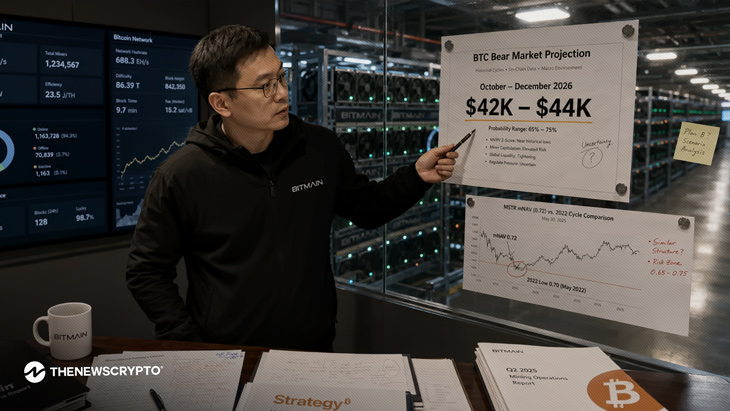
Jiang Zhuoer, a prominent Chinese Bitcoin miner and veteran market watcher, believes the current Bitcoin bear market could reach its final bottom between October and December 2026, with BTC potentially trading in the $42,000–$44,000 range.

The outlook is based on the behaviour of Strategy’s mNAV ratio, a metric that compares the company’s market value to the value of its BTC holdings. According to him, mNAV has fallen to 0.72, approaching the cycle low of 0.7 recorded on May 11, 2022, during the previous market downturn.

While the current mNAV level suggests deep pessimism in the market, Jiang cautioned that an mNAV bottom does not necessarily coincide with Bitcoin’s price bottom. In the previous cycle, Strategy’s mNAV hit its low when Bitcoin traded around $31,017. 

However, BTC continued falling and reached its bear market low of $15,476 in November 2022, roughly six months later. Moreover, based on this historical pattern, Jiang argues that mNAV may serve as a leading indicator rather than a direct signal of Bitcoin’s final price floor. 

He added that current market conditions, including the notable decoupling of Strategy’s STRC-related sentiment indicators, suggest mNAV is already trading within its lowest zone of this cycle.

A Four-Year Cycle Model Points to Late 2026

His forecast is built on a mathematical model that compares Bitcoin’s long-term market cycles to a bouncing ball, where each successive bounce becomes smaller as volatility declines. As Bitcoin’s market cap expands, price swings tend to moderate over time.

Jiang revealed that his recent trading strategy has involved reducing spot exposure and maintaining short positions. If his cycle thesis plays out, BTC could continue facing pressure through 2026 before entering its next major accumulation phase. 

Is Bitcoin’s Price at Risk of a Steeper Downturn?

The largest asset, Bitcoin (BTC), is currently trading at $61,424, with its daily trading volume having surged by over 38.47% to the $42.98 billion mark. During the last 24 hours, the BTC market has experienced a liquidation of $411.91 million, as reported by the Coinglass data

If the bearish phase intensifies, the BTC price could fall to the support at $61,320. Upon the downside correction gains more traction, the death cross might form, and send the price even lower. Assuming the current momentum shifts bullish, the price could climb to the resistance at $61,514. With the steady upside pressure, a golden cross would emerge and lead the price action to move up. 

Both the Moving Average Convergence Divergence (MACD) and signal lines are below the zero line, indicating that BTC is in a bearish trend. The sellers remain in control of the broader market, reflecting sustained downside pressure rather than a temporary pullback.

(Source: TradingView)

Besides, the daily Relative Strength Index (RSI) at 42.37 suggests a mild bearish trend. It is below the neutral level and remains above the oversold zone, with selling pressure present but not strong. The momentum is balanced, and a clear trend has yet to strengthen. 

Crypto Market Highlights

Humanity Protocol (H) in Freefall: Can Buyers Halt the 35% Slide?

  • Bitcoin is hovering around $60.3K, remaining trapped between $58K and $61K levels.
  • The BTC indicators point to a cautious market.

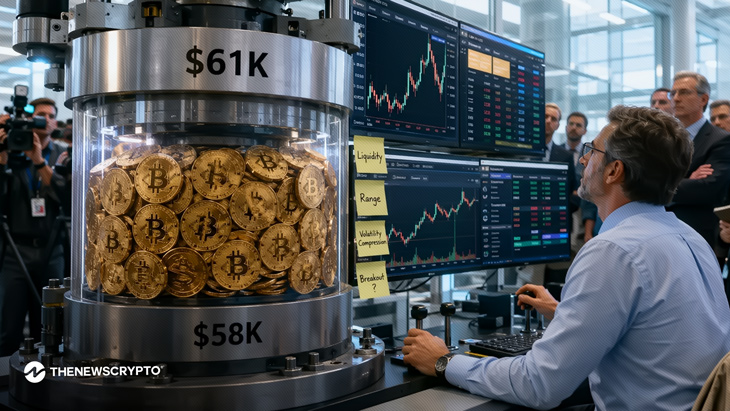
Bitcoin (BTC) is continuing to trade within a well-defined range. Price action remains trapped between key support near $58,000 and resistance around $61,000, with repeated attempts to reclaim the $60,000 region falling short. 

Recent trading activity shows buyers stepping in at slightly higher lows, suggesting demand is strengthening despite the lack of a breakout. However, sellers continue to defend the $60K–$61K zone, keeping BTC confined within its current range.

As buying and selling pressure become more balanced, volatility tends to compress before expanding again. The longer Bitcoin remains within this range, the greater the potential for a sharp move once either support or resistance gives way.

Bitcoin Dominance Hints at a Shift in Market Sentiment

Beyond price action, Bitcoin dominance is also drawing attention. The metric has continued to form lower highs, indicating that Bitcoin’s share of the overall cryptocurrency market has been gradually declining.

While this does not guarantee an immediate rotation into altcoins, it suggests that market participants are becoming less concentrated in BTC alone. Some analysts believe recent caution has been driven more by uncertainty than by weakening fundamentals.

For now, a sustained move above $61K could strengthen bullish momentum, while a break below $58K may invite additional selling pressure. Until then, BTC appears to be in a period of consolidation, with traders monitoring both levels for confirmation of the market’s next significant trend.

Is Bitcoin Stuck in an Extended Downward Cycle?

Bitcoin is currently trading at around the $60,384, with its daily trading volume having surged by over 59.33%, and reaching $23.59 billion. As reported by the Coinglass data, the BTC market has witnessed a liquidation of $98.11 million in the last 24 hours. 

The recent trading session of Bitcoin shows the potential of the bears, with the price slipping to the key support at $60,231. Further correction on the downside could easily send the price even lower. Conversely, if the bulls re-entered, the BTC price could move up toward the $60.4K resistance range. With the strengthened upside pressure, the momentum is likely to drive the price higher.

Both the MACD and signal lines are below the zero line, exhibiting that the Bitcoin market remains under bearish momentum. While short-term recoveries can occur, the overall trend remains weak until the indicators move back above the zero line, reflecting a continued downtrend.

(Source: TradingView)

BTC’s daily RSI value is stationed at around 44.06, hinting at mild bearish momentum. The sellers have a slight edge, and it is above the oversold zone. This points to a cautious market, where bearish sentiment is present but not strong enough to confirm an extended downtrend.

Crypto Market Highlights

South Korea’s Crypto Push Gains Steam as Kiwoom Moves to Invest in Bithumb

  • As part of the launch, GoMining is onboarding an initial set of up to 10 merchants and ecosystem partners.
  • GoBTC Pay settles directly on Bitcoin while protecting user ownership and non-custody.

GoMining is announcing the GoBTC Pay Gen1 SDK and API, allowing merchants, wallet providers, and ecosystem partners to integrate Bitcoin payments into real-world products and services.

The introduction represents the next step of GoBTC Pay, GoMining’s layer 1 Bitcoin payment technology intended to facilitate quick, non-custodial Bitcoin transactions. The Gen1 release changes GoBTC Pay from a restricted demo version into an open infrastructure layer, allowing merchants, wallets, and ecosystem partners to develop and scale Bitcoin payment experiences on top of the network.

As part of the launch, GoMining is onboarding an initial set of up to 10 merchants and ecosystem partners who will begin integrating GoBTC Pay into their products and services. 

“Satoshi didn’t create Bitcoin to sit idle in wallets. It was designed to move value between people,” said Mark Zalan, CEO of GoMining. “With the launch of the GoBTC Pay SDK and API, we’re giving merchants and wallet providers the infrastructure to bring that vision into real-world commerce in a way that is seamless and intuitive for users. We believe Bitcoin’s next chapter will be defined by how people use it, in addition to how many people own it.”

GoBTC Pay settles directly on Bitcoin while protecting user ownership and non-custody. The Gen1 version offers merchant onboarding tools, payment management capabilities, a web-based merchant dashboard, online payment connectors, public developer documentation, and an open API for wallet providers and institutional partners.

GoBTC Pay is powered by GoMining’s private 15EH/s mempool based on Stratum V2 protocol supporting prioritizing of GoBTC Pay transactions. With an estimated 12hrs average settlement window GoBTC Pay is aimed to protect the essential concepts of Bitcoin while delivering debit card-like payment experience. Users keep custody of their BTC, transactions settle immediately on Bitcoin, and businesses enjoy a smooth payment experience without asking consumers to convert their assets into cash.

Its incentive scheme is meant to harmonize the interests of merchants, wallets, and miners. Merchants pay a 0.2% transaction fee, which is distributed equally between participating wallet providers and miners in the GoMining pool that handle payments. GoMining seeks to promote network expansion and boost actual Bitcoin payment activity for routine purchases by directly compensating infrastructure participants who enable transactions.

The launch is the start of a larger ecosystem strategy aimed at promoting merchant, wallet, and partner use of Bitcoin payments. It comes after GoMining introduced GoBTC Pay at Consensus Miami.

GoMining is an all-in-one Bitcoin ecosystem that makes mining, earning, and using Bitcoin every day easy and safe. GoMining maintains data centers in the United States and other countries, services 5 million customers, and is one of the top 10 Bitcoin miners worldwide by hashrate. Through tokenized hashrate and a growing range of payment and earning options, the firm makes Bitcoin accessible.

GoMining created GoBTC Pay, a Bitcoin-native payment protocol that allows quick, non-custodial Bitcoin payments for customers, businesses, and ecosystem partners. GoBTC Pay gives businesses, wallets, and platforms the infrastructure they need to accept and process Bitcoin transactions quickly and affordably. It was designed to enable real-world commerce while upholding the concepts of non-custody and user ownership. GoBTC Pay is creating an open payments ecosystem with partner integrations, developer APIs, and merchant tools to increase the widespread adoption of Bitcoin.

Wall Street is heading into July with a more bullish tone after a volatile June, as strategists point to seasonality, stronger earnings and renewed AI appetite as potential tailwinds for US equities.

Wells Fargo, in a strategy note led by Ohsung Kwon, called for a “strong summer rally ahead,” citing improving investor positioning, delayed AI-related IPOs and expected second-quarter EPS growth of 22%, up from 19% in the first quarter.

The bank also expects tariff refunds to help lift parts of the market.

Wells Fargo estimates that about $36 billion of refunds have already been processed, with another $90 billion potentially still to come.

Consumer staples and industrials are seen as two of the clearest beneficiaries.

For investors looking at ETFs, that creates three possible routes into the same July setup: broad-market exposure, AI infrastructure, or concentrated big-tech upside.

VOO: Betting on broad-market seasonality

The Vanguard S&P 500 ETF is the cleanest way to play the broad July rally thesis without making a narrow call on one sector.

VOO tracks the S&P 500 and charges a low 0.03% fee, one reason the fund recently became the first ETF to surpass $1 trillion in assets.

That matters in the current setup because Wells Fargo’s argument is not only about AI. The bank is also leaning on the old seasonal playbook.

MarketWatch reported that Wells Fargo sees the first half of July as the strongest comparable period for the S&P 500 over the past century, with an average return of 1.35%.

VOO gives investors access to that broader move. It also captures any earnings boost from tariff refunds, without requiring a specific bet on whether consumer staples, industrials, or technology stocks lead the month.

Also read: 3 tech stocks to buy before July 2026 prices move higher

SOXX: Playing the AI infrastructure catch-up trade

The iShares Semiconductor ETF is the more targeted option for investors who believe the AI trade is spreading from the biggest chip designers into the wider semiconductor supply chain.

SOXX tracks US-listed semiconductor stocks and gives exposure across the chip value chain, including companies tied to AI and digital infrastructure spending, according to iShares.

The fund had 30 holdings as of June 30 and an expense ratio of 0.34%.

This is where the Goldman Sachs argument fits. Ben Snider, chief US equity strategist at Goldman Sachs Research, wrote that AI-related investment is expected to drive roughly 40% of S&P 500 EPS growth this year.

Goldman also said the largest cloud infrastructure companies are expected to spend about $670 billionin 2026, after consensus capex estimates jumped by $130 billion last quarter.

Also read- Summer rally pattern: 4 stocks with historical edge in early July

QQQ: Concentrated upside if big tech leads again

If July’s rally is led once more by mega-cap technology, the Invesco QQQ ETF remains one of the most direct ways to capture that move.

QQQ tracks the Nasdaq-100 and carries a 0.18% expense ratio, according to Invesco.

The attraction is straightforward. If investors return to AI leaders, cloud platforms and dominant growth stocks, QQQ should be better positioned than a broad-market fund. That is also the risk.

Goldman’s Snider has warned that market breadth has dropped to one of its narrowest levels since the dotcom era, even as earnings expectations remain strong.

He also wrote that near-term market swings are likely to keep tracking geopolitical volatility.

Charles Schwab’s mid-year outlook made a similar point. Liz Ann Sonders and Kevin Gordon wrote that earnings are driving the bull market, but leadership remains narrow and concentrated in AI and energy-related sectors.

They also warned that markets could be vulnerable to disappointment because positioning is stretched and bond yields remain a pressure point.

The post 3 ETF picks that could deliver strong upside in July’s rally appeared first on Invezz